Sanofi Czechia chief: new drugs take 659 days to reach patients

USD 22,28
Popular
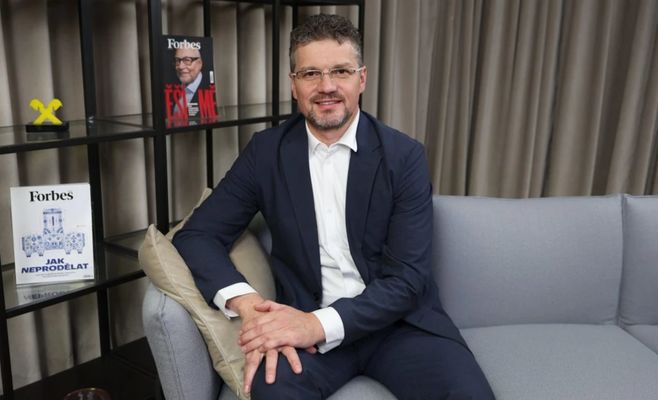
Vivek Basantani, head of Sanofi's Czech branch, says patients in Czechia wait four times longer for new drugs than in Germany: 659 days. A native of India who has led the pharmaceutical giant's Czech unit for more than a year, he believes Czechia can become a European research power.
Most people in Czechia know Sanofi for some of the country's best-selling medicines: Paralen, the undisputed leader among painkillers (more than four million packs sold in 2025), Ibalgin or Mucosolvan. But those brands now belong to a separate company, Opella, in which Sanofi kept a little over 48 percent after selling a controlling stake last year. Like rivals such as MSD or GSK, Sanofi focuses on developing innovative drugs.
An Indian learning Czech
Basantani took over the Czech branch last autumn. The 47-year-old manager came to Prague from the United Kingdom, where he ran the group's neurology and dermatology unit. He lives in Prague with his wife and two teenage sons, studies Czech and speaks it with almost no accent. “It helped when I realized that many of your letters are pronounced the same way as in Hindi,” he says. The hardest word for him is the numeral “four.” When reminded that Sanofi earned almost four billion crowns in Czechia last year, he joked that the turnover probably needs some work.
Basantani trained as a mechanical engineer in India and redirected his career into pharmaceuticals twenty years ago. His engineering background, he says, taught him to break complex problems into small solvable parts, and that is how he looks at the Czech health care system. He praises it but also sees shortcomings: “Individual parts of the system sometimes do not work together in a sufficiently connected and predictable way. I think Czech health care can make better use of its strengths.”
Clinical trials and data
The group plans to grow despite its investment in research, which in Czechia takes the form of clinical trials of new treatments. Last year the company spent more than 250 million crowns on them. Sixty trials are under way now, with 1,400 patients taking part. “We want to focus on this even more. Czechia has a high-quality health care system, strong medical expertise and a long tradition of scientific research,” Basantani says.
As an example, he cites data from the Institute of Health Information and Statistics, which collects information on all patients in the country through the National Health Information System. In his words, that is rare in Central and Eastern Europe. With more digitalization, the data could be used, for example, to match patients to clinical trials more easily and to make better health care decisions, always in full compliance with personal data protection.
This is also one of ten points in the recommendations for supporting clinical research in Czechia prepared by the Association of Innovative Pharmaceutical Industry (AIFP), which brings together 35 international companies, including Sanofi. In July, the Ministry of Health adopted the first national strategy for clinical trials of medicines, which AIFP helped prepare. Basantani hopes this will get Czechia talked about more in Europe and that, once the strategy is implemented, the country's competitiveness will grow even further.
By the Around Prague newsroom