6 Cemeteries in Prague Where History and Art Outweigh Mourning: A Guide to the Necropolis-Museums
In Prague, cemeteries are often more fascinating than museums: here you can admire sculptures by Myslbek and Bílek, learn about plagues and wars, delve into the history of Prague's Jewish community, and find the graves of Kafka, Dvořák or Gott. This guide is for those unafraid of quiet strolls among gravestones and eager to see Prague from an unexpected angle — as an open-air museum city where every stone is an exhibit. All the sites listed here are open to the public (some charge admission or require a dress code), making this a perfectly legitimate and respectful form of tourism, provided basic tact is observed.
Vyšehradský hřbitov a Slavín, Prague 2
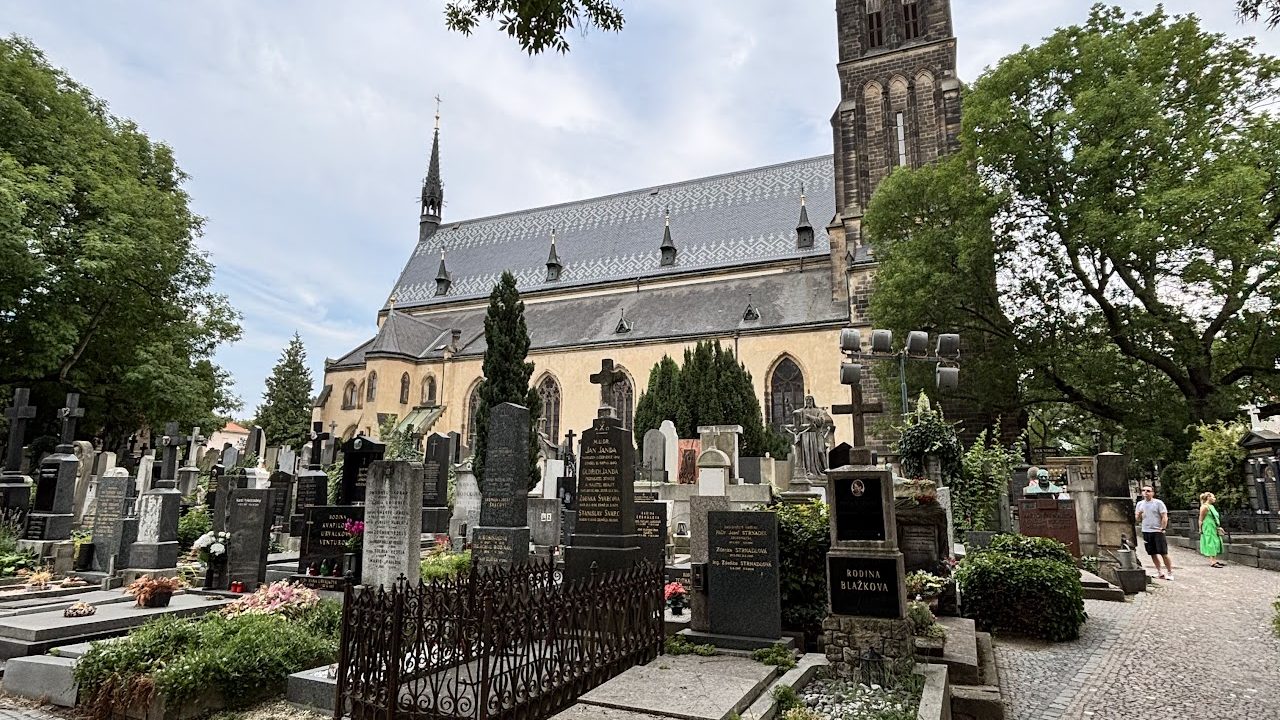
The entrance to the cemetery is to the left of the Basilica of St. Peter and St. Paul at Vyšehrad. Address: K Rotundě 1, Vyšehrad, 128 00 Prague 2. The Vyšehrad Cemetery, adjoining the Church of St. Peter and St. Paul, is one of Prague's most significant burial grounds, the final resting place of more than 600 notable figures — writers, scientists, poets, artists, composers, actors, physicians and politicians. Visitors can admire a unique gallery of funerary sculpture by renowned artists such as J. V. Myslbek, F. Bílek and B. Kafka. At the heart of the composition stands the monumental Slavín tomb, the shared burial place of the nation's "greats." The cemetery is open Monday through Friday year-round, with opening hours varying by season.
Olšanské hřbitovy, Prague 3
Address: Vinohradská 1835/153, Žižkov, 130 00 Prague 3. Covering more than 50 hectares, the Olšany Cemeteries form Prague's central and largest burial complex and the biggest cemetery in Czechia. The sprawling rectangular grounds are split by Jana Želivského Street into two sections comprising twelve separate cemeteries. Here you'll find the graves of Karel Jaromír Erben, Voskovec and Werich, Josef Lada and Josef Jungmann, as well as First World War military burials and the New Jewish Cemetery with its ceremonial halls, where Franz Kafka is buried. A learning trail with information panels runs through the grounds. Opening hours vary by season: January–February 8:00–17:00, March–April 8:00–18:00, May–September 8:00–19:00, October 8:00–18:00, November–December 8:00–17:00.
Starý židovský hřbitov, Josefov, Prague 1
Address: Široká 3, 110 01 Prague 1 — Staré Město/Josefov. The Old Jewish Cemetery is one of the oldest surviving Jewish burial sites in Europe, in use from 1439 to 1787, and today holds more than 12,000 tombstones. Due to lack of space, burials were made in layers, resulting in an astonishing density of stones — a true labyrinth of leaning steles bearing Hebrew epitaphs. The cemetery is included in the Jewish Museum's combined ticket alongside six synagogues. Men must cover their heads when entering the Old Jewish Cemetery and the active synagogues; kippahs are provided at the entrance.
Nový židovský hřbitov, Žižkov, Prague 3
Address: Izraelská 1, 130 00 Prague 3. The New Jewish Cemetery sits right by the "Želivského" metro station (Line A), spanning 74,037 m² between Želivského and Nad vodovodem streets, and was designed to accommodate roughly 100,000 graves. The main draw for visitors is the modest grave of Franz Kafka, though the cemetery is also notable as an early 20th-century Art Nouveau architectural ensemble. It is the only Prague cemetery still used for burials by the Jewish Community of Prague today. Opening hours: April–September Sun–Thu 9:00–17:00, Fri 9:00–14:00, closed Sat; October–March Sun–Thu 9:00–16:00, Fri 9:00–14:00, closed Sat.
Hřbitov Malvazinky, Smíchov, Prague 5
Address: U Smíchovského hřbitova 444/1, Prague 5 — Malvazinky, 150 00. This municipal cemetery was established in 1876 after the old Smíchov cemetery on Arbesovo Square was closed, and today covers 7.58 hectares with more than 50,000 people buried here. The complex is dominated by the Neo-Romanesque Church of St. Philip and St. James. Among those interred here are President Antonín Novotný, writer Jakub Arbes, Ondřej Sekora, Egon Bondy, physician Jan Janský, musician Milan Hlavsa, singer Karel Gott and singer Eva Pilarová. Malvazinky is far less touristy than Olšany or Vyšehrad, offering a peaceful place to wander among modest yet striking 19th- and 20th-century gravestones.
Ďáblický hřbitov, Střížkov, Prague 8
Address: Ďáblická 564/2a, Prague 8 — Střížkov, 182 00. What makes this cemetery unique is its architecture: it's the only Cubist cemetery in Czechia — and since Cubist architecture is a purely Czech phenomenon, it's the only one of its kind in the world. The design was created by architect, urban planner, stage designer and artist Vlastislav Hofman, who incorporated Cubist forms throughout, giving the cemetery a wholly distinctive character. Covering 29 hectares, it is Prague's second-largest cemetery after Olšany, and was declared a National Cultural Monument in 2017. Look out for the angular portals and fencing at the main entrance — a rare example of "geometric" Prague Cubism within a cemetery landscape.
Each of these cemeteries tells its own chapter of Prague's history — from the national revival at Vyšehrad and the tragedies of the Jewish community in Josefov and Žižkov, to the architectural experiments at Ďáblice and the quiet legacy of Smíchov's notable figures at Malvazinky. When planning a visit, check seasonal opening hours and — especially at the Jewish cemeteries — observe dress codes and behavioral requirements: these are not parks but active places of remembrance that deserve silence and respect.
See also:
Comments (0)
Please be polite. Spam and insults will be removed.