9 Buildings That Reveal Prague's DNA: Art Nouveau, Cubism and Functionalism on One Route
Prague is a rare city where, within a single day's walk, you can trace three architectural eras of the early 20th century: lavish, romantic Art Nouveau; Czech Cubism, a truly unique phenomenon — the only time in the world a painting movement became a building style; and the austere Functionalism of the 1920s–1930s. This guide is for anyone tired of Gothic spires and Baroque façades who wants to see a "different" Prague through the eyes of architects like Kotěra, Gočár, Chochol and Loos. The route covers the city centre, Vinohrady, Vyšehrad and Holešovice — plan for a full day, with coffee breaks along the way.
Obecní dům, Praha 1
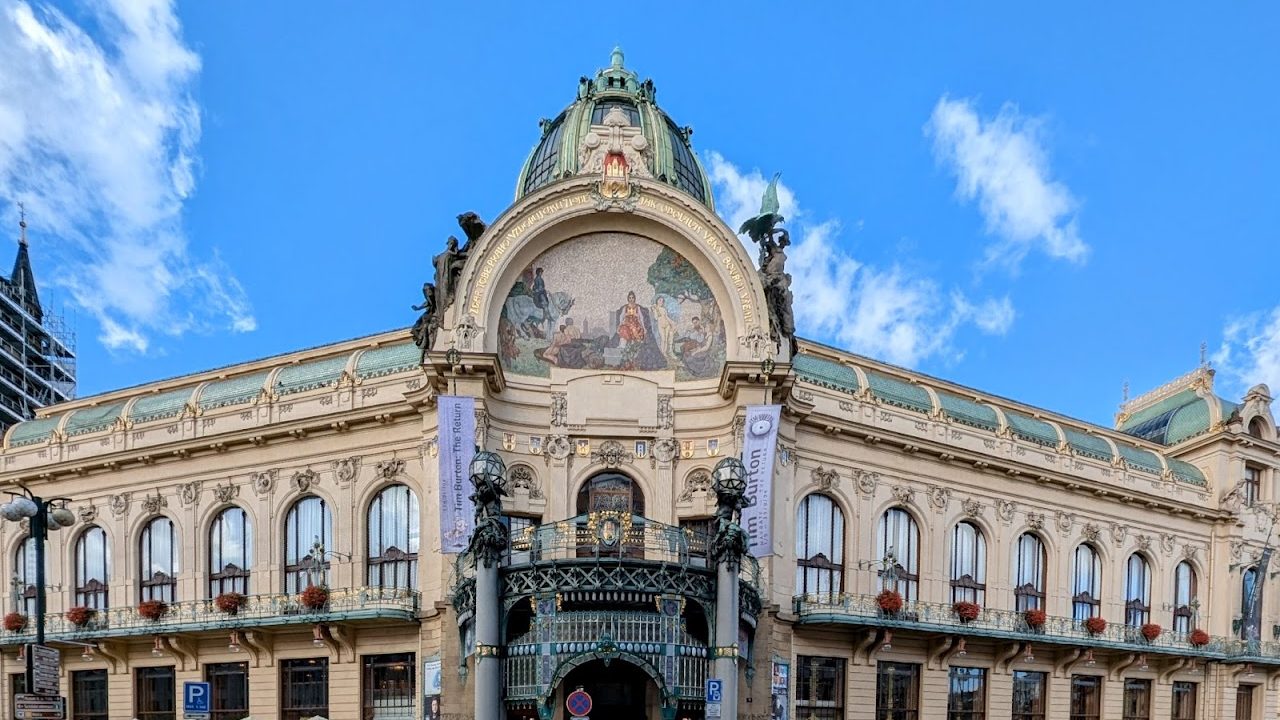
The finest monument of Prague Art Nouveau stands on Republic Square, right next to the Powder Tower. The Municipal House was built between 1905 and 1912 by architects Osvald Polívka and Antonín Balšánek, and it remains a striking example of Art Nouveau architecture, with its elaborate façade, exquisite interiors and use of then-modern materials like steel and glass. It rose on the site of the former royal residence of King Wenceslas IV. Inside you'll find the Smetana Concert Hall along with cafés and restaurants that still preserve their early-20th-century interiors; you can explore it on your own (the café, the lobby) or join a guided tour of the grand halls.
Peterkův dům, Václavské náměstí 12, Praha 1
Modest in appearance but historically significant, this four-storey Secession-style building on Wenceslas Square was the first Prague commission of architect and professor Jan Kotěra, who designed its early Art Nouveau façade and lobby. It's considered one of the first heralds of modern Czech architecture — worth a peek inside to see where it all began, before heading to the far more opulent Municipal House.
Grand Hotel Evropa, Václavské náměstí 25, Praha 1
The Grand Hotel Evropa, built in 1905, is regarded as one of Prague's finest Art Nouveau landmarks. Its golden façade, adorned with stucco and stained glass, is a signature sight on Wenceslas Square; some of the original interiors survive intact, and the ground-floor café lets you sip coffee beneath carved belle époque panelling.
Dům U Černé Matky Boží, Celetná 34, Praha 1
The world's only purely Cubist house stands on the corner of Celetná Street and Ovocný trh. This textbook example of "pure Cubism" in Prague was designed by architect Josef Gočár in 1911–1912. The basement originally housed a wine cellar, the ground floor held the Grand Café Orient (for which Gočár designed the furniture and a stained-oak bar), and the upper floors contained shops and the manager's flat. Today it houses the Museum of Czech Cubism, a Cubist café and a design shop — so you can admire the architecture and sip your coffee from a Cubist tea set at the same time.
Kubistický trojdům, Rašínovo nábřeží, Praha 2 – Vyšehrad
At the foot of Vyšehrad, near the Vyšehrad Tunnel, stands an entire colony of Cubist houses by architect Josef Chochol. The Triple House sits on Rašínovo nábřeží along the Vltava riverbank, at addresses 42/6, 47/8 and 71/10. Completed in 1913, its façade is executed in pure Cubist style. A few steps away, on Libušina Street, stands Kovařovic Villa by the same architect, its façade defined by sharp pyramidal shapes, while on the corner of Neklanova and Přemyslova streets you'll find the Hodek Apartment Building, notable for its unusual windows and sharply angled corner.
Palác Adria, Jungmannova / Národní, Praha 1
A prime example of "Rondo-Cubism," the postwar Czech take on Art Deco that swapped sharp edges for rounded forms. The Adria Palace, at the corner of Národní 36/40 and Jungmannova 36/31, was built in 1925 for an Italian insurance company to a design by architect Pavel Janák. The building so impressed Le Corbusier that he described it as "a massive structure of Assyrian character." Inside is an arcade with sculptures and the Adria Cabaret theatre; the façade, with its bay windows and bas-reliefs, deserves a look from both streets.
Palác Archa, Na Poříčí 24, Praha 1
Another fine example of Cubist-Rondo-Cubist bank architecture. The Archa Palace at Na Poříčí 24 was also built in the 1920s to a design by Josef Gočár — a former bank building that now houses offices, shops and cafés. It's a great spot to compare "early" and "late" Gočár — from the strict Cubism of the House of the Black Madonna to his more decorative 1920s style.
Müllerova vila, Nad hradním vodojemem 642/14, Praha 6 – Střešovice
One of the icons of global Functionalism and Adolf Loos's masterwork in the Czech lands. The villa was built in 1928–1930 for the influential engineer František Müller, who entrusted the design of his residence to Adolf Loos; externally it presents strict Functionalist lines, while its layout and interior follow Loos's signature "Raumplan" concept. Trams 1, 2 or 18 to the Ořechovka stop get you there easily; inside, a museum preserves the original 1930s furnishings — entry is by guided tour only, with advance booking required.
Veletržní palác, Dukelských hrdinů 47, Praha 7 – Holešovice
The leading monument of large-scale Functionalism in Prague, once the largest building of its kind in the world. Built between 1925 and 1928 by architects Josef Fuchs and Oldřich Tyl, the Trade Fair Palace was, at the time, the biggest structure of its type on Earth. Its enormous mass, made up of a series of cubic volumes, forms a distinctive four-storey bay window on the Dukelských hrdinů street façade, projecting above the second floor and crowned by a rooftop terrace. Today it's one of the National Gallery's venues, home to a permanent collection of 20th- and 21st-century art (Tue–Sun, 10:00–18:00); trams 12, 14 or 17 to the Veletržní stop offer the easiest access.
String these nine addresses together in a single day and you get a vivid crash course in the history of Czech architecture: from the gilded Art Nouveau of the Municipal House, through the sharp crystalline facets of the House of the Black Madonna and Josef Chochol's Vyšehrad colony, to the austere lines of Müller Villa and the monumental bulk of the Trade Fair Palace. Bring comfortable shoes and a public transport map — and don't forget to step inside wherever you can: the most fascinating details in these buildings are often hidden behind the façade.
See also:
Comments (0)
Please be polite. Spam and insults will be removed.