UK Citizens Travelling to Prague: Visa, Passport, EES, ETIAS
Popular
No, UK citizens do not need a visa for Prague. With a British citizen passport you can stay in Czechia and the rest of the Schengen area for up to 90 days in any 180-day period. The passport must have been issued less than 10 years before you arrive and must be valid for at least 3 months after the day you leave. At the border your photo and fingerprints go into the EU Entry/Exit System (EES), which costs nothing. ETIAS, the planned €20 (about £17) travel authorisation, is not running yet and has no start date. Around Prague checked the rules on official UK, EU and Czech websites on 12 November 2026.
UK citizens and Prague: the rules at a glance
| Item | Rule on 12 November 2026 | What may change in 2027 |
|---|---|---|
| Visa | Not needed for tourism, family visits, business meetings or short courses, up to 90 days in any 180 | Same rule |
| Passport | Issued less than 10 years before you arrive; valid at least 3 months after you leave Schengen | Same rule |
| EES | Photo and fingerprints at your first Schengen border; free, nothing to do in advance | Same rule; your EES record is valid for 3 years |
| ETIAS | Not required: the system is not in operation | No start date announced. Once it starts: €20 (about £17), valid up to 3 years |
| Health | GHIC or EHIC for necessary state care, plus travel insurance | Same rule |
| Cash | Declare €10,000 (about £8,360) or more | Same rule |
Pound amounts are our calculation at the Czech National Bank rates of 11 November 2026 (fixing No. 217, valid until the next fixing on the afternoon of 12 November): £1 = 29.152 CZK and €1 = 24.380 CZK, so €1 is about £0.84.
Passport: the two dates to check
Czechia follows Schengen rules. The UK Foreign Office (FCDO) travel advice for Czechia sets two tests for a full British citizen passport:
- the date of issue is less than 10 years before the day you arrive;
- the expiry date is at least 3 months after the day you plan to leave the Schengen area.
The first test catches passports renewed before 1 October 2018: they can be more than 10 years old while the expiry date is still in the future, and then they are not valid for Schengen.
Example: you land in Prague on 18 February 2027 and fly home on 22 February. Your passport must have been issued after 18 February 2017 and must be valid until at least 22 May 2027.
A passport reported lost or stolen is refused too. If either date fails, renew before you book.
The 90/180 rule: how to count your days
The 90 days cover the whole Schengen area, not each country: Czechia, Germany, Austria, France, Spain and the other Schengen states count together. Ireland and Cyprus are not in Schengen. GOV.UK's method: take the date you will leave Schengen on your next trip, count back 180 days, add the Schengen days already spent in that window and the days of the new trip. The total must not be more than 90.
Two official tools do the sum for you: the European Commission's short-stay calculator and the EES page Check how long you can stay. The second ignores stays that began before 10 April 2026.
Overstaying can lead to a Schengen entry ban of up to 3 years, the FCDO warns. At the border you may be asked for a return ticket and proof of enough money for your stay. For work or stays over 90 days, ask the Czech Embassy in London.
EES: fingerprints instead of passport stamps
The EU Entry/Exit System started on 12 October 2025. Since 10 April 2026 it has been fully operational at all external border crossings of the 29 countries that use it, the EU says, and it replaces passport stamps.
- As a visa-free visitor you give four fingerprints and a photo of your face. Children aged 11 or younger are not fingerprinted but may be photographed.
- Registration is free and needs nothing before you travel. The record is valid for 3 years, but you may be asked for biometrics each time you enter or leave.
- Allow extra time when you fly home: EES checks can take place before boarding, the FCDO says.
Where you register depends on your route:
- Direct flight to Prague. All UK flights use Terminal 1. Prague Airport asks non-EU passengers to register at a self-service EES kiosk in arrivals first and then go to passport control. Children under 12 (or under 140 cm) and holders of non-biometric passports skip the kiosk.
- Connection in Amsterdam, Frankfurt or another Schengen airport. The EES records you where you cross the external Schengen border, so you register there.
- Eurostar, Le Shuttle or Dover. Checks are done in the UK before you leave: at St Pancras, Folkestone or the Port of Dover.
What is stored and for how long is explained in our EES and ETIAS guide. If you also hold an Irish or other EU passport, travel on it: the EES applies only to non-EU nationals.
ETIAS: not yet, and no start date
ETIAS will be an online travel authorisation for visa-free visitors, and the EU's FAQ confirms that UK nationals will need it. On 12 November 2026 the official EU website says ETIAS is "currently not in operation"; the start date will be announced several months ahead. GOV.UK guidance from April 2026 expected ETIAS from autumn 2026. That has not happened, and no new date exists.
- Fee: €20 (about £17); under-18s and over-70s will not pay.
- Validity: up to 3 years or until your passport expires; a new passport needs a new ETIAS.
- Where: only the official EU website or app. GOV.UK warns that any site selling ETIAS now is doing so fraudulently.
UK nationals who hold a residence document issued under the EU–UK Withdrawal Agreement by a Schengen country will not need ETIAS, the EU says.
Health: GHIC, EHIC and travel insurance
For medically necessary state healthcare in Czechia you need a UK Global Health Insurance Card (GHIC) or a still valid EHIC, the FCDO says. The NHS adds that the GHIC is free, lasts up to 5 years and covers care that cannot wait until you are home, free or at the price a Czech resident pays. Apply on the NHS website, not on sites that charge a fee. If the card does not arrive in time, ask for a Provisional Replacement Certificate.
A GHIC is not travel insurance: it does not pay for repatriation to the UK, private clinics or changed travel plans. In an emergency dial 112. For non-urgent help, see our guide to English-speaking doctors in Prague.
Driving, ID, cash and food rules
- Driving. A UK photocard licence is valid; with a paper licence you may need a photocard or an international driving permit (IDP), and hire firms may ask for an IDP anyway. Any alcohol in your system can mean a fine of up to 50,000 CZK (about £1,715).
- Carry ID. Carrying ID is a legal requirement, the FCDO says. Police normally accept a scan of your passport if you have not committed a crime.
- Registration. You must register your address with the foreign police within 3 days; hotels do it for you. The fine is up to 3,000 CZK (about £105).
- Cash. Declare cash or travellers' cheques worth €10,000 (about £8,360) or more when you enter or leave.
- Food. No meat, milk or products containing them into the EU; baby milk and baby food are exceptions.
- Onward to Germany. Germany runs temporary controls at its land borders, so keep your passport handy on the train or coach; see our Germany–Czechia border controls guide.
Lost or stolen passport in Prague
- Report a theft in person at a Czech police station within 24 hours and ask for a crime report number for your insurer. The FCDO names the station at Jungmannovo náměstí 9 (metro Můstek) as open 24 hours with English-speaking interpreters; the airport police station also issues reports.
- Apply online for an emergency travel document. It costs £125, cannot be refunded and is open online to people who have had a UK passport issued on or after 1 January 2006.
- The document is usually ready 2 working days after you apply and pay. The British Embassy Prague (Thunovská 14, Malá Strana) gives consular help 24/7, but visitors are seen by appointment only, booked through its online contact form.
This guide is not legal advice. The Czech border officer decides on entry, and the Czech authorities decide on visas and residence.
UK citizens travelling to Prague: questions and answers (FAQ)
Do UK citizens need a visa for Prague?
No. A British citizen passport allows up to 90 days in any 180-day period in the whole Schengen area for tourism, family visits, business meetings and short courses. Work and longer stays need a Czech visa or permit.
How long must my UK passport be valid for the Czech Republic?
At least 3 months after the day you leave the Schengen area, and it must have been issued less than 10 years before you arrive. Check the date of issue if you renewed before October 2018.
Do I need ETIAS for Prague in 2026 or 2027?
Not yet. On 12 November 2026 the EU says ETIAS is not in operation and gives no start date. When it starts, it will cost €20 (about £17) and last up to 3 years.
Will I be fingerprinted at Prague Airport?
Yes, if Prague is your first Schengen airport: an EES kiosk in Terminal 1, then a border officer. On a connection via another Schengen airport, it happens there.
Is my GHIC valid in the Czech Republic?
Yes. A UK GHIC or a valid EHIC gives you medically necessary state healthcare on the same terms as Czech residents. It does not replace travel insurance.
Can I drive in Czechia with a UK licence?
Yes, with a photocard licence. Paper licence holders may need an international driving permit.
Sources: FCDO travel advice for Czechia: entry requirements, health, safety and security; GOV.UK: EU Entry/Exit System, travelling to the EU and Schengen area, emergency travel document, British Embassy Prague; official EU website: ETIAS and EES; NHS: UK GHIC and EHIC; Prague Airport: EES and destinations; Czech National Bank exchange rates. Checked on 12 November 2026; rules can change, so check them again before you travel.
See also: EES and ETIAS: entering Czechia and the EU, Direct flights from the UK to Prague, From Prague Airport to the city centre, Prague prices in pounds, dollars and euros, Prague stag do: rules, bans and fines, Is Prague safe? Scams, pickpockets and tipping, Entry rules for US citizens.
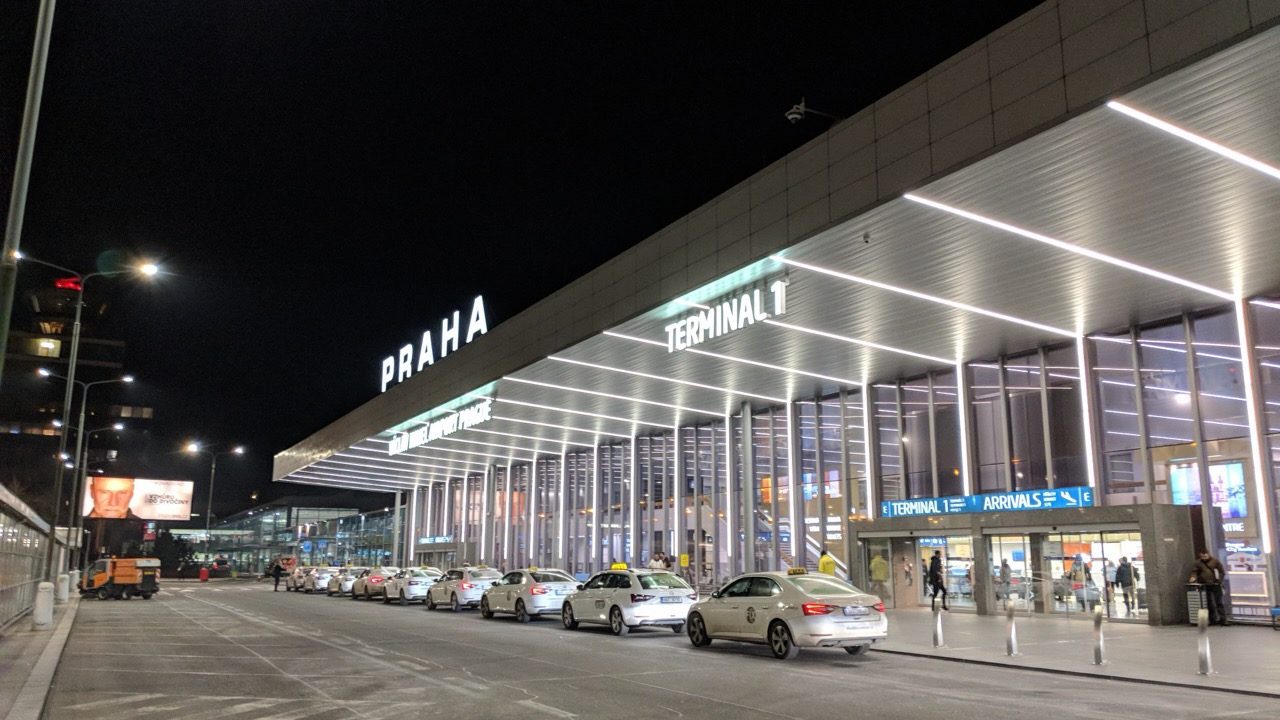
Photo: Terminal 1 at Václav Havel Airport Prague, where flights from the UK arrive. Felix Riehle, Wikimedia Commons, CC BY-SA 4.0.
Comments (0)
Please be polite. Spam and insults will be removed.