Is Prague Safe in 2026? Tourist Scams, Pickpockets and Tipping
Popular
Yes, Prague is safe for tourists. Czechia ranks 13th of 163 countries in the Global Peace Index 2026, recorded crime in the city fell 9.3% in 2025, and violent offences made up 4.6% of the total. What visitors mostly risk is money: pickpockets, street money changers, padded bills and taxis. Around Prague checked police data, ČNB and ČOI guidance, Czech laws and Prague regulations on official sites on 30 October 2026.
Is Prague safe? The numbers
The Global Peace Index scores whole countries on 23 indicators covering conflict, militarisation and social safety. It does not count pickpockets. Ireland is 5th, the UK 39th, the US 134th.
Prague police recorded 34,853 offences in 2025, 3,582 fewer than in 2024. Pickpocketing plus other theft from the person made up 8.5% of all cases, about 2,960 (our calculation: 34,853 × 0.085). Nationwide, pickpocketing fell from 4,161 cases in 2024 to 3,384. In the first quarter of 2026 overall crime in Prague fell another 2%, but violent crime rose from 449 to 513 cases.
In April 2026 police said tourists most often fall victim to pickpocketing and fraud, and that organised foreign groups are often behind the thefts. UK advice warns about trams to Prague Castle; German advice names crowds at sights, stations and public transport. Carry only the cash you need that day.
Exchange offices and street money changers
A "0% commission" sign tells you nothing: exchange offices may not charge a fee at all, except on coins and cheques. Compare rates instead, because each office sets its own. German advice warns of offices in tourist areas advertising the rate for the opposite deal. Selling euros or pounds? Read the "we buy" (nakupujeme) column.
The 3-hour rule. By law you can cancel an exchange free and without giving a reason within 3 hours, at the same office, counting only its opening hours. The limit is EUR 1,000 or its equivalent. Always take the receipt. Exchange machines give you 3 working days, and if you were misled or blocked, you have 6 months. Complain to the office first, then to the Czech National Bank (ČNB) or the Financial Arbitrator.
Never change money on the street. In January 2026 police reported three men who promised tourists a good rate and handed over invalid Belarusian roubles in streets such as Na Příkopě, Na Poříčí and Opletalova. Also refuse offers to "break" your cash at an ATM. See our currency exchange guide.
Cards and ATMs: always pay in crowns
A terminal or ATM may offer to charge you in your home currency. This is dynamic currency conversion (DCC). ČNB says the rate is usually worse than your card issuer's. Choose CZK.
In the EU you must be shown the total and the mark-up over the European Central Bank rate first, and you can always say no. If the terminal already shows your currency, ask for the amount to be re-entered in crowns. ATM complaints go to ČNB, terminal complaints to ČOI, the trade inspection. Your bank and the ATM owner may add fees.
Taxis
Prague scrapped its taxi price cap on 30 September 2026. City Hall then received dozens of complaints, mainly from foreign tourists, with receipts showing up to 450 CZK to get in and up to 500 CZK per km. A decision of 20 October restored the cap for metered taxis within Prague: 70 CZK boarding, 42 CZK per km, 7 CZK per minute of waiting, no surcharges. German advice is to order a car: unlicensed taxis often wait at tourist hotspots. More: Taxis in Prague.
Restaurants, bars and tipping
Under the Prices Act you must see the price in crowns before you buy, and it must be final, with all fees included. So a cover charge, bread or a service fee should be visible up front. Prices must relate to a stated quantity, so check the size of your drink.
- Snacks or a shot you did not order? Ask if they are free. Consumer law treats demanding payment for unordered items as an aggressive practice.
- A "service" charge for foreigners only is illegal discrimination. In 2017 ČOI found a café charging it to English speakers only.
- Check the bill before paying. On request the venue must give you a document with date, service, price and trader.
Raise it on the spot, then write to ČOI, which handles prices and billing but not food quality: [email protected], +420 222 703 404 (Mon and Wed 8:00–16:00).
Tipping in Prague. We found no tipping guidance on prague.eu. A 2014 Czech foreign ministry guide says 5–10% is appreciated in restaurants with table service. The waiter states the total and you say what you will pay including the tip. By card it works the same: on a 550 CZK bill, say "600" first (about 9%). More in our Czech etiquette guide.
Bans and fines
| What | Rule | Fine |
|---|---|---|
| Street drinking | Banned at listed places including Charles Bridge, Old Town Square, Wenceslas Square and Karlova, within 100 m of schools, healthcare sites, playgrounds and metro entrances, and at stops. An open bottle counts. Parts of the riverside: 0:00–9:00. Allowed on terraces, at licensed stalls, at festivals, and on 31 Dec and 1 Jan. | up to 100,000 CZK; on the spot up to 10,000 CZK |
| Night noise | Quiet hours 22:00–6:00 | up to 10,000 CZK (repeat offence 15,000 CZK) |
| Smoking | Inside restaurants and bars, at stops, on public transport, on playgrounds; the last three also cover e-cigarettes | up to 5,000 CZK |
| Transport ticket | Validate a paper ticket on boarding or entering the metro; otherwise it is invalid | 1,200 CZK on the spot, 1,500 CZK within 15 days, otherwise 2,000 CZK |
Pub crawls. Since 1 November 2024 Prague's market rules allow walking tours only with a guide and only between 6:00 and 22:00, which bans organised night pub crawls. The 2026 amendments left this in place. The ban targets organisers. Selling tours on the street in the centre is also illegal.
E-scooters. Shared e-scooters left the city's system on 1 January 2026; shared bikes remain. E-scooters are banned on the metro and on Nerudova, and you may not ride on pavements. Tickets: see our Prague transport guide.
ID. UK advice says to carry your passport; police normally accept a scan.
What to do if you are robbed
- Block your cards in your banking app or by phone.
- Call 158 (police) or 112; city police are on 156. See our list of emergency numbers.
- Report it in person within 24 hours and get a crime number for your insurer. Any station can take a report, but interpreters can take time. The Můstek station, Jungmannovo náměstí 771/9 (+420 974 851 750), is open 24 hours with English-speaking staff.
- Lost passport: UK Embassy, Thunovská 14, by appointment (emergency travel documents online). US Embassy, Tržiště 15, +420 257 022 000. Others: Czech foreign ministry list.
Someone in plain clothes wants to see your currency and passport? UK advice warns of fake police: do not show your money, offer to walk to a station or call 112.
Prague at night
We found no official list of dangerous districts; warnings concern situations. German and UK advice mention bars: inflated bills, drink spiking, theft. Keep your drink with you and check prices early.
In March 2026 police ran an anti-drug operation in Vrchlického sady, the park by the main station, on Wenceslas Square and in bars on Masná, Kozí and Dlouhá. That is no reason to avoid the centre, but late at night walk from the station along the streets, not through the park. Prague 1 city police say Malá Strana has fewer problems than the Old and New Towns. Staying longer? See our safe neighbourhoods guide.
Prague safety questions (FAQ)
Is Prague safe for tourists?
Yes. The main risks for visitors are pickpocketing and money scams.
What are the common tourist scams in Prague?
Police and foreign ministries name street money changing, inflated bar bills, taxis and fake police.
How much should I tip in Prague?
5–10% in restaurants with table service, says the Czech foreign ministry. Tell the waiter the total.
Can I get my money back from an exchange office?
Yes, within 3 hours at the same office, up to EUR 1,000. Keep the receipt.
Can you drink beer on the street in Prague?
Almost nowhere in the centre: the ban covers listed streets and squares, plus areas near metro entrances, schools and stops.
Sources: GPI 2026, Prague police, 2025 results, Q1 2026, street changers, Operation NARCOS, Czech Statistical Office, ČNB exchange rules, ČNB on DCC, Your Europe, taxi price decision, Prices Act, Consumer Protection Act, Offences Act, Act 65/2017, Prague alcohol ordinance, market rules, ČOI, Czech foreign ministry, 2014, PID, prague.eu, German foreign ministry, GOV.UK. Checked on 30 October 2026; amounts and rules can change.
See also: Currency exchange in Czechia, Emergency phone numbers, Czech etiquette, Prague transport, Prague restaurant guide.
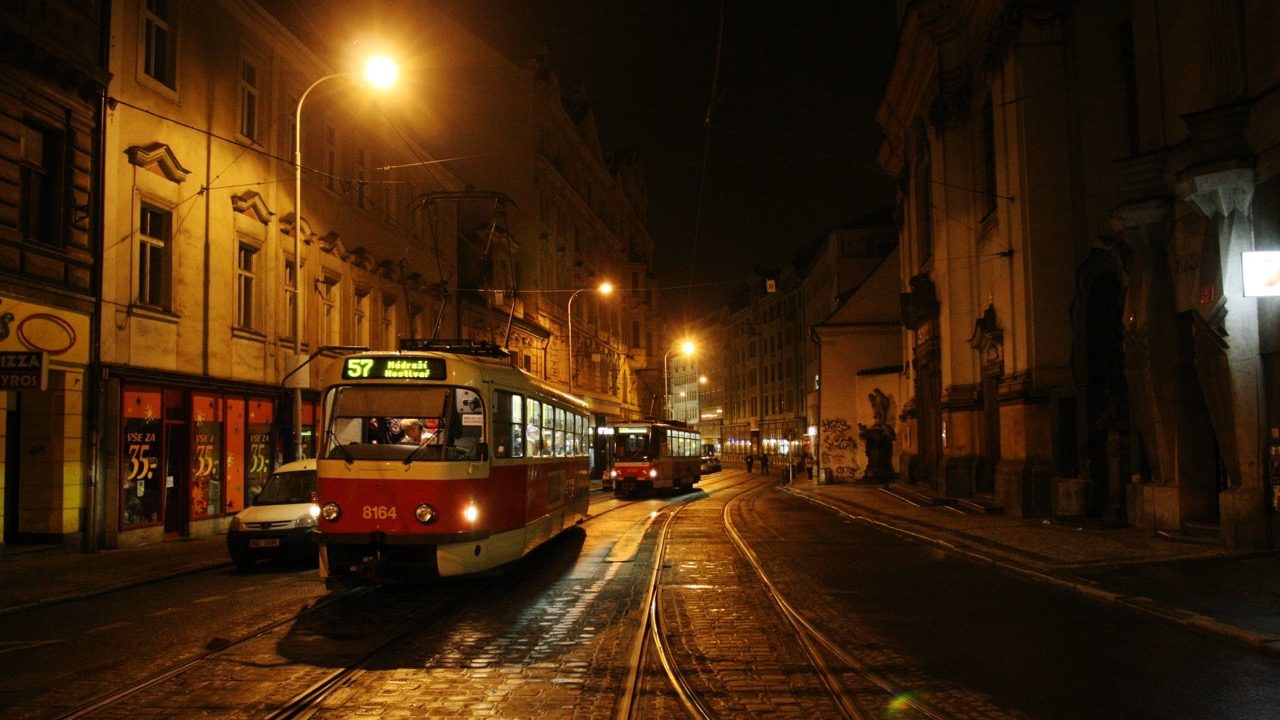
Photo: night tram on Spálená street, Prague. Petr Novák, Wikipedia, Wikimedia Commons, CC BY-SA 3.0.
Comments (0)
Please be polite. Spam and insults will be removed.