The State Institute for Drug Control (SÚKL) in Czechia is considering allowing insurance companies to reimburse the cost of a modern weight-loss drug for children and teenagers aged 12 to 18 with obesity. This was announced by the institute's director, Tomáš Boráň, who noted that no timeline for a final decision has yet been set.
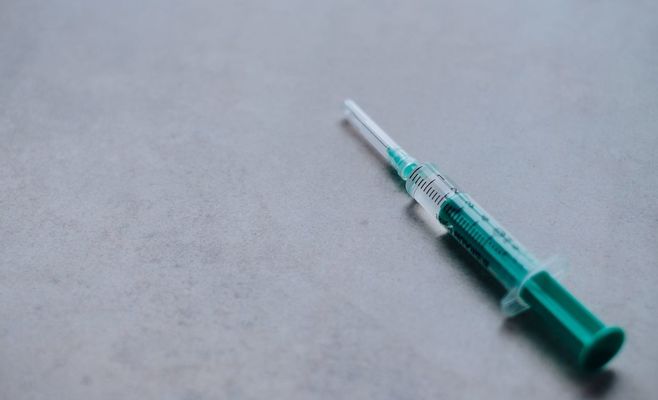
One injection a week
The drug in question is Wegovy, a new-generation weight-loss medication from the Danish pharmaceutical company Novo Nordisk. It appeared on the Czech market in 2021. Compared with older alternatives, it delivers better results, and its main advantage is that the injection only needs to be given once a week. SÚKL is currently considering reimbursement solely for children aged 12–18 who suffer from obesity.
Strict conditions for reimbursement
Even if insurers do start paying for the drug, getting reimbursed will not be straightforward. A child cannot rely on the medication alone — Wegovy is meant only as an addition to treatment, meaning parents will have to prove that the child is already trying to lose weight through diet and physical activity. What's more, if the child's weight has not dropped after 12 weeks on the drug, the right to insurance reimbursement is automatically lost.
Treatment is already available — but out of pocket
Doctors can already prescribe these drugs to children, but patients currently have to pay for the treatment themselves, and it isn't cheap. In the first weeks, a weaker dose is used, costing around 3,500 crowns a month. The dose is then gradually increased to the final level, which costs more than five thousand crowns a month and is taken over a long period.
“We warn patients that this is long-term treatment. You can't assume that taking the drug for six months, losing weight, and then simply stopping will be enough,” said Jana Křenek Maliková, head of the pediatric obesity section of the Czech Pediatric Society.
According to her, if reimbursement for children with obesity is approved, it would be excellent news — treatment would become available to far more children. She stressed that these drugs are usually not the first choice: doctors prescribe them only when they see that a patient is trying to lose weight but is not succeeding.
“This treatment also helps by reducing appetite. The child doesn't have to constantly think about food, cravings weaken, and smaller portions become enough,” Křenek Maliková explained.
Obesity is more common among the poor
According to the international HBSC (Health Behaviour in School-aged Children) study, the number of children with obesity in Czechia is growing: in 2010 the figure stood at 4%, while last year it had already reached 6.3%. The statistics also show a direct link between obesity and poverty: in wealthier families, 4% of children are obese, compared with 9% — almost one in ten — in poorer families. For such families, access to free treatment could prove especially important.
In children and teenagers, obesity is determined differently than in adults — by standards that depend on age and sex, rather than by a fixed body mass index. For example, for a twelve-year-old boy who is 165 centimeters tall, the obesity threshold is a weight of around 66 kilograms.
SpaceX reports third-quarter results after the market closes Tuesday, Oct. 20. Analysts expect revenue to jump to roughly $13 billion from $7.8 billion in the second quarter, driven mainly by its arti
Democrats are putting resources into Senate races in two deeply Republican states, hoping to build a path to a majority. NBC News reported Tuesday that Senate Majority PAC, the party's leading Senate
Relations between the United States and Ukraine have reached a new low, according to ABC News, after President Donald Trump waived sanctions on Russia that Congress had passed, said it was time for so
Vice President JD Vance said Monday that he will not endorse Israeli Prime Minister Benjamin Netanyahu for re-election, days after President Donald Trump publicly gave Netanyahu his full backing. Vanc
Actress Christina Applegate said on Tuesday that she does not have multiple sclerosis, five years after announcing she had been diagnosed with the disease. She shared the news, tearfully, in a two-par
A nor’easter spinning off the Atlantic coast is expected to bring coastal flooding, high surf, rip currents and gusty winds to parts of the East Coast for several days, according to The Weather Channe
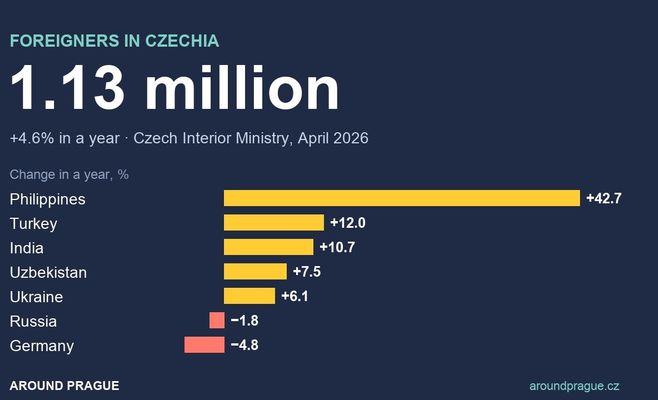
As of 30 April 2026, 1,130,280 foreigners held registered residence in Czechia. That is 49,907 more (+4.6%) than a year earlier. We went through the Interior Ministry's monthly tables by nationality, type of residence and district, and comp
An impatient SUV driver in Kyjov (South Moravia) put a child’s safety at risk: he overtook a stopped bus right at a pedestrian crossing just as a girl was walking across. The incident was captured by the bus’s dashcam, and the police have r
Relative humidity in Czechia is indeed falling, but that does not mean the air contains less water: according to measurements by the Czech Hydrometeorological Institute (ČHMÚ), the amount of water vapor is, on the contrary, rising. That is
Warming is increasing evaporation in Czech forests, which raises the risk of drought even when rainfall stays almost unchanged. That is the picture from long-term measurements in a number of forest catchments, presented at a scientific conf
The Czech government has approved amendments under which the Czech Environmental Inspectorate (ČIŽP) will gain the power to shut down a plant immediately if it endangers people’s health. This is stated in materials presented by the Ministry
Excess levels of lead have been found in the drinking water at the Agel hospital in Nový Jičín. Hospital management informed the Moravian-Silesian Region, which owns the building, and the two sides discussed how to assess the state of the f
On Monday morning, PID bus services collapsed around Smíchov railway station in Prague: passengers sat in traffic and waited up to an hour for transport. According to the official profile of the Prague Integrated Transport system, the cause
The Czech health minister’s advisory commission on infant and toddler nutrition spent almost three hours arguing about doctors’ ties to infant formula makers and devoted just 15 minutes to the contamination of the formula itself. This follo
In Czechia, a flu shot costs 600–700 crowns this season, but health insurers reimburse part of that sum, and some cover all of it. People over 65, patients with certain chronic illnesses and healthcare workers are vaccinated free of charge:
In Czechia, foggy mornings and sunny spells at the start of the new week will give way to rain from Wednesday, and it will turn cooler towards the weekend. According to forecasters, up to 20 mm of rain will fall by Thursday — across most of
Litvínov’s Janov is one of the best-known socially excluded neighbourhoods in Czechia, and the local school is almost entirely segregated. Residents and teacher Marián Danco told Deník.cz this as part of the “People from Hostels” series.How
Experts say that the “72 hours” leaflet is not enough to make people in Czechia ready for a large-scale blackout. As Novinky reported, a system for preparing the adult population for the defence of the state will not be in place by the end