Poll: Most Czechs Want to Ban Phones and Social Media for Children in Schools
USD 21,75
Popular
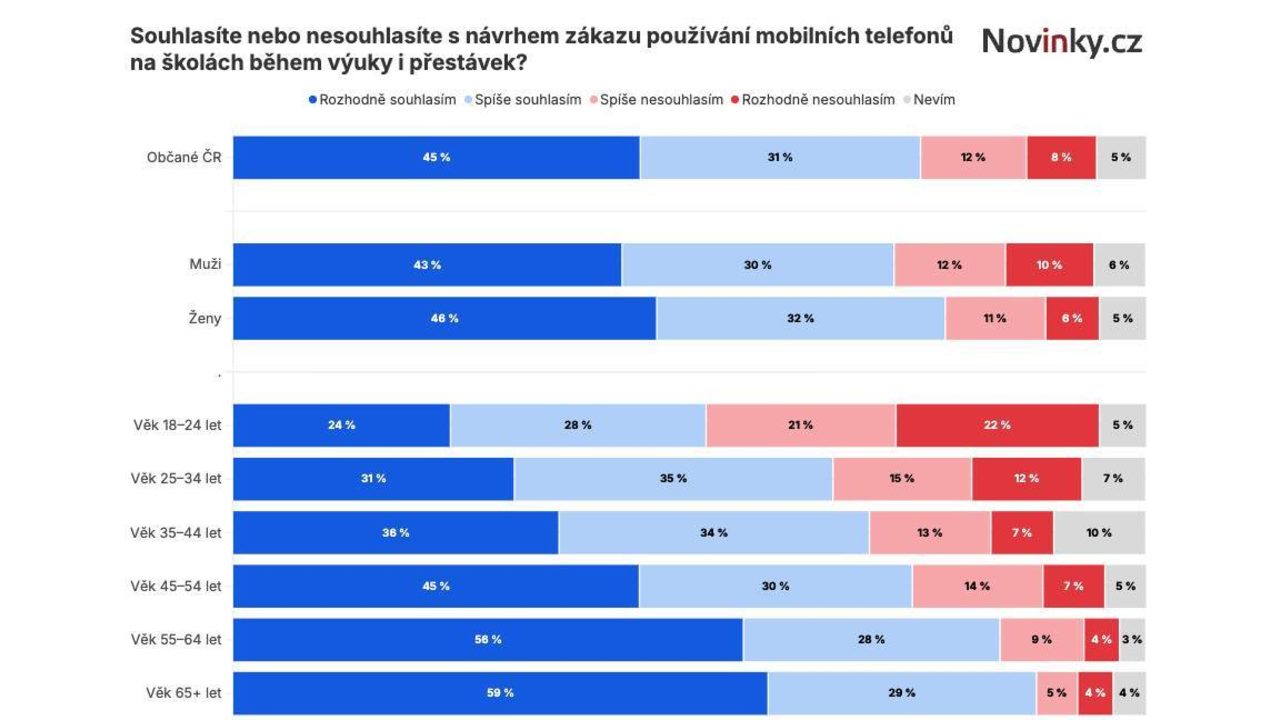
Most people in Czechia support banning children from using mobile phones in schools, as well as restricting access to social media for anyone under 15. That's according to a survey conducted by the polling agency NMS, whose findings were analyzed by political commentator Tereza Fridrichová.
"The ban on mobile phones in schools enjoys nationwide support. Czechs agree that school exists first and foremost so that children can learn there," Fridrichová said, summarizing the poll results.
The Older the Age Group, the Stronger the Support
Support for the ban grows with the age of respondents: the older people are, the more likely they are to favor taking phones away from students. The idea received the strongest backing among people over 65 — 88%. Among the youngest group, aged 18 to 24, 52% approve of the ban, while 43% oppose it.
Voters of every parliamentary party support the initiative to some degree. It's most popular among supporters of the ruling ANO (87%) and SPD (82%) movements. Among voters of the third coalition partner, the Motorists party, 71% back the ban, while 15% are strongly opposed and another 12% lean against it. The idea is least popular among Pirate Party supporters, though even there, fewer than a third of respondents oppose it.
Should Social Media Be Banned Too?
The poll also found broad support for banning children under 15 from using social media platforms such as Instagram, Facebook, WhatsApp, or TikTok. 71% of respondents agreed with this, about a fifth were opposed, and the rest were undecided. As with the phone ban, voters across all parliamentary parties generally support the idea, with Motorists party supporters most often opposed (39%).
According to Fridrichová, the push for these bans is largely driven by a desire to protect children. Still, contrary to public opinion, some experts warn that such restrictions may not deliver the expected benefits for students' mental health.
Experts Question the Effectiveness
"Within professional circles, these bans are viewed with skepticism. They're seen more as a political gesture than a genuinely effective solution. Banning phones in schools could theoretically help improve students' concentration. But the public and politicians tend to link it to mental health — for instance, preventing addiction — even though the ban wouldn't have any real impact in that regard," said researcher Lukáš Blinka from the Institute for Research on Children, Youth and Family at Masaryk University in Brno.
Data from countries that have already introduced similar measures back up the researcher's point. Results from Iceland, for example, show that banning phones in schools did nothing to help children struggling with psychological issues. Meanwhile, most Czech schools already regulate phone use through their own internal rules — without any need for legislation. "It would be naive to expect any real effects," Blinka noted.
A similar picture emerges around the proposed social media ban. Blinka pointed out that under current law, children under 15 are already only allowed to use social media with parental or guardian consent. "If the existing rules were actually followed, many of these problems would already be solved," the researcher emphasized, adding that what usually matters most isn't the ban itself but how it's enforced. He also noted that enforcement would inevitably affect the privacy of not just children but also adults who support the ban, since it would require verifying users' ages.
Read also: Brno: What to See and Where to Go
Source: novinky.cz