Setúbal Cathedral in Portugal: Mannerist facade and azulejos
USD 21,81
Popular
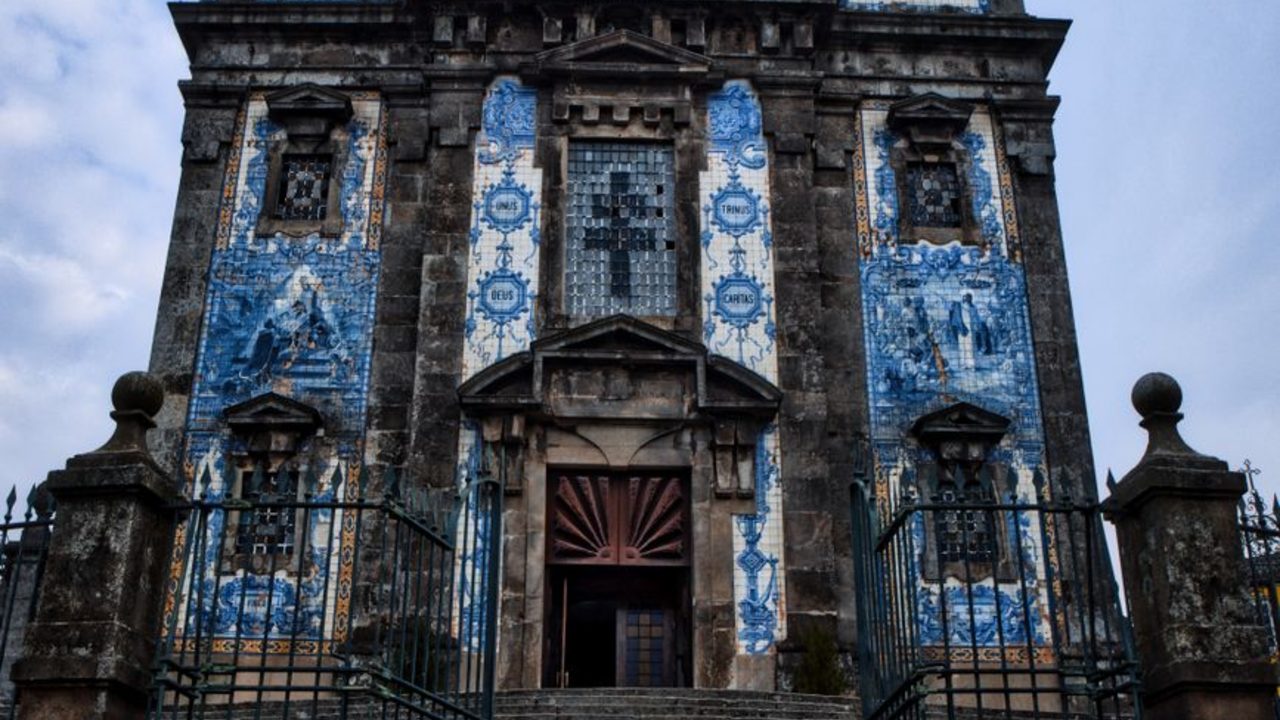
The main church of the port city of Setúbal in Portugal, the Cathedral of Our Lady of Grace (Santa Maria da Graça), began to be built as early as the 13th century. Today its most distinctive feature is the austere Mannerist facade by the architect António Rodrigues (1520–1590), a native of the city.
The building was listed as a Portuguese national monument in 1955, but it received cathedral status only in 1975. The church stands at Rua Dr. António Joaquim Granjo, 31. The predecessor of the present church was demolished in the mid-16th century and, strangely enough, the new building was entrusted to the royal architect and fortification engineer. The facade with its two low bell towers is indeed military in its severity, as are the portico shaped like a Venetian window and the balcony with a balustrade.
What is inside the cathedral
The three-nave interior is decorated with painted Tuscan columns and arcades, carved wooden furnishings, a Baroque high altar with twisted columns, a Mannerist pulpit, a painted wooden ceiling and blue-and-white azulejo tiles. All of it dates from the 17th and 18th centuries. The contrast between the stern facade and the rich decoration is one of the most interesting features of the church.
Fourteen azulejo wall panels created in 1766 by Sebastião de Almeida tell the story of the life of the Virgin Mary. There are also several majolica tiles from the late 16th century. The grotesque paintings from the second half of the 18th century on the columns and arcades are unusual. The chancel, renovated in the late 17th century, is covered in gilded carving, and on the triumphal arch you can see fantastic beasts and winged angels on chariots drawn by eagles.
History for those who love details
The first, Romanesque-Gothic church, according to tradition, held its first service in the summer of 1248. It soon became too small, and King Manuel I ordered it rebuilt, but the old building was demolished only in 1550, 29 years after the king's death. The new church was largely completed in 1570.
The first side chapel, that of the Blessed Sacrament, was added in 1586, followed by the chapels of Saint Anne (1618), Saint Andrew (1614) and Saint Joseph (1618). The altar and galleries are covered in gilded carving by the master José Rodrigues Ramalho (1697) and the gilder Vicente Nunes (1716). The Chapel of the Immaculate Conception and the chapel of Saint Peter Gonzales, patron of the city's oldest maritime brotherhood, are decorated in the same way.
The cathedral is one of the most significant and interesting sights of Setúbal. Around it, an important medieval city quarter once took shape, and later a religious and administrative center.
Around Prague guide on the topic: Прага 1: какие кварталы входят, население, достопримечательности, парковка и аренда (2026)
Around Prague, based on reporting by turistika.cz