Why Does Greece Have So Many Earthquakes? A Guide for Holidaymakers
USD 22,28
Popular
Greece sits on one of the most active seismic belts in Europe. Many Czech holidaymakers fly to Crete, Rhodes, Corfu, Athens or Santorini each year, so it helps to know why the ground there shakes, how often it matters, and what to do if it happens while you are in a hotel.
Why Greece shakes
The country lies where the African plate meets the Eurasian plate. USGS describes the Hellenic Trench, south of Crete and the Peloponnese, as a place where African lithosphere is pushed northward beneath the Aegean. This is the Hellenic arc, and it produces the region's strongest earthquakes. The Aegean itself is also being stretched north to south, which creates many normal faults on the islands and the mainland, such as the Gulf of Corinth.
The result is frequent, mostly small quakes. Most are felt only as a short jolt. A few each decade cause damage, usually where old or poorly built buildings stand close to the epicentre.
Biggest quakes on record
- AD 365 and 1303, Crete: historical records point to magnitudes of about 8 or more, with tsunamis. Magnitudes of such old events are estimates.
- 1956, between Naxos and Santorini: USGS lists an M7.7 shock as the largest instrumentally recorded quake in the region.
- 7 September 1999, Athens: M6.0, about 143 deaths, according to the Wikipedia list of Greek earthquakes.
- 30 October 2020, near Samos: USGS M7.0 at about 21 km depth. Two people died on Samos, and more than 100 in Izmir, Turkey (secondary figures).
- 2021, Crete: USGS lists an M6.0 shock near Thrapsano, in the middle of the island.
Lists differ on what counts as the "largest" quake, because older events are only roughly measured.
The Santorini swarm of 2025
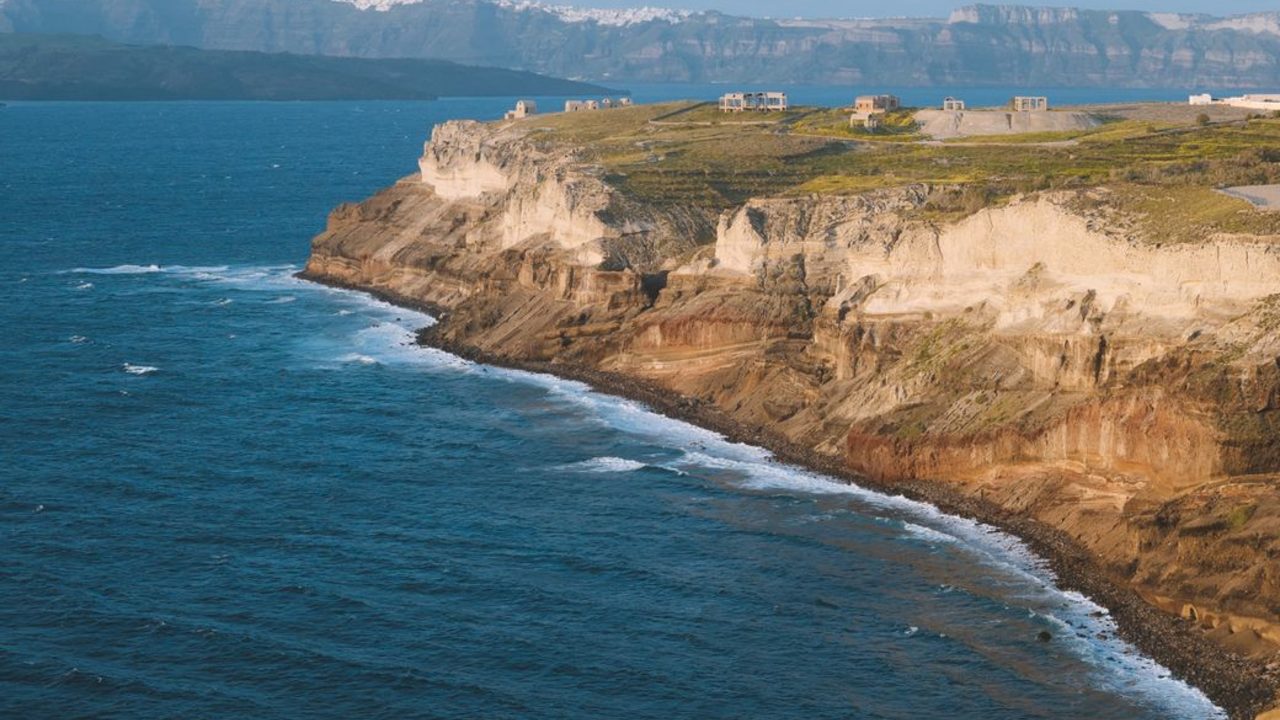
In late January 2025 thousands of small quakes began between Santorini and Amorgos. Greek officials counted more than 15,300 between 26 January and 10 February. The strongest reached M5.3, and several islands declared a state of emergency, including Santorini. Many residents and visitors left, and schools and some events were closed for a time. Scientists described it as a swarm, with no single main shock, and the activity declined gradually in the following weeks. Reports give slightly different dates for the strongest event, so we do not give one here. Damage was minor.
A swarm does not mean a larger quake is coming, but nobody can predict that. Seismologists said so openly at the time.
If it happens while you are in a hotel
Greek authorities and the tourism ministry give similar advice to visitors:
- Indoors: drop, cover and hold on under a sturdy table or desk, or next to an inside wall. Stay away from windows, mirrors, balconies and heavy furniture.
- Do not run for the stairs or use the lift while the shaking lasts. After it stops, leave by the stairs, calmly, wearing shoes.
- Outside: move to an open space away from buildings, walls and power lines.
- On the coast: if the shaking was strong or lasted long, go to higher ground. Do not wait for an official warning.
- Aftershocks are normal. Expect them for days, and avoid damaged or abandoned buildings.
Check in advance where the hotel's exits and assembly point are. The Greek civil protection ministry runs a safety map at mysafetyplan.gov.gr that shows designated safe areas.
How to follow alerts
- 112: the European emergency number works across Greece. Use it only if someone is in immediate danger. Greek authorities may also send warnings to phones through 112 alerts, so keep your phone's emergency alerts switched on.
- EMSC: the Euro-Mediterranean Seismological Centre publishes quakes quickly and offers an Android and iOS app and a messenger bot for felt earthquakes near you.
- Civil protection: follow civilprotection.gov.gr and the hotel staff, and your own embassy. The Czech foreign ministry also publishes travel advice for Greece.
For a plain-language explainer with the long list of recorded Greek quakes, see Live Earth Watch's guide to Greek earthquakes.
Should you cancel a trip?
Minor quakes are common and normally do not disrupt flights or holidays. Check your travel insurance and the current government travel advice before you go, and follow instructions from local authorities if a stronger shock occurs. We could not confirm hotel-specific alert systems, so ask your hotel at check-in what its evacuation plan is.
FAQ
Is Greece safe to visit? Yes, for most visitors. Serious damage from quakes is rare in tourist areas, and modern buildings are designed for shaking.
Can quakes be predicted? No. Scientists can map hazard, not give dates.
Which number do I call? 112, for danger to life.
Around Prague, based on reporting by USGS, EMSC, Greek Ministry of Tourism, GeoSphere Austria, Live Earth Watch