Archaeologists Find Bronze Age Hillfort With Three Ditches Near Olomouc, Czechia
USD 22,28
Popular
Archaeologists have uncovered a previously unknown fortified settlement from the Early Bronze Age in Charváty, a village next to Olomouc in the Czech Republic. The site was defended by three lines of ditches, the deepest about 3.3 metres deep and more than 7.5 metres wide at the top. The Archaeological Centre Olomouc (ACO) announced the find on 18 November 2026.
What was found
ACO carried out a rescue excavation between September and the end of October 2026, ahead of planned construction of family houses. The first stage covered four building plots, intended for two duplex houses, and part of a planned road. According to the ACO, the developer is Fidler Stavby s.r.o. Work will continue alongside further building.
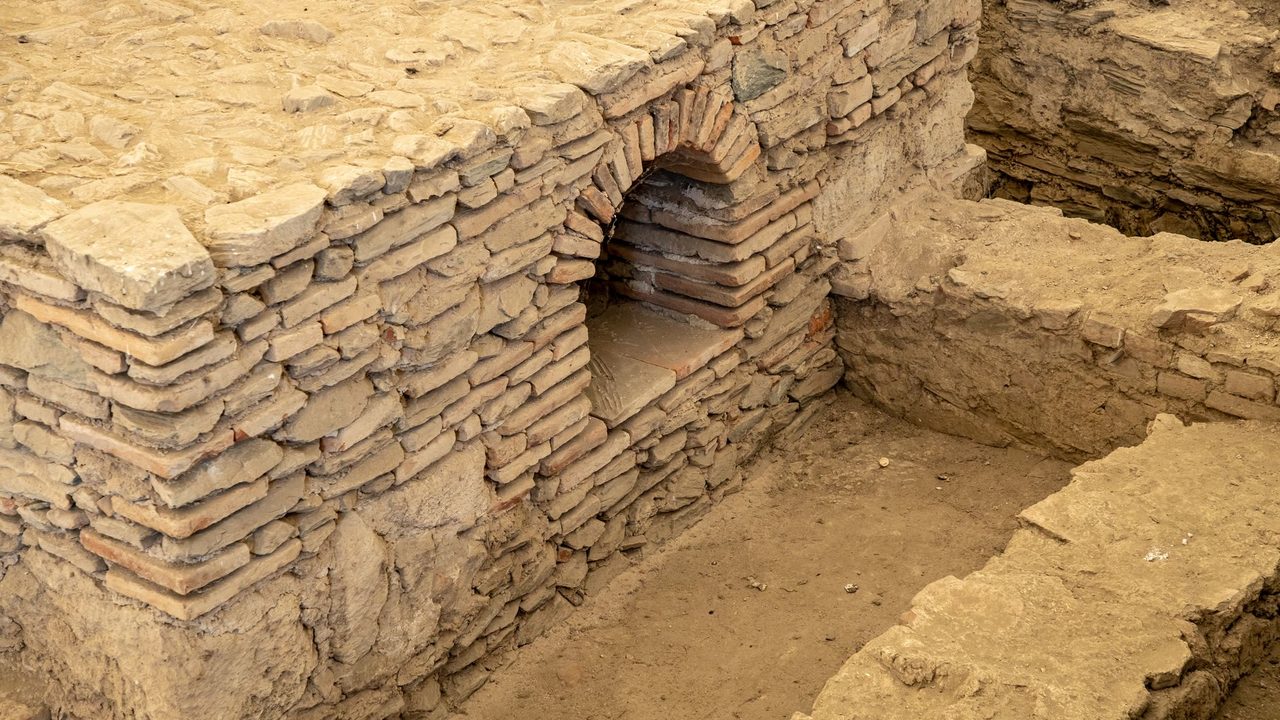
The team documented about 40 archaeological features: settlement and storage pits, burials and the defensive ditches. Two of the three ditches were partly investigated. The outer ditch is about 2.2 m deep, and the middle one about 3.3 m.
The settlement stood on a raised terrace above the Morava River, where the surrounding slopes gave natural protection. The ACO says the position may have allowed control of movement through the landscape.
How old is it?
Archaeologists tentatively link the fortification to the Věteřov culture of the Early Bronze Age. This culture is named after the hillfort at Věteřov in the South Moravian region, and is dated to roughly the 19th to 17th centuries BC in general archaeological literature. No radiocarbon dates have been published yet for the Charváty site, so that range is background, not a result of this dig.
The site has a longer history. The earliest finds are pottery, animal bones and stone tools from the 5th and 4th millennia BC, linked to the Lengyel and Jordanów cultures.
The four burials
- A child of about 10 with a stone battle-axe, tentatively linked to the Corded Ware culture (about 2900 to 2500 BC). The axe is typical of male burials in that culture.
- An adult in an unusual position, buried with ceramic vessels and a flint artefact. Its date is uncertain, and further analysis must show whether it belongs to the same period as the first.
- A person in an Early Bronze Age storage pit with no grave goods.
- A poorly preserved burial of a person lying face-down, with the skull missing. Age is not determined.
What the archaeologists say
ACO archaeologist Vít Záhorák said the fortification came as a surprise, because earlier research had already shown Bronze Age settlement at Charváty. He said it is not yet clear whether the site was the seat of an important community or a refuge for nearby settlements. The ACO says it may have been a centre for surrounding communities, but its extent, layout and function need further study.
A non-destructive geophysical survey by the Department of Archaeology and Museology at Masaryk University in Brno suggests the enclosure continues into neighbouring fields and gardens. It also detected possible building remains whose age is not yet known.
What happens next
Samples from the ditch fills were taken for pollen and micromorphological analysis, which may show what the landscape looked like and whether the ditches were maintained while in use. Planned work includes anthropological study of the human remains, pottery and natural-science analysis, and possibly radiocarbon dating.
ACO press spokesperson Nikola Jandová said early cooperation between builders and archaeologists lets finds be recorded before construction destroys them.
Context: Bronze Age hillforts in Czechia
Fortified settlements are well known from the Early Bronze Age in Moravia, particularly in the Věteřov group area of South Moravia, with the type site at Věteřov. A hillfort on flat ground beside the Morava River is a less expected setting, which is partly why the discovery drew notice. Be aware that the Charváty dating is still preliminary.
The story was also picked up by The Science Beat in its report on the Charváty hillfort, which cites the same ACO announcement.
FAQ
Where is Charváty?
It is a village next to Olomouc in the Olomouc Region of Moravia, in the Morava River valley.
Is the hillfort open to visit?
No. It is a building site and the excavation continues, so there is no public access.
Has the site been dated by radiocarbon?
Not yet. The Věteřov link is preliminary, and radiocarbon dating is only a possibility.
Around Prague, based on reporting by Archeologické centrum Olomouc, ČT24, The Science Beat