Brno high-tech farm: how the Sklenář family grows with a robot and AI
USD 21,76
Popular
The family-run Raječek Farm on the edge of Brno grows hundreds of tons of premium vegetables every year, using smart technology, artificial intelligence and a sharp-eyed robot. Matěj Sklenář is developing the farm together with his parents, and the Netherlands was their inspiration.
The farm's story began almost a hundred years ago: in 1930, Matěj's great-grandfather settled on this land right beneath Špilberk. He grew crops and kept livestock, but then came the war and, later, the Communists and collectivization, and the family's property passed to the local cooperative. The Sklenářs returned to farming on their own only after the Velvet Revolution: in 1997, Matěj's parents, Josef and Iveta Sklenář, revived the farm.
The start was dramatic. Having put all their savings into the venture, the family lost its harvest in the very first year, when devastating floods struck Moravia and the Svitava river inundated the farm. But the Sklenářs did not give up. A company of three people on one hectare grew into a business on 35 hectares, employing up to 70 people in season. Today they plant around 6 million lettuce seedlings a year — more than ten varieties, some of which used to grow only in warm Spain and Hungary. They sell to supermarkets, hotels and restaurants, and directly to customers in their own farm shop.
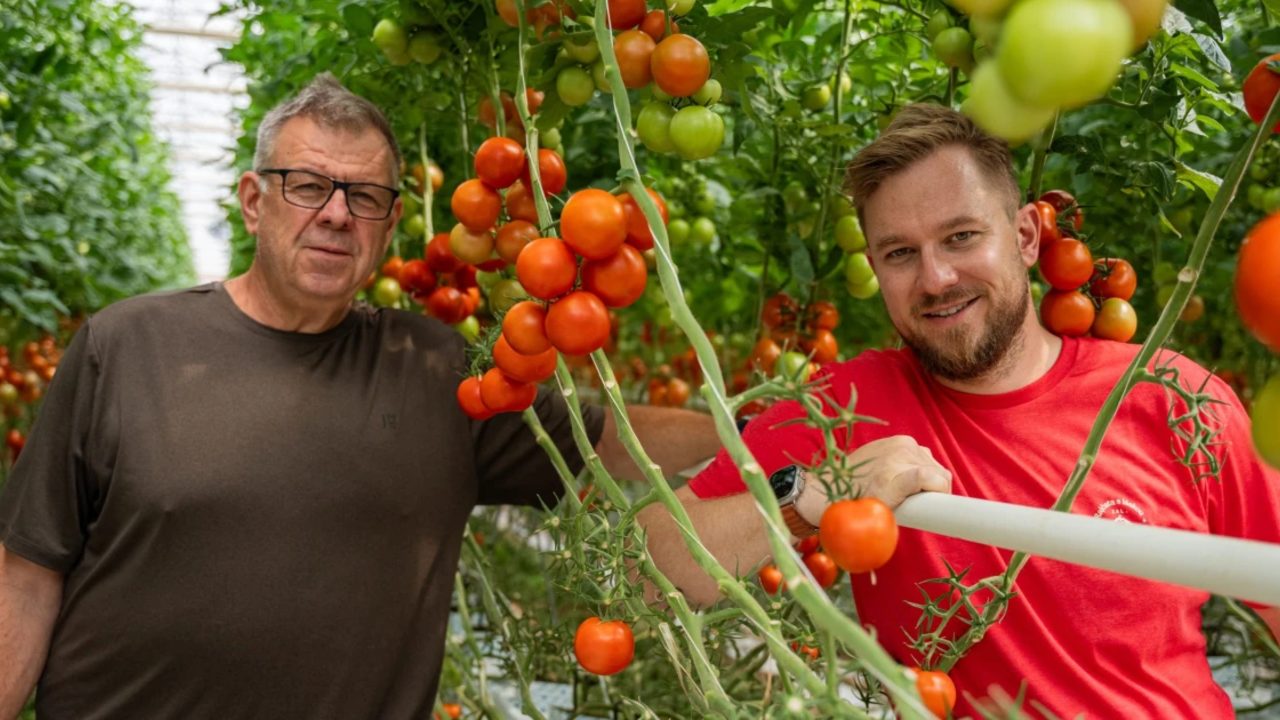
The main attraction is the film-covered greenhouses in the middle of the grounds, where tomatoes and strawberries are grown hydroponically. Strawberries are harvested from mid-April to mid-November, tomatoes for almost ten months of the year. The result is impressive: a single covered hectare yields about 500 tons of tomatoes a year. “If we grew them in a field, it would be twenty tons, or fifty if everything miraculously went right,” says Josef Sklenář, Matěj's father.
It was Josef who, more than ten years ago, proposed adding greenhouse growing to field farming: the farm cannot expand outward, since it is squeezed between the city and a nearby motorway. Building the greenhouses cost roughly 80 million crowns, with part of the sum covered by EU subsidies. “We decided to do what the Dutch did. They also have little land, so they intensified and modernized everything,” Josef explains.
The bet on technology is systematic here. A computer doses rainwater collected from the roofs to the plants — greenhouse growing saves up to 80% of the water compared with a field. Pests are dealt with by nature itself, using insects raised for the purpose, while AI and a robot help monitor the crop. That is how a small family plot beneath the walls of Špilberk became a model of modern agribusiness.
By the Around Prague newsroom