Curious By

Ghost towns of Czechia: how coal and reservoirs wiped Most, Doupov and Přísečnice off the map
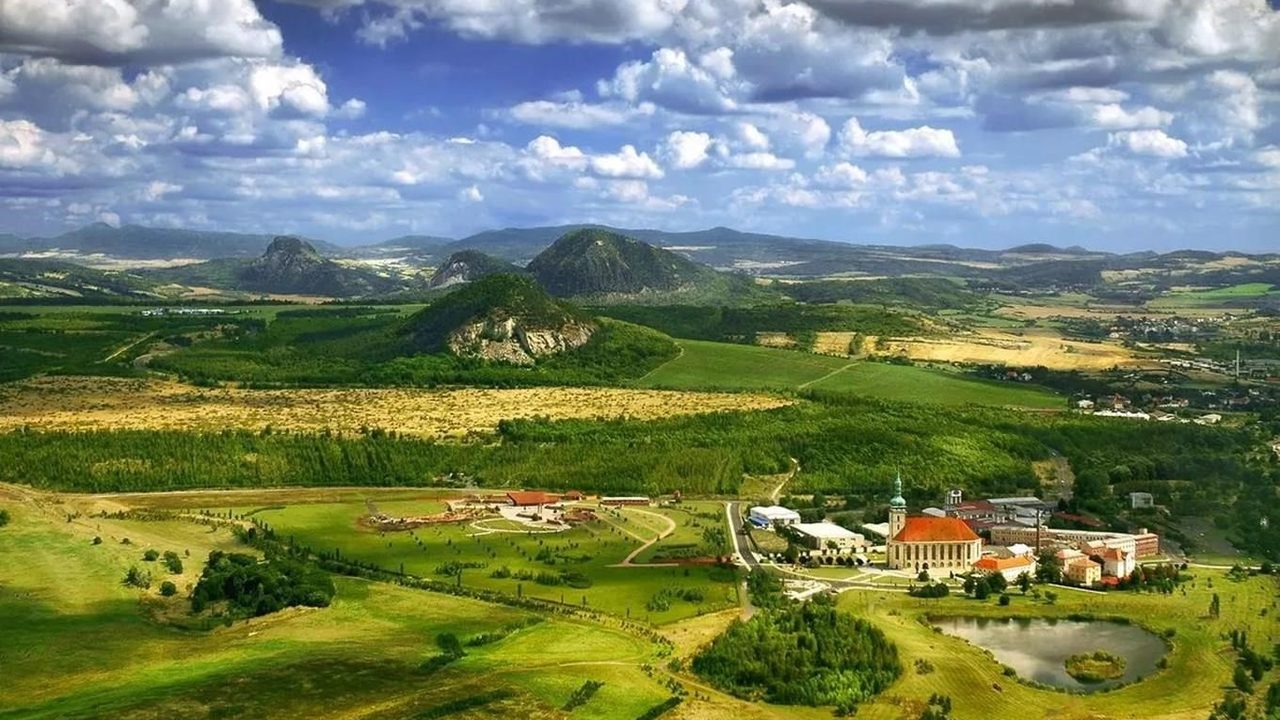
Ghost towns of Czechia: how coal and reservoirs wiped Most, Doupov and Přísečnice off the map

Czechia has towns that officially ceased to exist — demolished for brown coal mining or flooded to make way for reservoirs. The most famous examples are Most, Přísečnice and Doupov, whose stories rival the drama of legendary vanished cities like Pompeii or Troy.

The town of Most emerged at the turn of the 12th and 13th centuries beneath Hněvín Castle, along an important route from Prague to Freiberg in Saxony — it got its name (meaning "bridge") from the network of wooden bridges spanning the marshes of Komořany Lake. But in March 1964, the government decided to liquidate the town as coal mining advanced: beneath old Most lay 100 million tonnes of brown coal. Census data show the town had 47,199 residents in 1961; ten years later, just over eight thousand; ten years after that, five thousand; and by 1991, the population of the old town had dropped to zero. Demolition began in 1967, and the last houses were torn down two decades later. Filmmakers made frequent use of the crumbling town — it appears in several war films, but the most iconic shot remains a giant coal excavator rolling across the former Hus Square. All that survived of old Most is the late-Gothic Church of the Assumption of the Virgin Mary, which was relocated roughly a kilometre from its original site. Today, where the town once stood, the waters of Lake Most now ripple, while the new town of Most is home to around 64,000 people.

Přísečnice, a mining town in the Krušné hory (Ore Mountains) that also arose around the turn of the 12th–13th centuries, was known for its charming square with a castle and town hall, a cinema, a public bathhouse and excellent ski trails. It typically had three to four thousand residents, though after the postwar expulsion of the German population that number dropped to about a third. The town's fate was sealed by the construction of a reservoir in the early 1970s: gradual demolition and the flooding of the area erased it from the map. Before the flooding, all works of art were documented, the remains of the deceased were reburied at a forest cemetery in Vejprty, and some gravestones were transferred to the Chomutov museum. The Marian column from Přísečnice now stands in Klášterec nad Ohří, while a 1735 statue of the Virgin Mary of Svatá Hora seems to still watch over the town — it can be seen at a crossroads on the southern edge of the reservoir, not far from its original location.

Doupov, in the Doupovské hory, disappeared for a different reason — the creation of the Hradiště military training area. Of the small town, owned since 1858 by the Cedtvitz (Czedtwitz) family, who turned a once-unprofitable estate into a thriving community, all that remains today is the remnant of a linden alley, the steps of a former monastery chapel, cypress trees in the old cemetery, a warehouse where the train station once stood, and the neo-Gothic Cedtvitz family crypt. In independent Czechoslovakia before World War II, Doupov had a grammar school, two hotels, two wine bars, six taverns, five confectioneries, a lemonade factory, a steam sawmill and four mills — yet the town retained an almost medieval character to the end, without even running water. After the expulsion of the German population from the Sudetenland, the number of residents fell from nearly two thousand to a third of that, and new settlers had little interest in moving in. The final blow came with the establishment of the military training ground: in 1954, the 800-year-old town was officially abolished, and its territory remains off-limits to visitors to this day — with no hiking or cycling routes allowed.

Karviná is a separate case — it didn't disappear entirely, but changed beyond recognition. In the early 20th century it was a bustling town with Solca Castle, a splendid town hall, two churches, a brewery, schools, hotels and a swimming pool. Ground subsidence caused by coal mining destroyed almost all of old Karviná, and the present-day town emerged after World War II from the merger of several settlements, somewhat to the north and east of its original location.

Read also: 8 best swimming spots near Prague: lakes, quarries and beaches within an hour's drive of the capital

Around Prague, based on reporting by kudyznudy.cz

Share: Telegram WhatsApp

More science news

NASA Drone Test Shows Moon Landing Software Can Dodge Unsafe Sites
NASA says it has successfully demonstrated technology that lets a spacecraft pick a safe landing spot on its own. The agency flew the system on a drone that performed simulated lunar descents and land
Hubble Spots a Dark ‘Cat’s Tail’ Long Enough to Loop the Sun 500 Times
Astronomers using the Hubble Space Telescope have captured in visible light a long trail of dust called the Cat's Tail, which they think is the wreckage of a collision between two Pluto-sized bodies.
Cold Showers Linked to 31 Percent Fewer Sick Days in Swiss Study
People who regularly took cold showers reported 31 percent fewer days off work because of illness than those who did not, according to a Swiss psychology study. ScienceAlert reported on the findings,
Taurid Meteors Peak Nov. 4-5, With Fireballs Brighter Than Venus
The Southern Taurid meteor shower reaches a second peak overnight on Nov. 4-5, a window when unusually bright meteors called fireballs are more likely, according to Space.com and Live Science. The Nor
One-Shot Gene Editing for Cholesterol Is Closer, but Doctors Urge Caution
A single gene-editing treatment might someday keep cholesterol in check for decades and replace daily pills. Two University of Michigan cardiologists warn that permanent changes to a person's genes ca
Three Capsules Now Orbit Earth Growing Cancer Drug Crystals in Space
A California company has three small spacecraft circling Earth at the same time for the first time, and one of them is growing crystals of a potential cancer drug in weightlessness. The Guardian repor

Related news

Collins Dictionary has named “mogging” its word of the year for 2026. The slang term, which means outshining or upstaging someone or something, was announced Tuesday, according to ABC News and The Guardian. Dictionary experts said the word
A man visiting a married woman fell from a second-floor window when her husband unexpectedly came home. According to the British press, which called the scene “terrifying,” the frightened lover hung from the windowsill in the hope of avoidi
French actor Gérard Depardieu gave a chanson concert in Prague: on Monday evening he performed songs by Barbara at the Hybernia Theatre. Guests included former president Miloš Zeman and Czech Radio director-general René Zavoral.The actor de
Mark Bellingham, the father of England midfielder Jude Bellingham, scored seven goals on his debut for the England over-50s veterans team, according to The Mirror and Goal.com. England beat the Republic of Ireland 13-1 in Cambridgeshire on
In the center of the Portuguese city of Setúbal, at Avenida Luísa Todi 119, stands the Banco de Portugal Municipal Gallery. It hosts long-term exhibitions of treasures from the Setúbal Museum's collection from the Convent of Jesus, along wi
Briton Karl Bushby, who spent 28 years walking home from South America, reached his hometown of Kingston upon Hull in eastern England on Monday. According to news agencies, hundreds of people welcomed him in the city square.“This is absolut
British adventurer Karl Bushby has finished a walk around the world that took 28 years. He arrived in his home city of Hull, England, on Monday to a crowd of well-wishers, television cameras and a reunion with his mother, according to The G
Czech experts have once again tested the theory that body doubles appear in public in place of Vladimir Putin, and found no evidence for it. The largest analysis came from the machine learning group at the Faculty of Electrical Engineering
At the ceremony for the State Prizes in Culture at Prague’s Rudolfinum, two laureates refused to accept their awards: artist and educator Anna Daučíková and the family of director Juraj Herz, who received a posthumous prize for his contribu
In the Austrian city of Salzburg, a savings bank employee mistakenly handed a 25-year-old student from Georgia €120,000 (about CZK 2.9 million) instead of the €12,900 (roughly CZK 314,000) he had asked for. The student returned the money, a
Czech composer and lyricist Pavel Žák has died. Born on 28 August 1941 in Rychnov nad Kněžnou, he was one of the notable authors of Czech pop music.Žák wrote the lyrics to the hit “Holky z naší školky” (“Girls from Our Kindergarten”, music
Posobice is a tiny hamlet in the foothills of the Šumava, one kilometer north of Petrovice u Sušice, of which it is a part. It has 8 houses and 14 permanent residents, and the first written mention of the village dates from 1334.Little is k