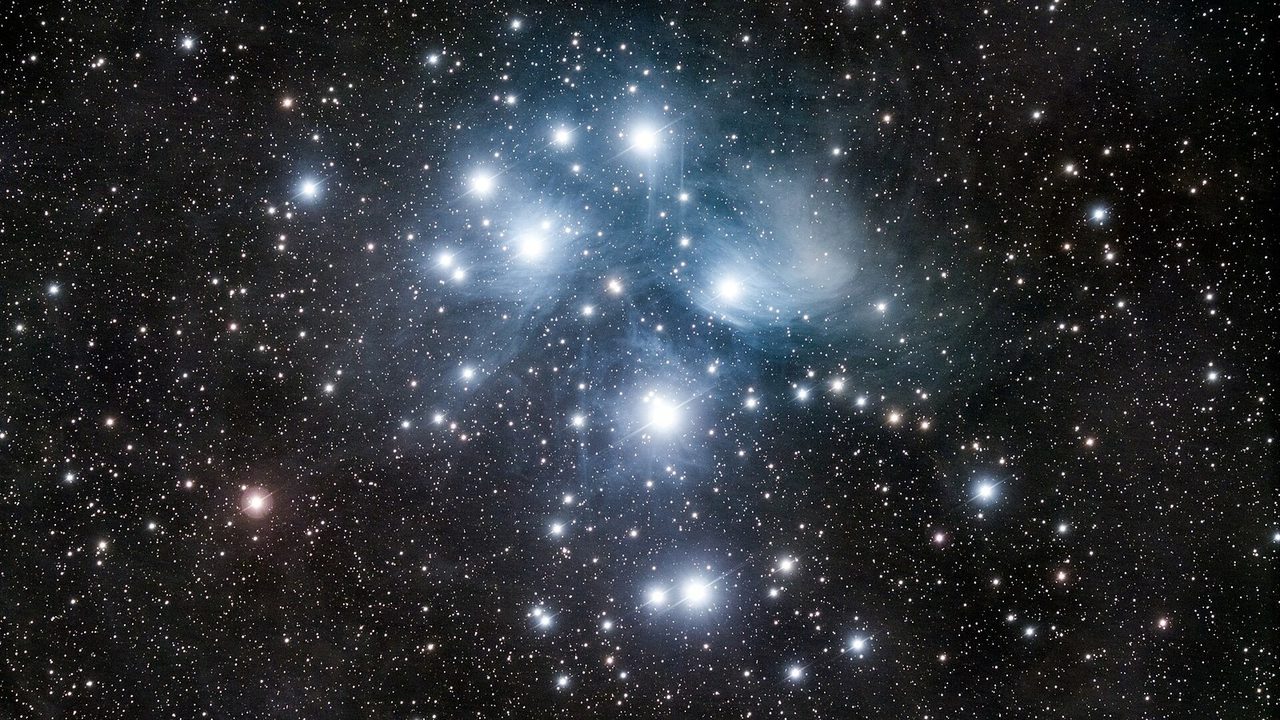
Why the Pleiades Are a Star Cluster, Not a Constellation, and How to Find Them
USD 22,28
Popular
The full Moon passing near the Pleiades on Nov. 24 has many people looking for the "Seven Sisters" for the first time. The cluster is often called a constellation, but it is not one, and knowing the difference helps explain how to find it and why a bright Moon makes it harder to see.
The Pleiades are a real physical group of stars, and they can be located on almost any clear autumn or winter night using a few easy markers, according to the stargazing site Star Walk.
Why a cluster is not a constellation
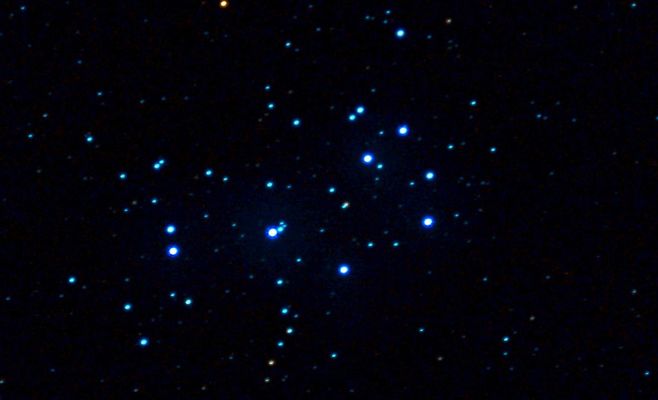
Star Walk explains that the Pleiades, also catalogued as M45 and known in some places as Subaru, are an open star cluster. That is a loosely bound group of a few dozen to a few thousand stars that formed together from the same giant cloud of gas at the same time.
A constellation is something different. It is one of 88 officially defined regions of the sky recognized by the International Astronomical Union, used mainly for mapping. Stars inside a constellation may look close together from Earth, but they are usually unrelated and can sit at very different distances. The Pleiades lie within the constellation Taurus, but they are a distinct object inside it. Star Walk says people confuse the two because the cluster makes a recognizable shape that resembles a small dipper.
How to find the Pleiades on any clear night
Star Walk suggests starting with Orion's Belt, the three bright stars in a straight line. Draw an imaginary line through them toward the bright orange star Aldebaran in Taurus. Then continue the line the same distance beyond Aldebaran, and a small blue-white cluster should come into view.
The cluster spans about 2 degrees, which Star Walk describes as four times the Moon's diameter. Under dark skies, most observers can pick out six stars with the naked eye.
When and where in the world it is visible
Because the Pleiades sit in the northern half of the sky, at about 24° N in declination, Star Walk says they can be seen from essentially all inhabited latitudes. They fail to rise only south of about 66°S. In the Northern Hemisphere the best viewing runs from October to February. In the Southern Hemisphere it runs from November to March.
What this means for your own viewing
Moonlight is the main obstacle on Nov. 24. Star Walk notes that the nearly full Moon is so bright that it may wash out many of the cluster's stars, and it recommends a telescope for a better view. Inkl reported that the Moon passes within 0.9 degrees of the cluster, while Star Walk lists the separation at conjunction as 0°56′. The two outlets express the gap differently.
What you see also depends on where you are. Star Walk publishes local viewing windows for the encounter, counting only the period when both the Moon and the cluster's brightest star, Alcyone, are at least 10° above the horizon and the Sun is more than 12° below it. Under that rule, the closest approach in Manila and Darwin happens before the sky is dark enough, so the listed best time is simply the start of the window. In New York, the two objects keep drawing closer after the window ends.
Star Walk also lists a lunar occultation, in which the Moon hides some of the cluster's stars from view. It says this is not visible from every location. Its app lets users change their location to watch how the event looks from other parts of the world.
What comes next
Inkl reported that this full Moon, popularly called the Beaver Moon, is the first of four consecutive supermoons spanning late 2026 and early 2027. Because the Pleiades are best placed from late autumn through winter in the Northern Hemisphere, the cluster will remain a regular sight in evening skies for months, though the Moon will not always be so close to it.
Earlier on Around Prague: Supermoon Slides Past the Seven Sisters Star Cluster Before Dawn on Nov. 24
Read next
The Pleiades: A Misty Dipper of Sibling Stars Visible From Almost Anywhere on Earth
Supermoon Slides Past the Seven Sisters Star Cluster Before Dawn on Nov. 24
Webb Telescope Finds Dense Star Clusters That May Have Birthed Black Hole Seeds
Around Prague, based on reporting by inkl, Star Walk
Cover photo: Stephen Rahn from Macon, GA, USA / Wikimedia Commons (public domain)