Unknown alloy found in Hiroshima sand — created by the 1945 atomic blast
USD 21,75
Popular
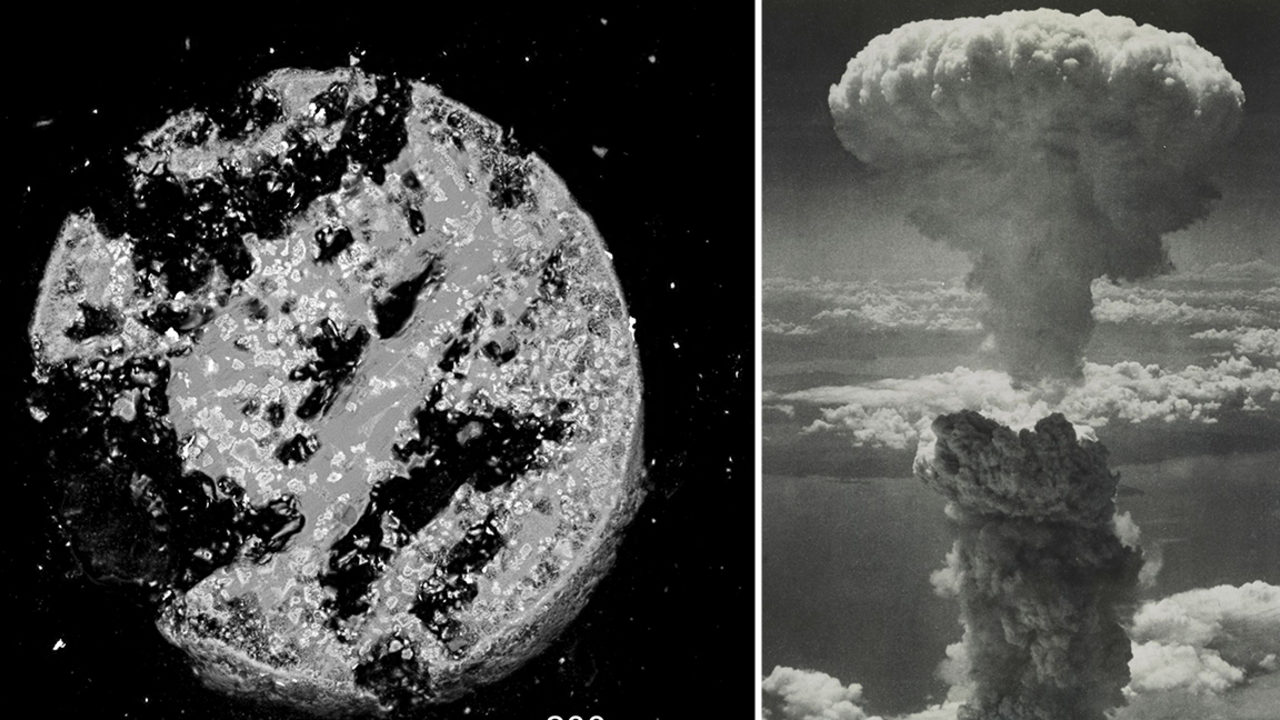
An international team of scientists led by Italian geologist Luca Bindi has discovered a microscopic particle of a previously unknown metallic alloy in sand from Hiroshima Bay, formed during the atomic explosion of August 6, 1945. The findings were published last week in the journal Science Advances.
The researchers analyzed 34 microscopic particles known in scientific literature as "Hiroshimaites" — spherules and fragments with a distinctive structure left behind after the bomb detonated over the Japanese city. Using electron microscopy, they identified metallic grains inside the particles, and the composition of one sample turned out to be a genuine surprise for the team.
It is an alloy of iron, chromium, nickel, manganese, molybdenum, aluminum and silicon with an ordered crystalline structure never before described in science. "We found only a single grain of the new alloy, so it appears to be extremely rare," Luca Bindi told Chemical & Engineering News.
According to the scientists, the alloy formed when a mixed metallic vapor condensed and then cooled at ultra-high speed inside the expanding fireball of the blast. In a fraction of a second, structural steel, aluminum alloys, glass, soil and other components of the city's buildings vaporized, mixing together in a superheated cloud before cooling abruptly — "freezing" the atoms into an unusual configuration before they could rearrange into a more stable form.
"Nuclear explosions are capable of creating new, complex alloys rather than simply melting or deforming existing materials," Bindi told Gizmodo. He noted that Hiroshima proved to be a uniquely rich environment precisely because the bomb detonated in the air above a densely built-up city: the fireball absorbed a far more diverse mix of construction, industrial and natural materials than would have occurred during desert tests or trials on remote islands.
Experts point out that multi-component alloys can offer high strength, corrosion resistance and stability at extreme temperatures, but in laboratories they are typically produced through tightly controlled metallurgical processes. In Hiroshima, however, the process occurred uncontrolled at temperatures exceeding 7,000 degrees Celsius. "The explosion essentially acted as a giant, random materials-science laboratory," Bindi described in an interview with IFLScience.
The discovery does not yet mean the new alloy will find practical use — scientists must first safely recreate it under laboratory conditions and study its mechanical, chemical and thermal properties.
As a reminder, the United States dropped an atomic bomb on Hiroshima on August 6, 1945 — the first use of nuclear weapons in armed conflict. The bomb, codenamed Little Boy, measured roughly three meters in length and weighed about four tons. It detonated at 8:15 a.m. local time nearly 600 meters above the city, with a yield equivalent to approximately 15,000 tons of TNT. The blast wave, extreme heat and radiation destroyed around 70% of the city's buildings; tens of thousands of people died instantly, and by the end of 1945 the death toll is estimated to have reached about 140,000. Three days later, on August 9, 1945, a second atomic bomb was dropped on Nagasaki.
Read also: Prague Metro: map and tickets
Source: novinky.cz