Science & Space By

Three Capsules Now Orbit Earth Growing Cancer Drug Crystals in Space
A California company has three small spacecraft circling Earth at the same time for the first time, and one of them is growing crystals of a potential cancer drug in weightlessness. The Guardian reported that Varda Space Industries launched two of the washing machine-sized capsules on Oct. 1 and a third on Oct. 20, calling it a step toward factories that make medicines in orbit.

The idea is still at an early, experimental stage. But if it works, drugmakers could gain new ways to shape their products, and some medicines that now need intravenous infusions might be reformulated as more convenient injections, according to the Guardian.

What the three capsules are doing about 300 miles up

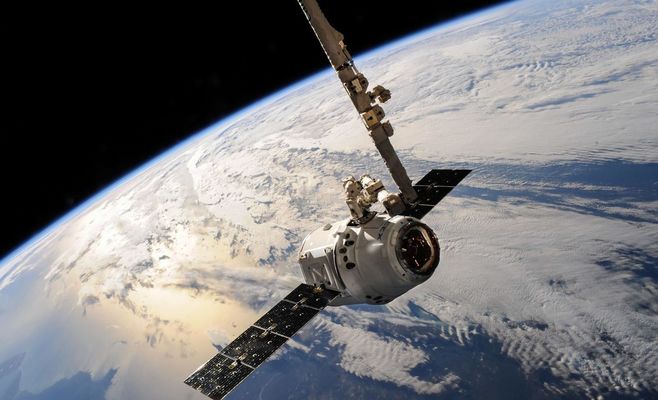
The spacecraft orbit roughly 300 miles above Earth, the Guardian said. One carries the cancer drug crystals. The other two are testing heat-protection materials and navigation systems for the return trip, when the capsules plunge back through the atmosphere at hypersonic speeds.

Varda's spacecraft ride into orbit on SpaceX rockets and carry miniature laboratories that run without astronauts. When the work is done, a capsule separates, falls through the atmosphere and lands by parachute in an uninhabited region. Will Bruey, Varda's chief executive, said the company is the first to launch multiple commercial re-entry vehicles at once. He said more frequent launches make the "crazy future" of space manufacturing more certain.

Why weightlessness helps crystals grow

On Earth, gravity makes particles in a liquid settle, and differences in density create currents. Both can disrupt crystal growth. Dr. Meganne Christian, a mission manager for in-space manufacturing at the UK-based Satellite Applications Catapult, said removing those effects lets crystals form in a more ordered way.

That matters for medicine because a drug crystal's size, shape and arrangement can change how easily it dissolves, how stable it is and how it can be given to patients. Semiconductors, used in devices from smartphones to electric vehicles, might also come out purer and with fewer defects when made in microgravity and without air, the Guardian reported.

Why it matters for patients and the drug industry

For patients, any effect is a long way off. The cancer drug in Varda's capsule is described only as a potential treatment, and the Guardian's account did not report results from the experiment. The nearest-term possibility it describes is a change in how existing kinds of drugs are formulated, not a new cure.

For drug developers, the draw is speed. Michael Reilly, Varda's chief strategy officer, said waiting a year, let alone 10 years, between experiments does not fit modern drug development. The International Space Station has hosted manufacturing research for decades, but Dr. Ryan Reeves of the ISS National Laboratory said it was not designed for manufacturing. He described it as mainly a "test kitchen" for ideas. The station is scheduled to retire around 2030.

Christian also cautioned that production in orbit will not be commercially viable for every application. Companies, she said, must find high-value uses where the benefits justify the expense.

Other companies are chasing the same market

Several firms are building commercial space stations to replace the ISS, and others are designing laboratories to fly on them. The UK-based BioOrbit recently sent a microwave-sized laboratory to the ISS as a step toward self-injected cancer drugs.

Cardiff-based Space Forge is taking a hybrid approach with semiconductors. Crystals grown in orbit would come back to Earth and serve as templates for growing larger quantities, much like a sourdough starter. Its first spacecraft, ForgeStar-1, recently demonstrated some of the needed processes but has not yet produced a finished material and returned it. Co-founder and chief technology officer Andrew Bacon said the company hopes to show the full process before 2030. He said it feels like "the start of a new Industrial Revolution," noting that when the company began in 2018 almost nobody was discussing the field.

What comes next

Varda has already returned several capsules from orbit. It plans seven more missions in 2027 and 10 in 2028. The Guardian said falling launch costs and more frequent commercial rocket flights have fed the optimism, though the central test remains whether orbital production can justify its cost.

Around Prague, based on reporting by The Guardian
Share: Telegram WhatsApp

More science news

Astronaut Captures Chicago and Detroit Glowing Before Dawn From Space
An astronaut aboard the International Space Station photographed the central and eastern United States in the dark hours before sunrise on Oct. 18, 2026. The image shows cities and highways glowing be
Radio Images Suggest Betelgeuse's Tiny Companion Skims Through Its Gas
Astronomers say new radio observations offer fresh evidence that a small companion star, named Siwarha, is traveling through the extended atmosphere of Betelgeuse, the red supergiant that marks the sh
Medieval Deforestation Set Up Italian Lake Tsunamis With Waves Over 50 Meters
Two huge tsunamis that struck Lake Iseo in northern Italy in the Middle Ages were partly the result of human activity, according to a new study in Nature Communications. Computer simulations suggest w
NASA Seeks Ideas to Save Hubble Before It Falls From Orbit in 2033 or 2034
NASA has reopened the question of how to keep the Hubble Space Telescope alive. On Oct. 29, the agency issued a request for information asking companies what they could do to service the observatory,
Three NASA Astronauts Vote in Midterms From the Space Station
Three NASA astronauts living on the International Space Station voted in the U.S. midterm elections on Nov. 3 without leaving orbit. Anil Menon said he, Luke Delaney and Jessica Watkins each filled ou
NASA's Swift Space Telescope Could Fall to Earth Within Hours
NASA's Neil Gehrels Swift Observatory, a space telescope that has been falling steadily out of orbit, could re-enter Earth's atmosphere as early as tonight, the agency says. Live Science reported that

Related news

An astronaut aboard the International Space Station photographed the central and eastern United States in the dark hours before sunrise on Oct. 18, 2026. The image shows cities and highways glowing beneath a thin band of colored light on th
Astronomers say new radio observations offer fresh evidence that a small companion star, named Siwarha, is traveling through the extended atmosphere of Betelgeuse, the red supergiant that marks the shoulder of Orion. According to a summary
Two huge tsunamis that struck Lake Iseo in northern Italy in the Middle Ages were partly the result of human activity, according to a new study in Nature Communications. Computer simulations suggest waves in the northern part of the lake ex
NASA has reopened the question of how to keep the Hubble Space Telescope alive. On Oct. 29, the agency issued a request for information asking companies what they could do to service the observatory, according to Space.com. Hubble is workin
Three NASA astronauts living on the International Space Station voted in the U.S. midterm elections on Nov. 3 without leaving orbit. Anil Menon said he, Luke Delaney and Jessica Watkins each filled out an electronic ballot and sent it to el
NASA's Neil Gehrels Swift Observatory, a space telescope that has been falling steadily out of orbit, could re-enter Earth's atmosphere as early as tonight, the agency says. Live Science reported that NASA's latest estimate, shared Nov. 2,
Astronomers are still waiting for the Blaze Star to erupt, and a new study suggests the first sign of the blast might not be light at all. According to EarthSky, researchers have proposed that neutrinos, tiny particles that barely interact
Dense star clusters in two very early galaxies seen by the James Webb Space Telescope may have been birthplaces for intermediate-mass black holes, according to a new study reported by Universe Today. Such black holes are thought to be the s
Radiation like that astronauts would face on a trip to Mars may raise the risk of a dangerous heart condition, a new study in rats suggests, according to Live Science. The effect appeared long after exposure, which leads the authors to argu
Paris Jackson, the daughter of Michael Jackson, has asked a Los Angeles court to order that $600 million from her father's estate be moved into a family trust for her and her siblings. PEOPLE reported the petition on Nov. 2, and Star News K
A new study suggests that people in prehistoric Japan were more resourceful after a catastrophic volcanic eruption than researchers had assumed. According to ScienceAlert, some regions were left uninhabitable for a very long time, but in ot
The Vera C. Rubin Observatory has spotted two previously unknown companions of the Milky Way: a probable dim dwarf galaxy and a faint globular cluster. Universe Today reported that both turned up in the observatory's Early Data Preview 2, r