App to Recognize Landmarks and Buildings: Prague Styles Walk
USD 22,28
Popular
From St Vitus Cathedral to the Dancing House is about 5.2 km on foot, roughly 70 minutes of walking without stops, and it passes through six centuries of building. Four styles do most of the work: Gothic at the Castle, on the bridge and on Old Town Square, Baroque in Malá Strana, Art Nouveau at the Municipal House and Cubism on Celetná. Each has two or three tells you can read from the pavement. The streets and squares are free; the paid interiors on the route cost 150-450 CZK. Prices and hours below were checked on the official websites on 25 November 2026.
The route below names the main buildings. For the unnamed houses in between, an app to recognize landmarks and buildings fills the gap: a photo in Chiaro gives the name and the builder.
The route at a glance
| Stop | Style | Look for | Walk to next stop | Inside |
|---|---|---|---|---|
| St Vitus Cathedral | Gothic and neo-Gothic | pointed arches, pinnacles, the rose window | about 10 min, 700 m, down steps | 450 CZK Castle circuit |
| St Nicholas, Malá Strana | Baroque | a curved front, a green dome | about 10 min, 800 m | 150 CZK |
| Old Town Bridge Tower | Gothic | a pointed gate arch, statues on the east face | about 10 min, 750 m | 250 CZK |
| Týn Church | Gothic | two spiky towers behind a row of houses | 4 min, 300 m | 50 CZK donation |
| House of the Black Madonna | Cubist | angled window bays, a statue in a cage | 3 min, 250 m | 150 CZK museum |
| Powder Tower and Municipal House | neo-Gothic and Art Nouveau | a dark tower beside a gilded mosaic | about 30 min, 2.2 km | 200 CZK tower, 320 CZK tour |
| Dancing House | 1990s | the glass "dancer" on the corner | - | 230 CZK gallery |
Distances come from OpenStreetMap walking routes and are rounded. Allow half a day with two interiors.
How to read a facade
- Gothic, 14th-16th century. Pointed arches over doors and windows, stone tracery, pinnacles and gargoyles, everything pulling upwards.
- Baroque, 17th-18th century. Fronts that bulge out and curve back in, domes, heavy cornices, statues standing on the roofline.
- Art Nouveau (secese), around 1900-1914. Mosaics, gilding, coloured glass, ironwork shaped like plants, female figures.
- Czech Cubism, around 1911-1914. Walls and windows folded into facets, as if cut from crystal. Czech architects took the painters' Cubism and turned it into houses, and Prague is where they built them.
The trap is neo-Gothic, a 19th-century copy of Gothic. One architect, Josef Mocker, turns up at three stops on this walk.
St Vitus Cathedral: real Gothic and a neo-Gothic front
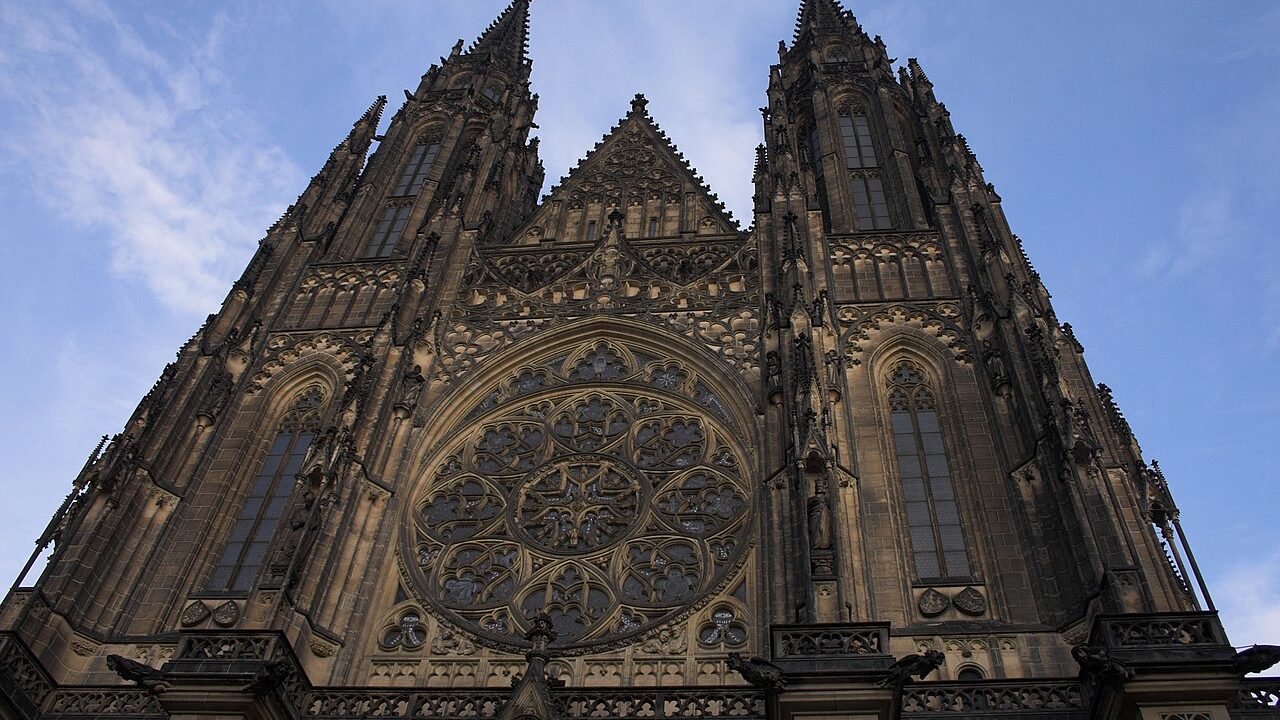
The west front, the side you reach first from the second courtyard, looks Gothic in every detail: two towers, 82 m high, a rose window 10 m across, pointed portals. It is the newest part of the building. According to the cathedral's own website, the whole western half, with the nave and the west front, was built only in the second half of the 19th century by Josef Mocker and finished in the 20th century by Kamil Hilbert. František Kysela designed the rose window, and the cathedral was consecrated in 1929.
For the medieval half, walk into the third courtyard, which is free, and look at the south side. Matthias of Arras began this end in 1344, and after his death Peter Parler, aged 23, took over. The porch is the Golden Gate, with a mosaic of the Last Judgement from the 1370s; the Golden Gate stop on Chiaro's audio guide for Prague Castle plays from right here in the courtyard. Above it rises the Great South Tower, almost 100 m high, straight up from the courtyard paving: a Gothic body with a Renaissance gallery and a later cap on top.
To tell the halves apart, compare the stone. The medieval work is uneven, darker and patched, and the carving has softened. The neo-Gothic west half is sharp, regular and symmetrical.
- Cathedral hours: Monday-Saturday 9:00-17:00, Sunday 12:00-17:00, last entry 20 minutes before closing. The Castle's English pages still give 16:00 in winter, so plan to be done by then. No tourist visits during services.
- Ticket: Prague Castle main circuit, 450 CZK, reduced 300 CZK, family 950 CZK. The South Tower climb is 200 CZK.
- Grounds: courtyards open daily 6:00-22:00, free.
St Nicholas Church, Malá Strana
St Nicholas fills the middle of Malostranské náměstí, ten minutes down the New Castle Steps (Zámecké schody) and Thunovská.
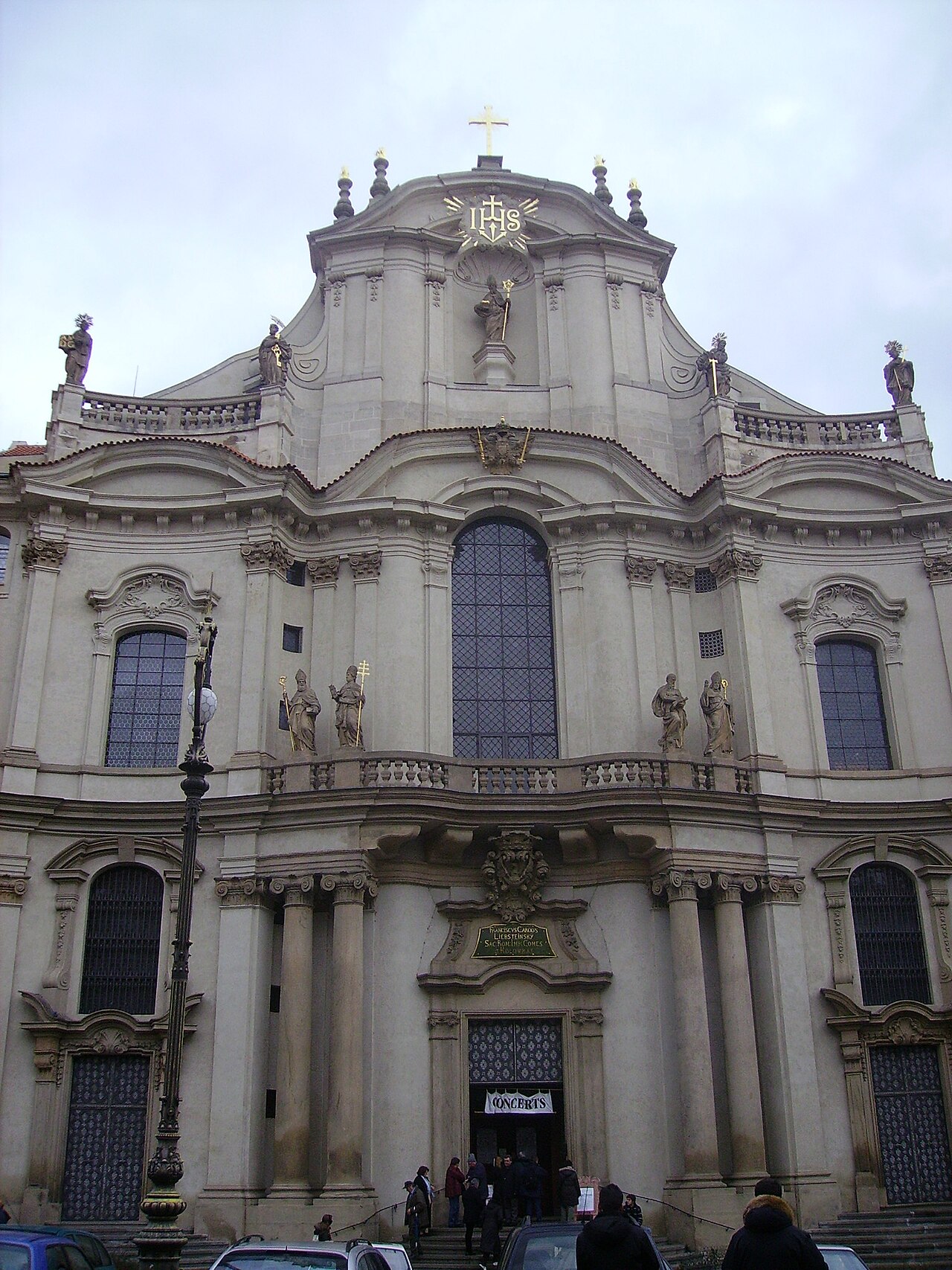
The facade was finished in 1710. It is built in waves of concave and convex forms, with three gables over the raised centre and a statue of St Nicholas on top. Three architects from one family, father, son and son-in-law, worked on the church over about a hundred years: Kryštof Dientzenhofer, Kilián Ignác Dientzenhofer and Anselmo Lurago.
The green dome is 20 m across and stands 79 m high, the same height as the slender belfry beside it. The belfry is owned by the city, and Lurago finished it in 1751-56. From the square the pair is hard to get into one frame; the 0.5x camera added to Chiaro in November 2026 fits the whole church in a single photo.
If you pay for one interior on this walk, we would make it this one. It costs a third of the Castle circuit, and the inside reaches almost 57 m to the top of the lantern, the tallest interior in Prague.
- Hours: November daily 9:00-17:00 (9:00-16:00 on 27 and 28 November); December Friday-Saturday 9:00-16:00, Sunday-Thursday 9:00-17:00. Last entry 15 minutes before closing.
- Ticket: 150 CZK, seniors and students 90 CZK, under 10 free. Cash or card at the church box office only; the Prague Visitor Pass is not accepted.
Old Town Bridge Tower: Peter Parler's Gothic gate
Mostecká street runs from the square through the Lesser Town Bridge Towers onto Charles Bridge; the self-guided tour of Charles Bridge runs the other way and ends under those towers. The Old Town Bridge Tower waits at the far end, and its best side faces Křižovnické náměstí, so cross and turn round.
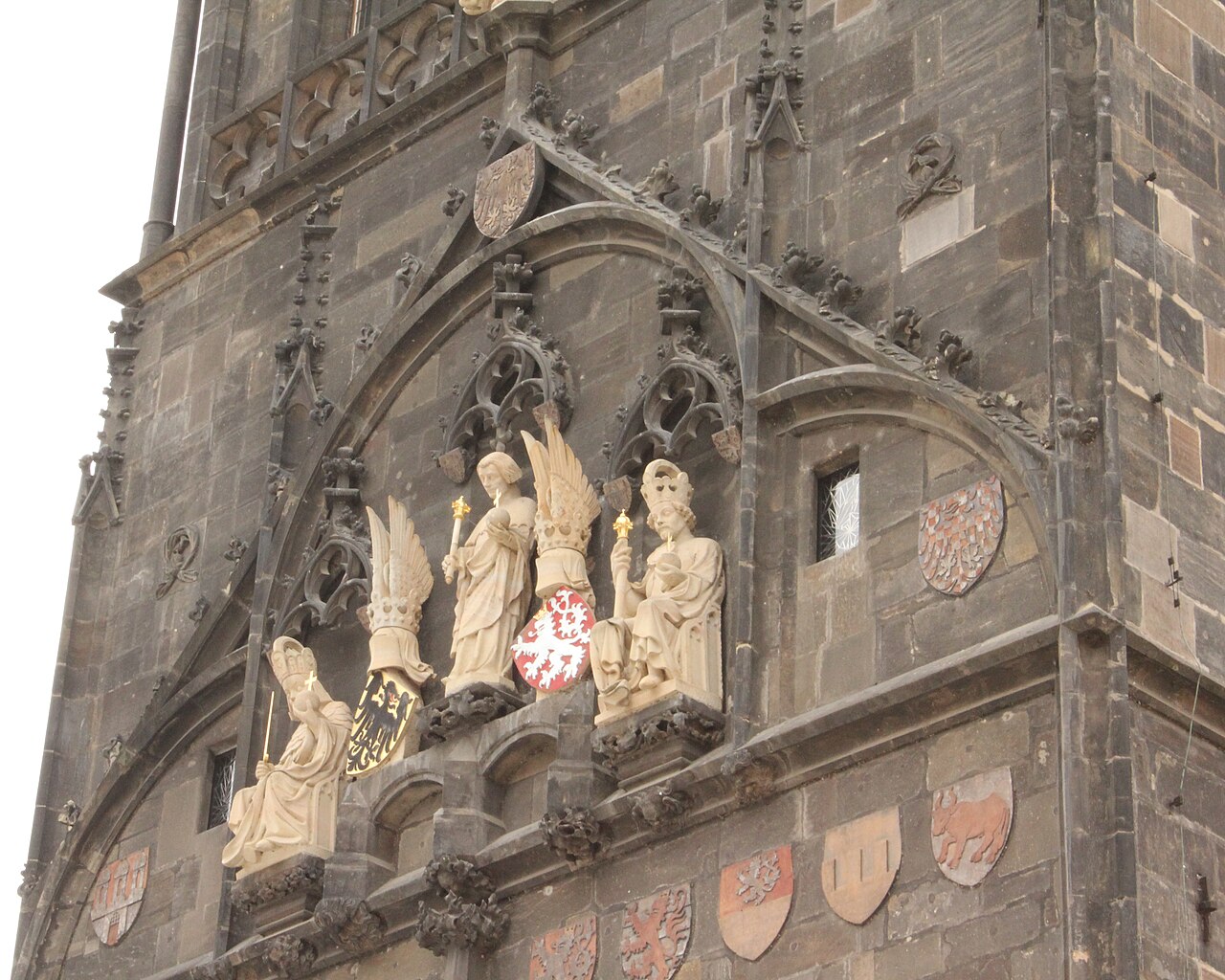
Peter Parler designed it in the second half of the 14th century, and Josef Mocker reconstructed it in 1874-78. The east face has the whole Gothic vocabulary: a pointed gate arch, tracery framing the figures, coats of arms in a row below. In the middle St Vitus stands on a model of a bridge, with Charles IV as an older man and his son Wenceslas IV as a young one seated on either side. Above them stand St Adalbert and St Sigismund. The statues date from 1380-1400 and the originals are in the National Museum's Lapidarium, closed for now.
- Old Town Bridge Tower: 250 CZK, reduced 170 CZK, 138 steps, about 47 m. Open 10:00-18:00 in November. The first hour after opening is half price.
Týn Church
The Church of Our Lady before Týn stands behind the houses on the east side of Old Town Square, ten minutes from the bridge along Karlova, so from the square you see its two towers rising over their roofs.
Those towers show Gothic at city scale: steep and pointed, each ringed with small spires. Prague City Tourism gives them 80 m, the south one, Adam, about a metre taller than Eve to the north. Building ran from the mid-14th century to the early 16th, and the south tower was finished in 1511.
You enter through a passage from the square at number 14.
- Hours: closed Monday; Tuesday-Saturday 10:00-13:00 and 15:00-17:00, Friday afternoon from 15:30. Sunday hours differ between the church's site and the city's, so check before you go.
- Entry: voluntary donation, 50 CZK suggested. No photography inside.
House of the Black Madonna
The House of the Black Madonna stands at the corner of Celetná and Ovocný trh, four minutes east of Týn.
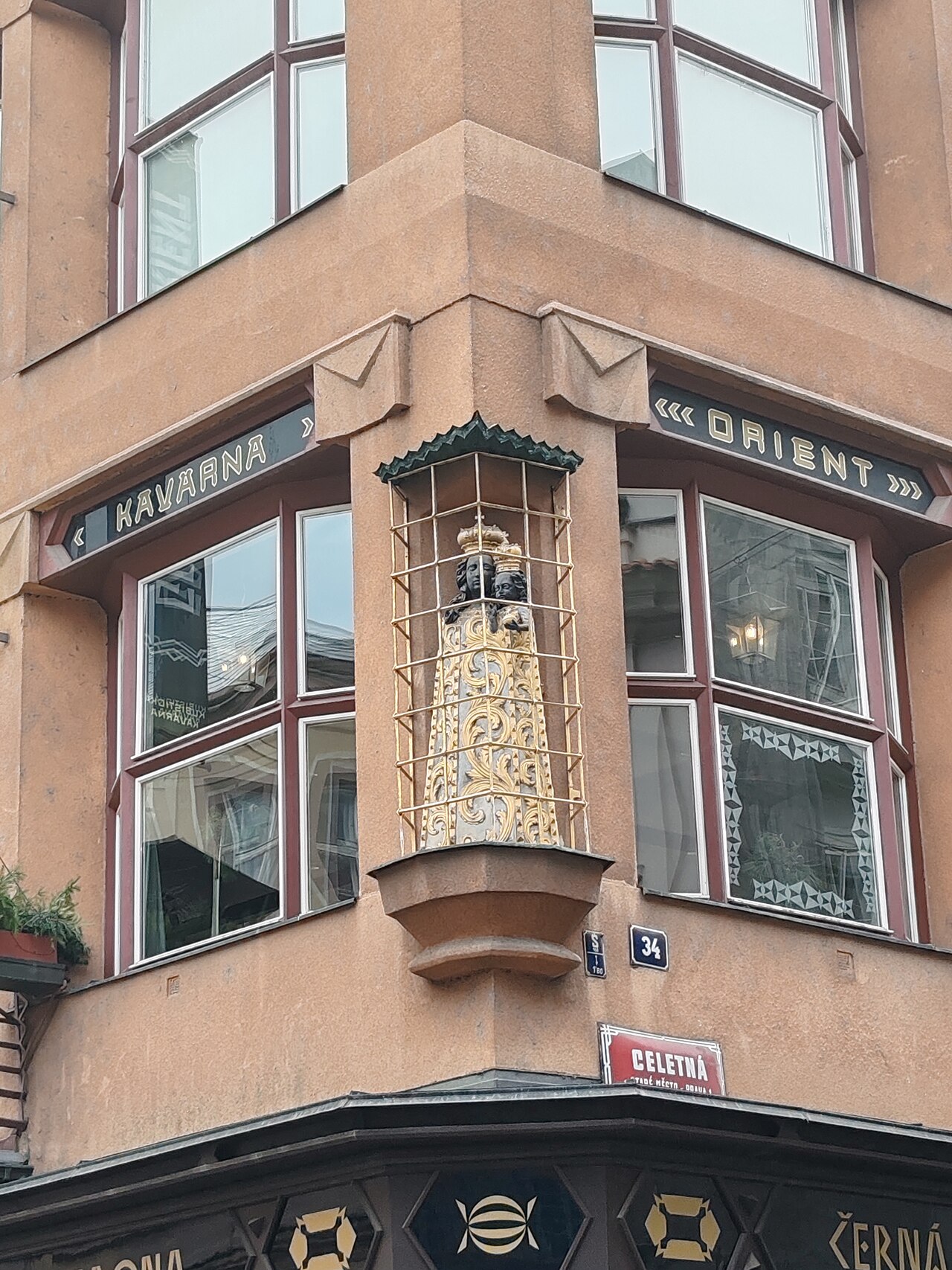
Josef Gočár designed it in 1911-12. Look at the window bays: they fold forward in angled planes, and the cornices and pilasters break into facets. On the corner, behind a gilded cage, stands the Black Madonna, a copy of a 17th-century statue that came from the earlier Baroque house on this spot.
The Museum of Decorative Arts runs a permanent Czech Cubism exhibition on the second and third floors. If you came for the art as much as the buildings, Chiaro is an app for art lovers too: in the museum a photo of a Cubist chair or vase brings up its designer. On the first floor, the Grand Café Orient is Gočár's Cubist café, and it bills itself as the only Cubist café in the world. It is open daily, 9:00-21:00 on weekdays and 10:00-21:00 at weekends.
- Museum: Tuesday 10:00-20:00, Wednesday-Sunday 10:00-18:00, closed Monday. 150 CZK, reduced 80 CZK.
Powder Tower and Municipal House: neo-Gothic beside Art Nouveau
Celetná ends three minutes on at the Powder Tower. Its foundation stone was laid in 1475 and Matěj Rejsek took over the work in 1478. Today's look, though, dates from 1875-86, when Josef Mocker restored and completed it in what Prague City Tourism calls pseudo-Gothic style.
The Municipal House is joined to it on the left. Antonín Balšánek and Osvald Polívka built it in 1905-1912 on the site of the medieval Royal Court. Over the main entrance, above a curving iron and glass canopy, is Karel Špillar's mosaic Apotheosis of Prague. Gilding, coloured glass, plant ornament and figures: everything on the Art Nouveau list above.
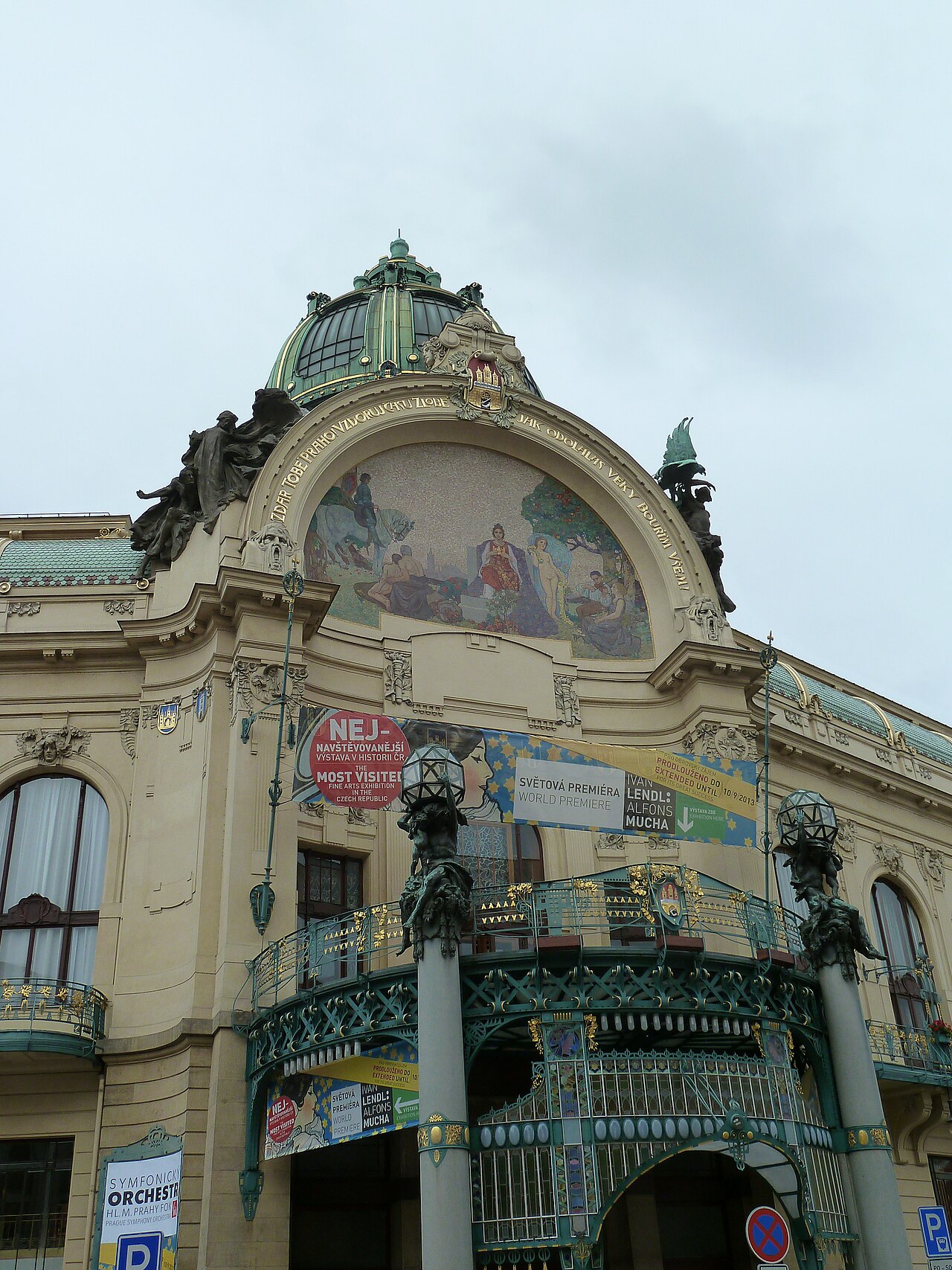
Inside, Alfons Mucha decorated the Mayor's Hall. The guided tour is the only way into the ceremonial halls.
- Municipal House tour: about an hour, in English or Czech, 320 CZK, reduced 270 CZK, family 660 CZK. Box office 10:00-19:00.
- Powder Tower: 200 CZK, reduced 130 CZK, 186 steps to the gallery at 44 m. Open 10:00-18:00 in November.
Dancing House
The last stop is about 30 minutes away on the river, best reached via Jungmannovo náměstí. At the back of that square, by the Adam pharmacy, stands a Cubist street lamp by Emil Králíček from 1913; Prague City Tourism calls it the only one of its kind in Prague. From there walk down to the embankment and south along it.
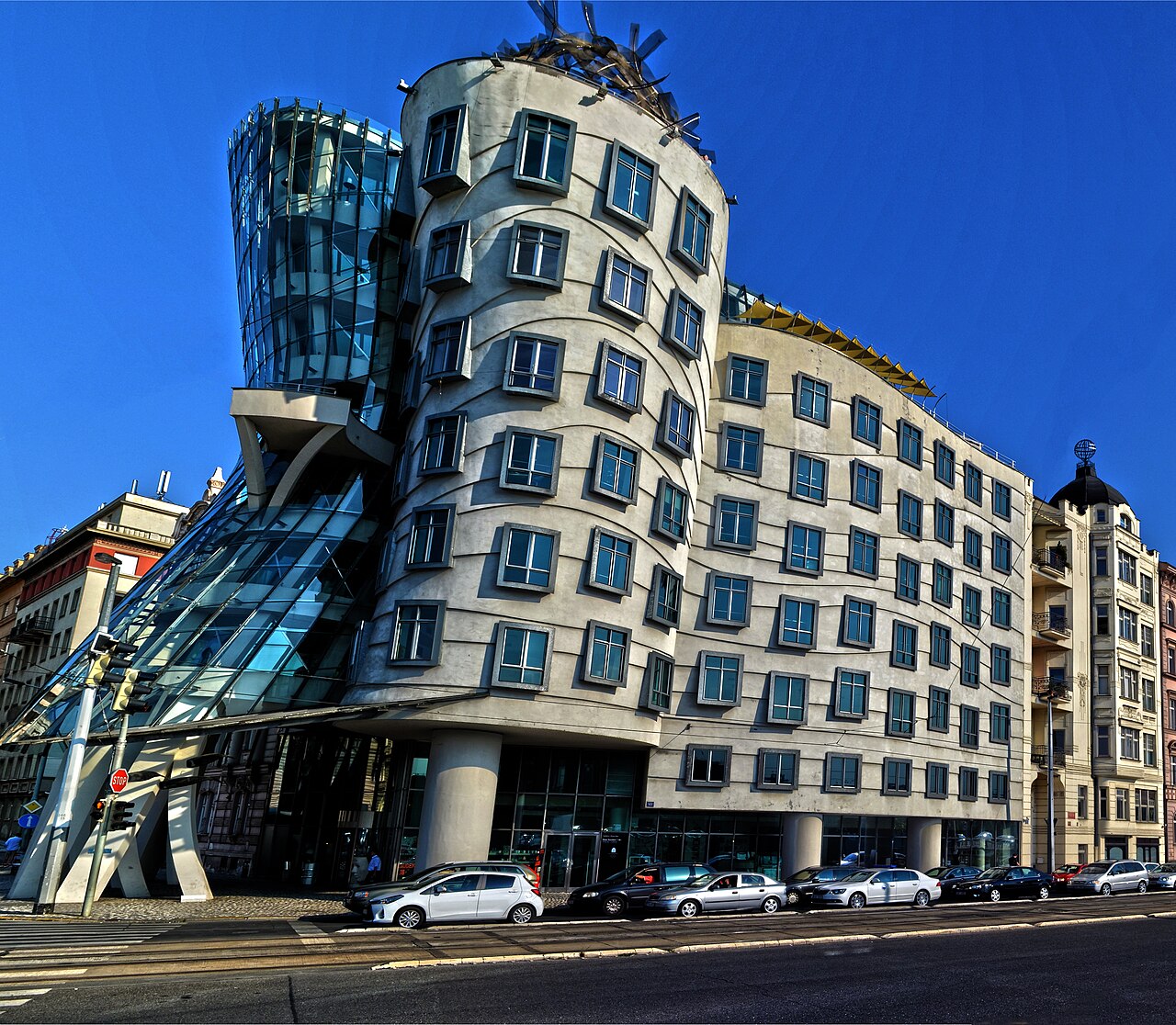
Vlado Milunić and Frank Gehry built the Dancing House in 1992-1996 on the corner of Rašínovo nábřeží and Jiráskovo náměstí, and it is nicknamed Ginger and Fred. The Vltava runs just across the embankment road. It fits none of the four styles.
- Galerie Tančící dům: daily 9:00-20:00, 230 CZK, students and seniors 185 CZK.
- Glass Bar on the rooftop terrace: daily 10:00-22:00.
Getting there and timing
- Start: tram 22 or 23 to Pražský hrad, then walk through the courtyards to the cathedral.
- Timing: in winter the cathedral may close as early as 16:00, so start by 10:00 if you want St Vitus and St Nicholas inside.
- Services: the cathedral closes to tourists during services, so check the daily programme on its website before you climb the hill.
- Steps: the New Castle Steps are a long staircase. With a pram, take tram 22 down to Malostranské náměstí instead.
- End: from the Dancing House, the nearest metro is Karlovo náměstí, line B.
Prague architecture walk: FAQ
How long is the Prague architecture walk?
About 5.2 km and 70 minutes of walking. With the cathedral, St Nicholas and a coffee at the Orient, plan four to five hours.
How do I tell real Gothic from neo-Gothic on the walk?
Check the date. Gothic-looking work from after 1850 is neo-Gothic. On this walk that means the cathedral's west half, begun to Josef Mocker's design in 1873, and the Powder Tower's present look, from Mocker's restoration of 1875-86.
Which buildings on the route are free?
All the facades, the Castle courtyards, Charles Bridge and Týn Church, where entry is by donation.
Is the Black Madonna museum open in winter?
Yes, Tuesday to Sunday. It is closed on Mondays.
By the Around Prague newsroom