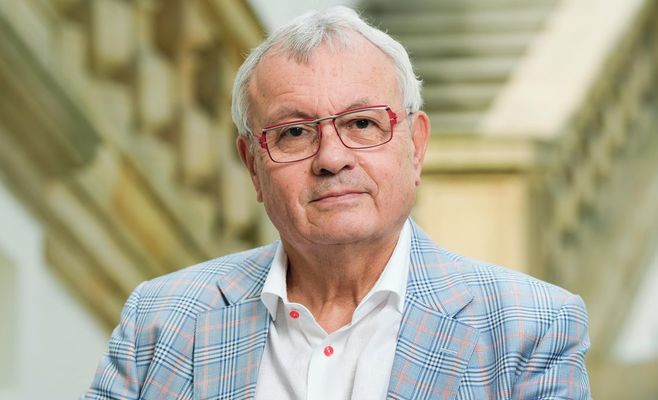
Ex-Minister Dlouhý: Europe is losing competitiveness and won't return to global leadership
USD 21,75
Popular
Former Czech Industry and Trade Minister Vladimír Dlouhý says the European Union has been losing economic ground to the US and China for decades, with India, Indonesia and Brazil now entering the competition as well. According to him, reversing this trend is by now practically impossible, though slowing the decline is still within reach.
According to figures cited by Dlouhý, in the year 2000 the EU economy — which then still included the United Kingdom — was roughly equal in size to that of the United States. Today, even including Britain, the EU economy amounts to only about two-thirds of the American one. The ex-minister also recalls the 2000 Lisbon Strategy, when the European Commission set the goal of making Europe the world's most competitive region by 2010 — a target that, as he puts it, looks "rather amusing" today.
Among the causes of this lag, Dlouhý points to Europe's postwar socio-economic model, which initially helped avoid crises after the Great Depression but over time evolved into deep state intervention in the economy — through worker and consumer protections, climate policy, and ESG rules (environmental, social, and governance). In his view, this "European way of life," for all its comfort, has become one of the main reasons behind the continent's economic decline.
The ex-minister is skeptical that European society is willing to change anything: people over fifty oppose raising the retirement age, forty-somethings demand a four-day work week, thirty-somethings push for tighter ESG rules, and Generation Z is focused above all on income redistribution. According to Dlouhý, European policy increasingly tries to achieve its goals through directives and regulation, while businesses are forced into costly preparations for new rules — costs that ultimately get baked into prices and undermine competitiveness. This hits small and medium-sized enterprises hardest, since they cannot pass the costs on to consumers.
On climate targets, Dlouhý believes they cannot be achieved through regulation and unrealistic deadlines alone. In his view, the key question is whether climate change is really such a short-term threat that it justifies deliberately slowing economic growth and productivity. The ex-minister thinks it is not, and that the threat would only become existential if Europe failed to respond to it through science, technology and investment. He notes that Europe isn't falling behind in research itself, but in commercializing it — in areas such as renewable energy, infrastructure and artificial intelligence. In a provocative forecast, he suggests that by 2060 it may turn out that the US and China have actually done more to fight climate change than Europe has, even though today the impression is the opposite.
Dlouhý calls on the EU to ease regulation while at the same time deepening integration of the single market — especially the capital market. According to his figures, private savings in the EU amount to roughly €33 trillion (about 800 trillion Czech crowns), of which €10 trillion — around 70% of household savings — sits in bank deposits earning low returns. Meanwhile, an estimated €300 billion flows out to American markets every year. In the ex-minister's view, the EU needs to remove barriers to cross-border business and simplify financing for European companies, so that successful startups no longer have to go abroad to the US in search of capital. Europe, he believes, is unlikely to fully return to the global economic elite — but by making better use of the single market, capital, and its technological potential, it could at least stop falling further behind.