The Pleiades: A Misty Dipper of Sibling Stars Visible From Almost Anywhere on Earth
USD 22,26
Popular
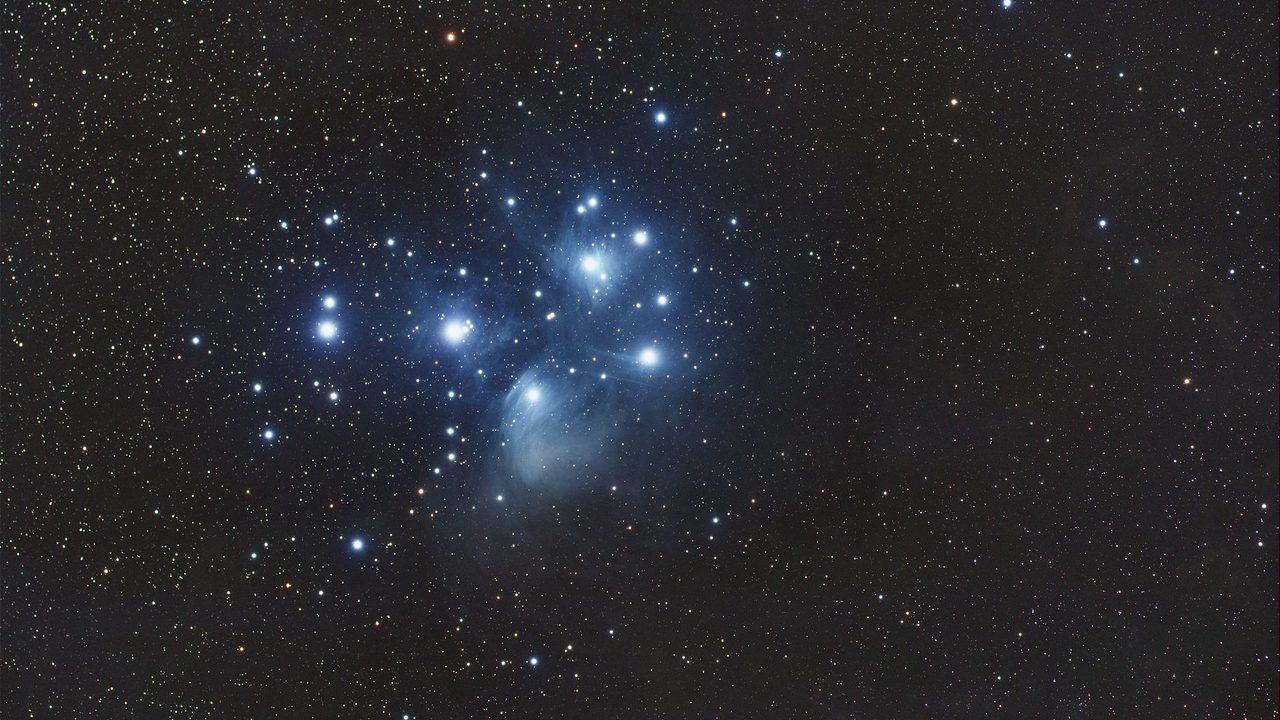
The Pleiades star cluster, also called the Seven Sisters or Messier 45, can be seen from almost every part of the globe, according to EarthSky. It appears as a tiny, misty dipper of stars, and November is the month when it shines from dusk until dawn for Northern Hemisphere observers.
Astronomers say the cluster's stars were born from the same cloud of gas and dust some 100 million years ago. EarthSky reports that they still travel through space together.
A family of stars, in myth and in science
Many ancient cultures told stories about the Pleiades. In Greek mythology, they were the seven daughters of the Titan Atlas and the oceanid Pleione: Maia, Electra, Alcyone, Taygete, Asterope, Celaeno and Merope. According to a Polynesian legend, the cluster was once a single star, the brightest in the sky, until the god Tane smashed it to pieces for bragging about its beauty.
Modern astronomy also treats the stars as siblings. The Pleiades is an open star cluster, a gravitationally bound group of several hundred stars about 440 light-years away. They drift through space at about 25 miles per second (40 km per second), and many shine hundreds of times more brightly than the sun. EarthSky says astronomers recently found that more than 3,000 sibling stars came from the same giant molecular cloud.
How to find the cluster
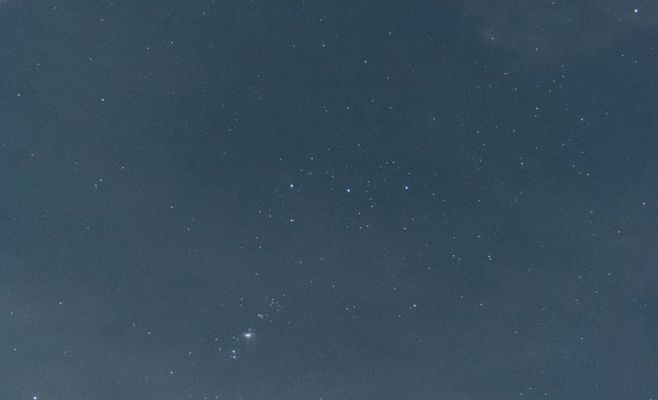
EarthSky suggests starting with Orion the Hunter. Draw a line through the three stars of Orion's Belt toward a V-shaped pattern, which marks the face of Taurus the Bull. The bright star in that V is Aldebaran, the Bull's Eye. Continue a bit past Aldebaran and the Pleiades appear, marking the Bull's Shoulder.
In the Northern Hemisphere, the cluster is linked with the approach of winter. EarthSky describes it as a patch of icy-blue suns, like frost clinging to the night sky. It stays visible in the evening sky well into April.
The name Aldebaran comes from an Arabic word for follower, which is thought to refer to the star's endless chase of the Pleiades across the sky. As a rule, the cluster rises and sets before Aldebaran does. The exception is at far southern latitudes such as Tierra del Fuego in South America, where the Pleiades rise a short while after Aldebaran.
The legend of the lost sister
Most people see six stars, not seven, in a dark country sky. Even so, EarthSky says the story of a lost seventh sister appears in cultures around the world. The astronomer Robert Burnham Jr. found it in the star lore of European, African, Asian, Indonesian, Native American and Aboriginal Australian peoples.
Burnham suggested the legend may have a basis in fact. The seventh-brightest star in the cluster, Pleione, is a complicated shell star that goes through many changes, and those changes can make its brightness vary.
Some people with exceptional eyesight have reported seeing many more stars, with claims going as high as 20. EarthSky also cites writer and astronomer Agnes Clerke, who reported that Michael Maestlin, the mentor of Johannes Kepler, mapped 11 Pleiades stars before the telescope was invented.
What this means for skywatchers
Spotting more than six or seven stars takes very good eyesight or a pair of binoculars, plus time under a dark, moonless sky. EarthSky cites dark-sky observer Stephen O'Meara, who claims that eyes adapted to the dark for 30 minutes are six times more sensitive to light than eyes adapted for 15 minutes. According to EarthSky, the surest way to see additional stars is to use some optical aid.
Because the cluster is visible from the North Pole to beyond the southern tip of South America, it is an easy target for observers almost anywhere, and November evenings are a good time to look.
Around Prague, based on reporting by EarthSky