Telescope Finds a 26-Light-Year Gas Jet, Hinting at a Black Hole Next Door
USD 21,70
Popular
A team of Japanese astronomers has found a jet of cold molecular gas stretching 26 light-years from LMC P3, a strong gamma-ray source in the Large Magellanic Cloud, according to Universe Today. The finding strengthens the case that the object is a microquasar powered by a black hole, though the researchers still describe the black hole as a possibility.
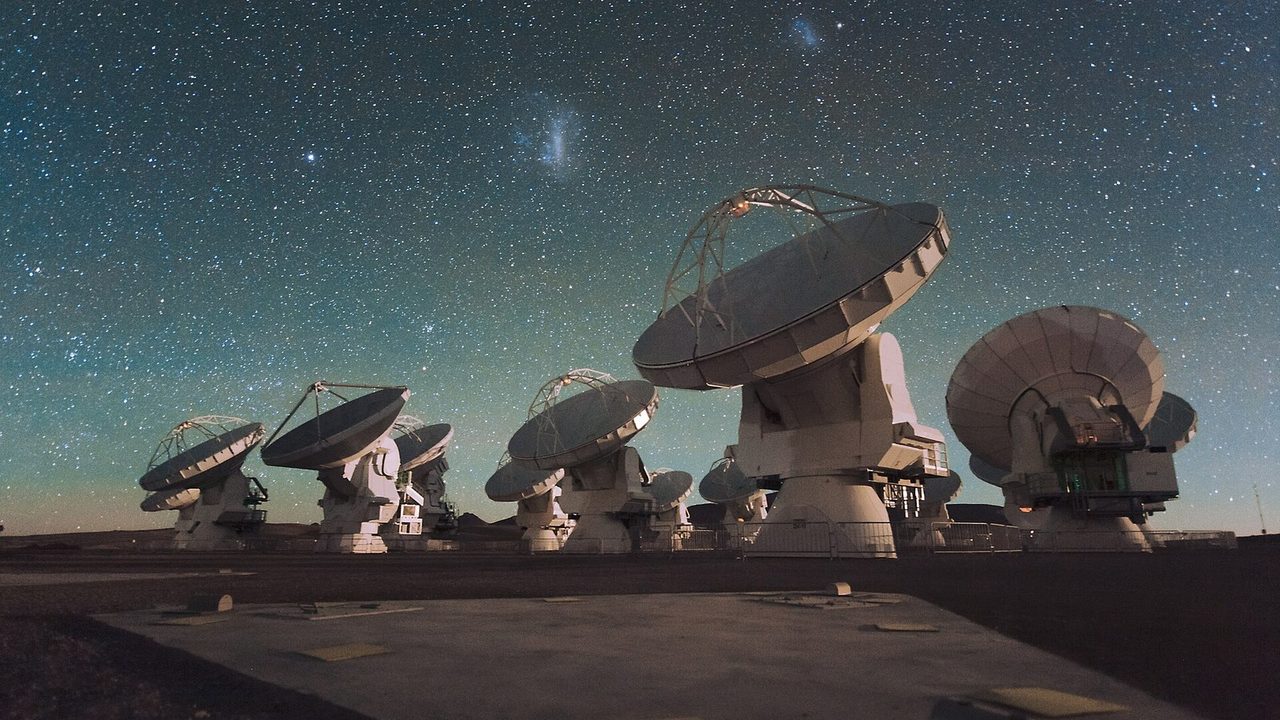
The team used the Atacama Large Millimeter/Submillimeter Array, or ALMA, in Chile. Instead of following the gamma rays, they mapped radio emission from carbon monoxide gas in the cloud around LMC P3.
What is LMC P3?
LMC P3 sits inside the remains of a supernova and was first found in 2016 because of its very strong gamma rays. Universe Today reports it was the first such object discovered outside the Milky Way. It pairs a giant O-type star with a compact object that could be either a black hole or a neutron star. Fermi observations found a 10.3-day cycle in its gamma-ray emission.
The pulsar explanation
One long-standing idea held that a pulsar was behind the emission. In that picture, a spinning neutron star sends out streams of energetic particles in pulses. The supernova remnant around LMC P3 fits part of this story, Universe Today says, but not all of it.
The microquasar explanation
The rival idea is that LMC P3 is a microquasar: a black hole or neutron star pulling material from its companion star into a swirling disk. That process produces X-rays, gamma rays and fast jets. The ALMA team reported a gigantic molecular jet, according to Yasuo Fukui of Nagoya University, who worked with team leader Bhuvana Gadikere Rajendra of Gifu University.
The gas in the jet is heated to about 35 to 60 Kelvin, compared with about 15 Kelvin for the surrounding gas. Fukui said that warmth over so much of the cloud strongly suggests the gas is being struck by a high-energy jet from the compact object, the same kind of jet that could drive the gamma rays.
The researchers wrote in their paper that shock heating from a microquasar jet best explains the high temperatures, and that the jet matches predictions from simulations. They said the result lends support to the idea that material falling onto the compact object is the source of the gamma rays.
Why it matters: what is still unsettled
Because black holes drive more powerful jets than neutron stars, and LMC P3's gamma-ray emission is especially high, Universe Today describes the cold jet as pointing toward the microquasar explanation. Fukui said it gives very strong support to the possibility that the central object is a black hole. That is still a claim about likelihood, and the object has not been shown to be a black hole beyond doubt.
The result also matters beyond one object. The team says it offers new insight into how compact objects behave and interact with their surroundings, alongside continuing studies of SS 433, the first microquasar ever found.
Read next
Black Hole Jets Light Up Gas Far Beyond a Galaxy’s Stars, Study Finds
Hunting Lone Black Holes Within 50 Light-Years of Earth, Hidden in Gas Clouds
Webb Telescope Finds Dense Star Clusters That May Have Birthed Black Hole Seeds
Around Prague, based on reporting by Universe Today
Cover photo: ESO/C. Malin / Wikimedia Commons, CC BY 4.0, cropped