Czech beavers near Pohorelice: avoiding conflict with people
USD 21,59
Popular
Scientists at Mendel University in Brno studied the Eurasian beaver population in pond country near the town of Pohorelice in southern Moravia and found that long-term monitoring of the animals helps prevent conflicts with farms before they happen. The researchers recorded four active beaver territories across eight ponds and a total of 250 signs of the animal's presence.
Ponds where two rivers meet
The study was carried out around Pohorelice, a predominantly agricultural area near the confluence of the Svratka and Jihlava rivers. The local ponds are used mainly for commercial fish farming, and their banks and dams are infrastructure sensitive to beaver burrowing, flooding and other effects of the animal's activity.
The Eurasian beaver remains a strictly protected species under Czech law, a status also enshrined in the EU Habitats Directive. The species management programme therefore divides territories by conservation goals and conflict level: where the population faces no threat, it is left to develop naturally, while extra attention goes to areas with vulnerable water-management infrastructure.
Poplars and willows suffer most
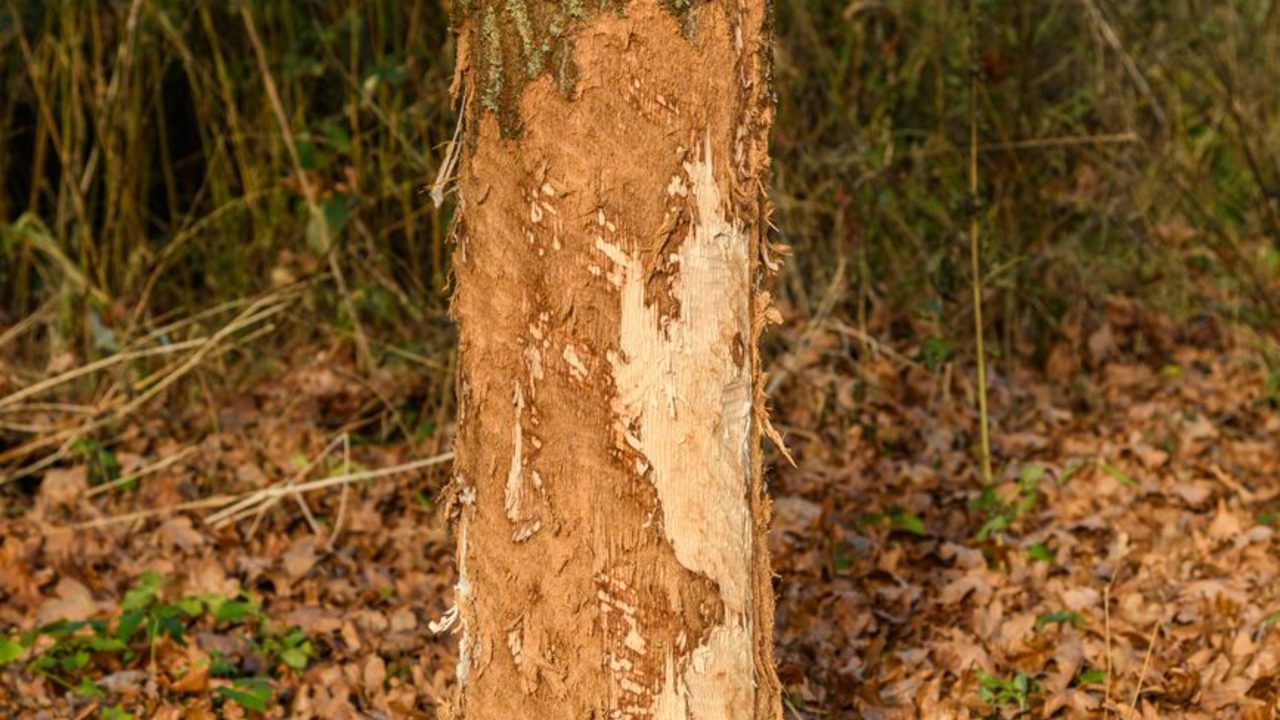
Of the 250 recorded signs of beaver presence, 81% were gnawed trees — most often poplars and willows, which typically grow near water. The scientists stress that the mere presence of a beaver, or the number of traces of its activity, does not by itself indicate serious economic damage. Which trees are chosen depends heavily on what grows at a given spot, so mass gnawing of poplars or willows is not comparable in significance to damage to purpose-grown oaks, ashes and other valuable timber.
A spatial analysis showed differences between individual water bodies in how far from the water beavers gnawed trees, but no statistically significant pattern could be identified — the result may have depended on which trees were actually available to the animal at a given spot. The study's authors acknowledge that the findings should be interpreted cautiously, and that, for example, GPS telemetry would be needed to accurately track the movements of individual animals.
Ponds suit beavers just as well as rivers
The density of beaver territories near Pohorelice turned out to be close to figures already known for river stretches in the Morava basin, even though the local landscape is quite different — dominated by standing water. This confirms that pond systems are perfectly suitable for beavers to live in. But the researchers say the presence of the species needs to be assessed separately from the actual risk to dams, banks, plantings and other economic interests.
Effective measures include protecting trees, reinforcing dams and banks, wrapping them in mesh or covering them with riprap. The authors suggest choosing measures based on the specific type of damage, local conditions and data from long-term monitoring. According to the study's authors — Ondrej Mikulka, Jakub Spoula and Martin Kincl — it is precisely the combination of field surveys, spatial analysis and knowledge of local conditions that makes it possible to find the most vulnerable spots, target protective measures precisely and assess their effectiveness. The study was published in a scientific journal of forestry research.
Read also: 8 best places to swim near Prague: lakes, quarries and beaches an hour from the capital
Source: ekolist.cz