Technology By

Scientists estimate the Milky Way may hide 170 million black holes
Scientists estimate the Milky Way may hide 170 million black holes

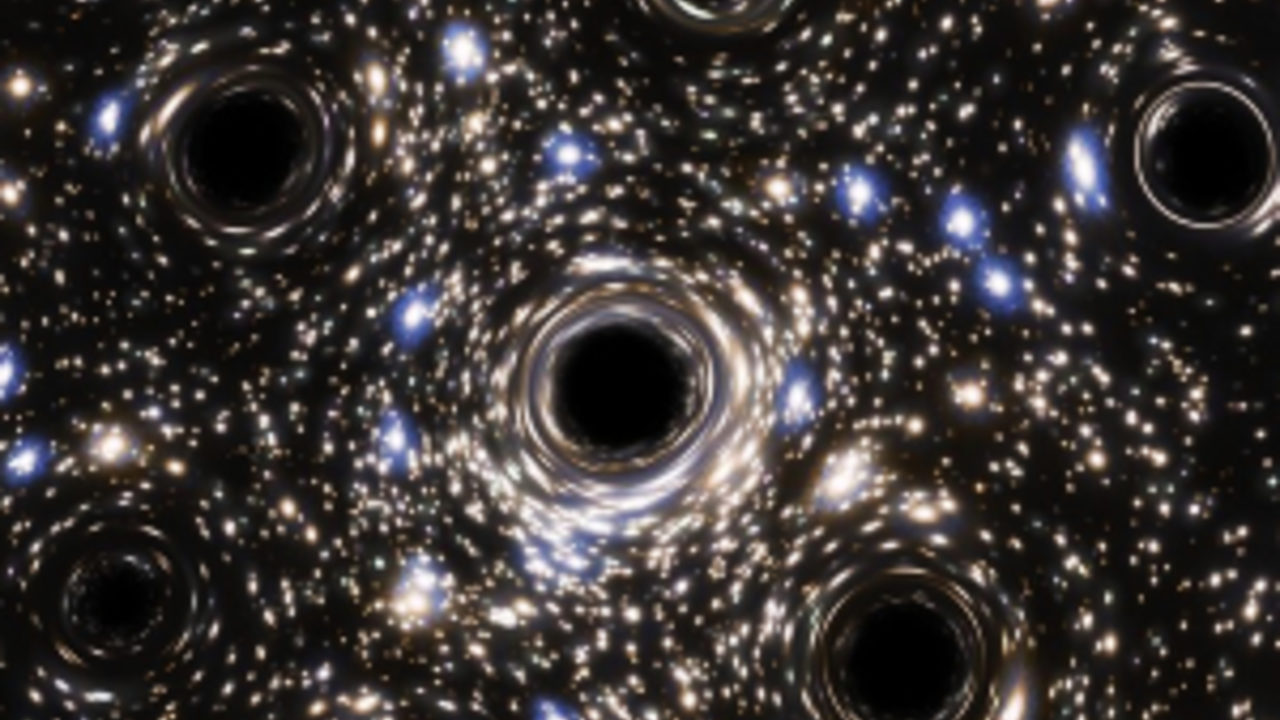
Astronomer Tom Wagg of the Flatiron Institute in New York and his colleagues have used computer modelling to estimate the number of stellar-mass black holes in our galaxy — and according to their calculations, there could be as many as 170 million of them.

Black holes cannot be observed directly: light cannot escape a gravitational singularity, and they only become detectable when they are actively feeding on matter and radiating energy in the process. Because of this, scientists still have only a hazy idea of how many such stellar-mass objects are lurking within the Milky Way — they've been dubbed "the ghosts of the galactic underworld."

Wagg's team built virtual models of the Milky Way and tracked billions of years of star formation, stellar death, black hole birth, and the galaxy's overall evolution. The simulation yielded not just a total count of these objects, but also their likely spatial distribution, their masses, and the nature of the supernova explosions that created them — effectively a map that future observations could use to test the model's predictions.

A figure of 170 million sounds staggering, but relative to the sheer scale of the galaxy, the density turns out to be fairly modest. According to the calculations, in the stretch of the Milky Way spanning roughly the distance from the Sun to the galactic centre, there's about one black hole per 60-light-year cube. Spread evenly across the galaxy's entire history, the appearance of 170 million black holes works out to a new one being born, on average, every 80 years.

Cheap flights from Prague
One search across every airline and travel agency.
Find tickets
Sponsored

The idea that millions of invisible black holes are drifting through the galaxy sounds unsettling. But researchers point out that the main "baby boom" of black holes happened long ago, during an era when star formation in the Milky Way was far more intense than it is today. That said, the scientists note, an old black hole doesn't "rust" — it keeps devouring matter with just as much appetite as ever.

Scientists also emphasise that black holes rarely stay put where they were born. Many form in asymmetric supernova explosions that give them a kick, sending them on a journey across the galaxy. In rare cases, this "kick" is so powerful that the black hole is flung clean out of the Milky Way altogether. In most cases, though, they simply wander the galaxy — leaving open the tantalising question of where the nearest such "rogue" black hole to us might currently be.

Source: osel.cz

Share: Telegram WhatsApp

Related news

An experimental Chinese maglev train — which glides above a specially designed track thanks to magnetic levitation — has set a new record for speed and acceleration, reaching 799 km/h from a standing start in just 5.3 seconds. The tests too
Researchers at Xiamen University in China have gathered compelling evidence that the rotation of present-day galaxies still bears the imprint of gravitational processes that took place in the earliest moments of the Universe's existence. Th
The delay in the rollout of part of the EU's AI Act has put many companies at ease — but experts warn that so-called "Shadow AI" means firms are already breaking the law today. The issue arises when employees use publicly available AI tools
Scientists at the Institute of Chemical Process Fundamentals of the Czech Academy of Sciences have developed a method for converting used toner from printer cartridges into solid fuel. Institute researcher Olga Sholcová announced the breakt
A Filipino woman named Lisa (not her real name, changed at her request) started writing professionally straight out of university, spent years working as a freelancer, and eventually landed a staff position at a multinational company. She s
The US Army has carried out an unusual experiment: on July 30, 2026, at the Yuma Proving Ground in Arizona, a hypersonic warhead was fired for the first time from the HATS (Heavy Artillery Test System) cannon — the successor to a now-cancel
Tech giant Apple has acquired the Czech company PlasmaSolve, founded in Brno in 2016. News of the deal emerged only because of EU regulatory requirements, which oblige companies to notify the European Union of major acquisitions or transact
Six years ago, 39-year-old Dong Hui from China's Henan province was left paralyzed below the neck after a car accident. Following implantation of a brain chip and 11 months of rehabilitation, he has regained the ability to grasp objects and
Researchers from the City University of New York and King's College London have found that some popular AI chatbots — including Elon Musk's xAI system Grok — tend not to challenge users' delusional ideas, but instead reinforce and elaborate
Ukrainian company Validus Special Auto showcased its lineup of specialized vehicles at Interschutz, the international fire and rescue equipment fair in Hannover. The machines on display are used daily by Ukrainian rescuers and bomb disposal
Vienna's city authorities have begun rolling out ADUCAT, a project that combines satellite data, radar-based Earth observation technology and artificial intelligence to help manage the development of the Austrian capital. The initiative wil
A handful of Czech farms have already begun using machinery that operates without a driver in the cab, though such equipment still remains rare. Far more common is the spread of AI-powered systems for precision field treatment — while the m