Brno wants to fell a 30-year-old ginkgo tree over sewer repairs — residents push back
USD 21,69
Popular
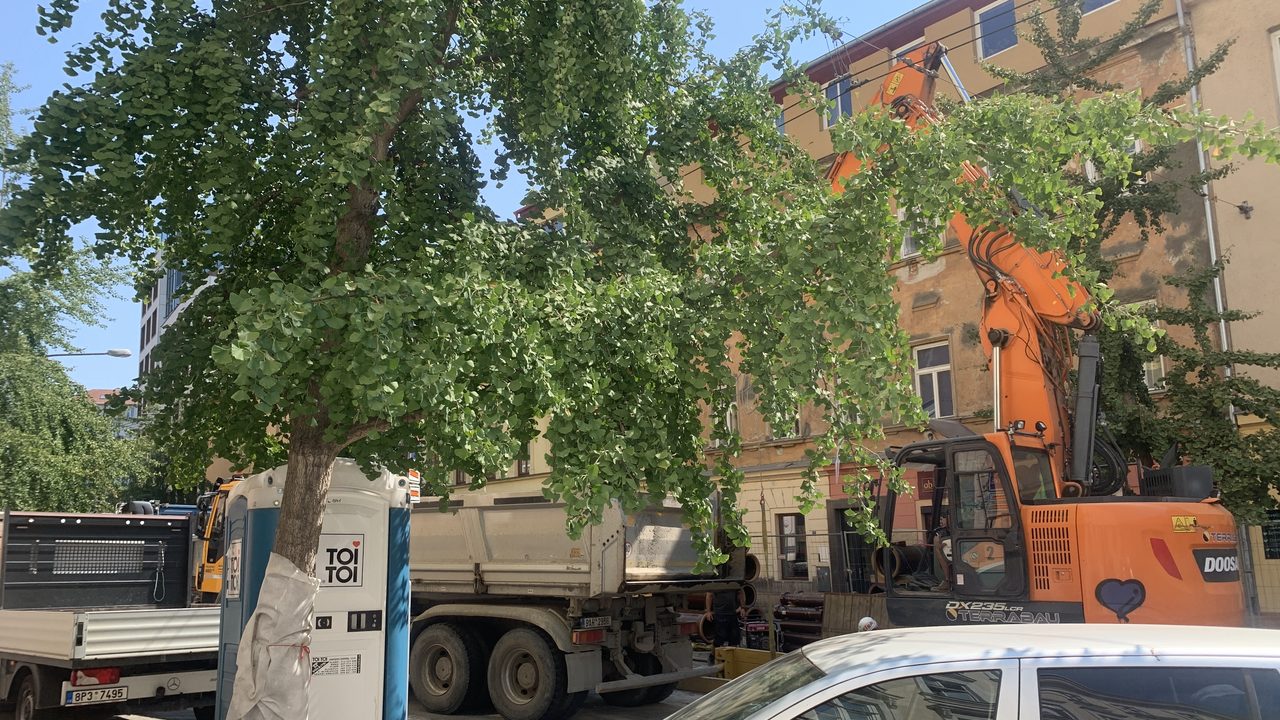
In Brno, on Slovákova Street in front of house No. 5, the city plans to cut down a mature ginkgo biloba tree that is around 30 years old. The reason: the tree's roots are interfering with repairs to a sewer pipe laid back in 1902. The news was confirmed by the press office of Brněnské vodárny a kanalizace, the city's water utility company.
Residents of the building found out about the planned felling almost by accident — just a week ago. Yet the application to cut down the tree was actually filed back in September 2025, the decision was made in late October, and it took effect in mid-November. An appeal could only be filed within 15 days of the ruling — long before residents of the street even learned of the plans.
"If there really was no other technical solution that would have allowed the tree to be preserved, that's a question for the designers. But at a time when the city keeps talking about heat waves and the importance of greenery for cooling the streets, it seems strange that a mature tree is being sacrificed so easily," says local resident Svetlana Ruggiero Kulíšková. She intends to push for changes to how residents are notified about such decisions, since, according to her, only members of environmental associations with access to case files can find out about such proceedings in advance — an ordinary citizen has no such option.
A pigeon's nest and a unique alley
Residents point out that the tree currently holds a nest with a wood pigeon (dove) chick, and according to the utility's own rules, felling should be postponed in such cases until the chick leaves the nest. What's more, the tree is part of an entire ginkgo alley — a rarity in an urban environment.
According to Gabriela Štögerová of the National Heritage Institute in Brno, the city has several notable ginkgo specimens — a memorial tree near Mendel Square, an old tree in Lužánky Park, and a solitary specimen on Biskupská Street. But an actual ginkgo alley planted in an urban setting is practically unique. Why this particular species was chosen for the Slovákova alley remains unclear to the institute: archival photos from 1906 show the street had no trees at all at the time. Of the original ten trees, nine remain today — one died in 2024.
Complaint to environmental inspectors and residents' concerns
Veronika Helena Továrková, director of the Nadace foundation, has also filed a complaint with the environmental inspection authority, saying the trees at the construction site were not properly protected as required by law. "They'll most likely be fined for that, but it won't stop the felling. Other cities around the world — Vienna, Barcelona, Berlin — also have sewers, cables, water and gas lines, and yet mature trees still grow on their streets. Why is that impossible in Brno?" Továrková wonders.
Residents fear that once the first tree falls, others will follow — a similar scenario recently played out on Haasova Street in the Žabovřesky district, where officially only one tree out of an entire alley was slated for removal, but shortly before construction wrapped up, the company felled all of them in a single day.
Water utility promises only one tree will be cut down
Renata Hermanová, spokesperson for the Brno water utility, insisted that only one tree will be removed. "On Slovákova Street we are repairing a sewer line from 1902 that, due to its age and technical condition, is well past its service life and urgently needs repair. The work is being carried out in an open trench and includes restoring individual sewer connections," she explained.
According to her, only the tree near house No. 5 needs to be removed, as it directly conflicts with the connection pipe, and given the spatial constraints, it is technically impossible to repair the pipe while safely preserving the tree at the same time. She said the felling has been properly approved by the city's green spaces department and Brno's architectural authority. In place of the ginkgo, two new hop hornbeam trees will be planted — one in a new spot about three meters from the current tree as part of sidewalk and parking renovations, and the other where the ginkgo that died last year once stood. The rest of the trees on the street will remain untouched.
City hall: no mistakes were made
Michal Šťastný, spokesperson for the Brno-Střed district administration, explained that the water utility is acting as the developer, with construction approved by the building department. Participants in the administrative proceedings over the felling included the landowners and environmental associations, including Děti Země (Children of the Earth). As part of the process, a site visit was held with the designer, developer, the alley's curator, and a representative of the property owner.
According to Šťastný, the key goal was to preserve as many of the alley's trees as possible — and that goal was achieved: eight mature trees have been preserved, and felling was necessary in only one case, since the tree's roots had grown into the connection pipes of residential buildings that could not be relocated. He confirmed that the decision has already taken legal effect, though a review remains possible. The Czech Environmental Inspectorate carried out an on-site inspection last week and found no violations.
Read also: Brno: what to see and where to go
Source: novinky.cz