Death on a machine in Valašské Meziříčí: firm fined CZK 105,000
USD 21,81
Popular
In November 2024, at the Tridas factory in Valašské Meziříčí, 43-year-old Miroslav was crushed to death by a heavy metal unit of a production line. According to the labour inspectorate, the company broke safety rules, but it received only a fine of 105,000 crowns, and only the dead man’s colleague was punished.
What the factory camera showed
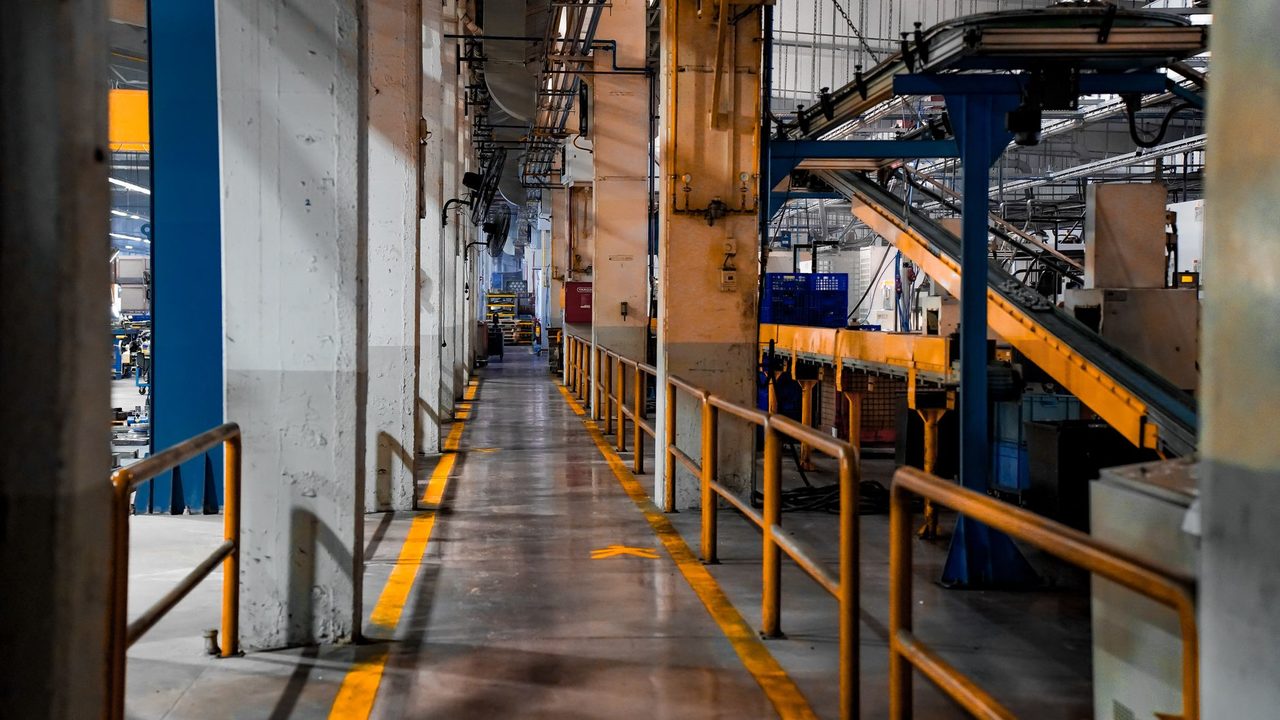
A camera in the corner of the hall shows two men in overalls cleaning the inside of a line that makes protective cardboard packaging. For a few moments one of them leans under a moving unit called the transfer, which weighs about 900 kilograms. He rests his hand on a duplicate control panel. The man seems to be trying to get out from under the machine, but in doing so accidentally presses a button on the panel. The metal transfer drops down. Rescuers arrived quickly but could no longer help.
The line was built and operated by Tridas itself: from a mix of paper and water it made rigid cardboard packaging. The machine clogged regularly and was cleaned with pressurized water, and sometimes the nozzles had to be cleared by hand with a wire or a cordless drill. The tragedy happened during exactly this kind of cleaning.
The police concluded that the main culprit was Boris, a colleague who worked with Miroslav. Shortly before the accident he turned the safety key and switched the machine to “service” mode, disabling the protective interlocks. According to the instructions, the line may be cleaned only in automatic mode after pressing “STOP”. Boris did not switch the mode back and did not warn Miroslav, who in turn did not check the settings himself. Boris did not deny it: “I forgot to switch back to automatic mode and forgot to tell my colleague. If he had known what mode the line was in, he would not have gone in there. I am very sorry.” The court sentenced him for negligent homicide to 22 months in prison, suspended, with a probation period of 30 months.
What the labour inspectorate found
The family does not agree with this outcome. “I thought he was going to a safe job. That was not true. He leaves a wife and two small children,” says the father of the deceased. His half-sister Silvie believes the machine was dangerous and should not have been there at all.
Two days after the accident, Tridas named Miroslav himself as the person at fault in its report: he had allegedly violated the instructions, while the company had broken no occupational safety rules. The firm gave the same answer to the inspectorate.
However, the labour inspectorate, which by law investigates all fatal accidents, found serious violations on the employer’s side too. Inspector Jaroslav Šula pointed out as early as August 2025 (Boris was sentenced only in March 2026) that the company, being both employer and manufacturer of the line, had not created safe conditions and had not taken measures to prevent risks. Among the problems:
the safety key was permanently left in the panel, although according to the instructions it should have been removed. “The key was inserted all the time,” said Bohdan Grigaržik, a former Tridas employee. According to several workers, briefly switching to service mode was a common, though informal, practice at the plant;
there was no official procedure for clearing clogged nozzles: the instructions described only removing dirt from the front of the machine;
the inspectors called the most serious violation the unguarded duplicate panel next to the longitudinal protective door: it could be used to move the transfer, and an operator could start it by accident. “If the panel had been out of reach, nothing would have happened, even if everyone had broken every rule,” Šula wrote in a letter to the police investigator.
Why the fine turned out so small
The inspectorate first fined the company 180,000 crowns. Tridas filed an objection, administrative proceedings began, and the violations were confirmed: Tomáš Musil, head of the inspectorate for the South Moravian and Zlín regions, called them serious offenses that exposed workers to increased danger. But the fine was reduced to 105,000 crowns. At the time of writing the decision had not come into force. A company with an annual turnover of 250 million crowns faced a fine of up to two million.
In his decision Musil refers to Tridas’s explanations of its financial situation, to measures already taken (the key is no longer left in permanently, the duplicate panel has been moved and covered, a signal lights up when switching to service mode, operators have been retrained) and to the company’s promise to invest money in safety. He also writes that these proceedings do not consider any link between the violations and the death, and adds that if the inspectorate had considered the violations the cause of death, the fine would have been several hundred thousand or even around a million crowns. He did not explain why there is no link. Police commissioner Libor Holiš declined to comment, and the company’s lawyer Jitka Špilková replied that neither the company nor its representatives were accused and that the administrative proceedings are confidential.
Silvie filed a criminal complaint against the company, but prosecutor Jiří Sachr saw no grounds for criminal proceedings: the shortcomings, he said, could only have created general conditions but did not directly lead to the death; Miroslav was also partly at fault. Labour law attorney Boris Achmedov, who studied the case, calls the prosecutor’s position premature and incomplete: “This was a long-neglected problem. Many employees knew about it, but none of the managers intervened. That can certainly be attributed to the employer.”
Around Prague, based on reporting by seznamzpravy.cz