Punkva river source found by cave divers in the Moravian Karst
USD 21,86
Popular
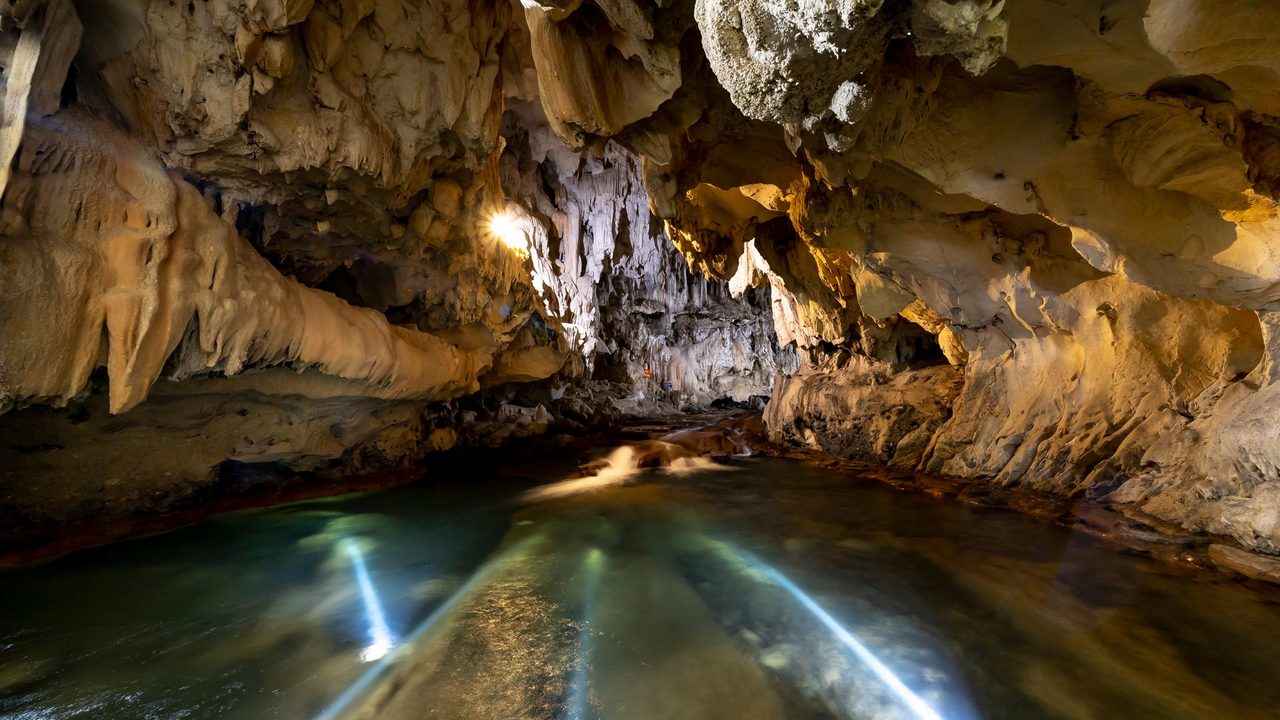
Cave divers have discovered a spot in the Amaterska Cave in the Moravian Karst where the Sloup stream and the Bila voda meet to form the underground Punkva river. They found the junction thanks to low water levels and better visibility.
The divers are only now preparing to confirm the find, but speleologist Radek Nezehleb stressed its importance for further research in an interview.
A labyrinth under water
The confluence lies under water, in Milan Schlechta's labyrinth, a complex network of horizontal and vertical passages of various sizes. It contains several chasms leading down to active water. According to dye tracing experiments, one of them was close to the suspected confluence. In May the divers connected it with the water level in another part of the labyrinth, where the Sloup stream was believed to flow. From this it followed that the confluence must lie somewhere between those two points.
The divers had to approach from two sides. From the south, from the Sholim Bowl, the spaces are enormous, which is exactly why earlier attempts failed: in large passages it is hard to decide which way to swim next. The depth in places exceeds 30 metres, and about 250 metres in a row must be swum under water. The discovery site is more than half a kilometre away, of which 400 metres are under water.
From the other side, the way was blocked by a passage so narrow that a diver could not fit through. To get further downstream with small seven-litre tanks, the divers had to dig a wider passage in the gravel with their hands. When the water is low, the gravel slides down to the lowest point of the passage, so it has to be cleared again each time.
How the side passage was spotted
In May visibility was poor, and diver Martin Bartosek did not notice a passage branching off to the north from the main corridor. It was only seen last Saturday during detailed mapping, when the divers measured directions and distances and sketched the shapes of the passages. They did not explore the junction then, but on Tuesday they swam to it and found a fairly strong current flowing from it, meaning another tributary joins the water they were swimming in.
The low water level helped: the lower it is, the clearer the water, whereas normally visibility is about a metre. When the water is high, it cannot fit into the narrow lower channels and is pushed upwards into the labyrinth, while at the lowest levels, like now, the confluence happens below the surface.
Why it matters where the Punkva begins
According to Nezehleb, the Punkva is the “mother of all caves” around the Amaterska and Punkva caves and the main watercourse of this part of the Moravian Karst. Knowing where the streams meet helps explain how the caves formed and suggests where new passages might be found.
There is also the question of protection: when it was discovered, the Amaterska Cave was completely isolated from the outside world, but now it opens to the surface, and farming is carried out above it, so changes are taking place inside. To set up a protection regime, it is necessary to know exactly where the water comes from and where the cave runs.
The final answer will come from a dye tracing study carried out jointly with a university and a hydrological institute: tracers are poured into both streams, and sensors record the time and intensity of their appearance. One small question remains: whether the Bila voda in the northern tributary mixes with the Sloup stream even further upstream. This needs to be ruled out.
Around Prague, based on reporting by seznamzpravy.cz