A Spacecraft Has Reached Mercury, and It Is About to Enter Orbit
USD 22,22
Popular
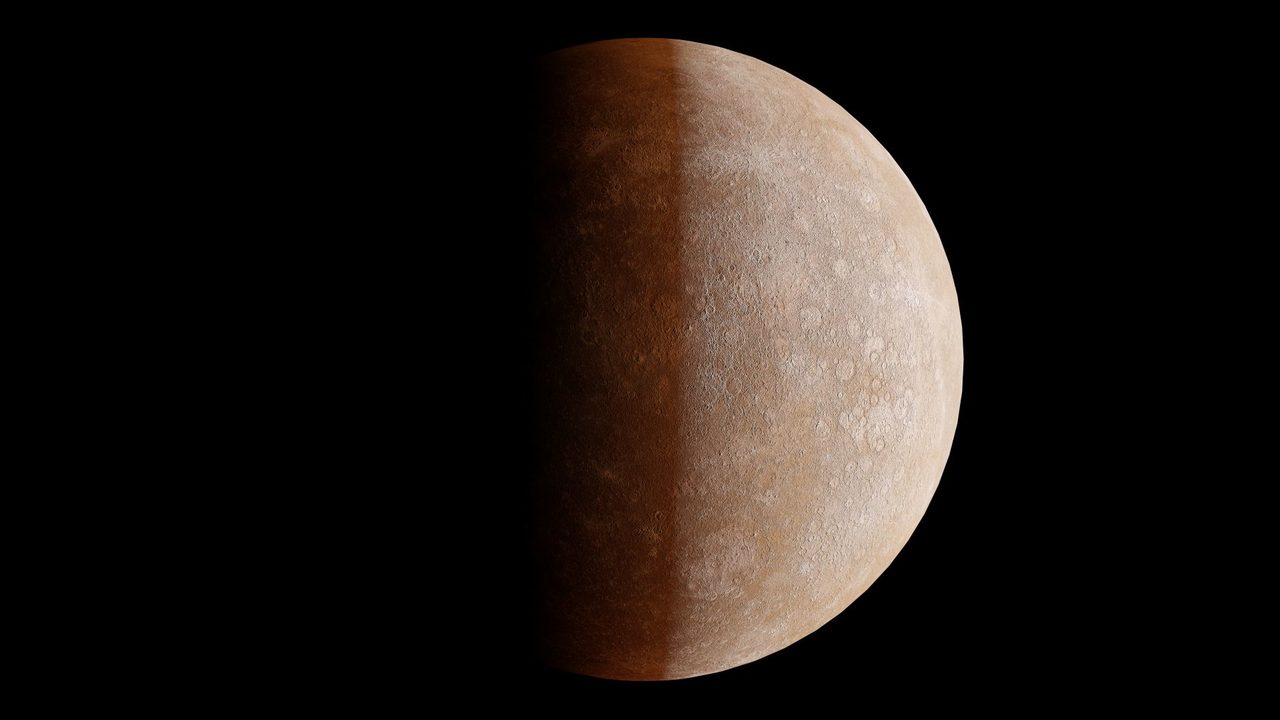
A joint European-Japanese space mission has arrived at Mercury after a voyage of more than eight years, The Guardian reported. Flight controllers are due to fire the spacecraft's thrusters on Saturday to send it into orbit around the smallest planet in the solar system.
The BepiColombo mission will be only the second in history to circle Mercury. Researchers hope it will explain how a planet so close to the sun formed, and why it has a magnetic field.
Why is Mercury so hard to reach?
Mercury sits near the center of the solar system, so a spacecraft heading there speeds up under the sun's gravity. According to The Guardian, that means the probe has to spend much of its journey braking to avoid shooting straight past the planet.
Prof. Emma Bunce of the University of Leicester, who has worked on the project for 20 years, called it a very complex and challenging mission. She said the long wait had been worth the excitement.
What happens after the thrusters fire?
Scientists will still have to wait. In early December, the spacecraft will split into two orbiters, one European and one Japanese. Each will maneuver into its own polar orbit around the planet. Science operations are due to begin in April next year.
The European probe, called the Mercury Planetary Orbiter, will map the surface and composition in high resolution and study the planet's interior. The Japanese orbiter will measure Mercury's magnetic field and its sodium exosphere, the extremely thin layer of gas and atoms around the planet.
What do researchers want to learn?
The mission is the best hope yet of answering several open questions, according to The Guardian. These include how Mercury formed so close to the sun, why it has a magnetic field and what makes up the frozen ice in its permanently shadowed craters.
Another puzzle is density. Mercury is only 50% larger than the moon but has four times its mass, and the mission will look into why the rock is so dense. The European probe will also study the interior to learn more about the planet's unusually large core.
Bunce is the principal investigator on an instrument called the Mercury Imaging X-ray Spectrometer, which will analyze the geochemical composition of the surface.
What makes Mercury such an extreme place?
The planet takes 58 Earth days to rotate once on its axis. As a result, any given spot can have daylight for three months and then night for three months. Ground temperatures reach 450C in the day and fall to -180C at night.
Prof. Geraint Jones, lead project scientist on BepiColombo at the European Space Agency, said the team expects to learn a huge amount from more powerful instruments on two spacecraft. He said they will study the planet's interior, surface and surrounding space, using cameras across a wide range of wavelengths, instruments that sample the gases around the planet, sensors for the magnetic field and a laser to map the planet's shape.
Why does it matter?
Mercury is the first rock from the sun and one of the least explored worlds in the solar system. Only one earlier mission has entered orbit around it, so much about its origin, structure and surface remains uncertain. Two orbiters working together offer a chance to study the planet from the inside out, from its core to the thin gas around it.
The mission also shows how much time and money such exploration takes. The Guardian put the cost at €1.6bn (£1.4bn), and the journey alone lasted more than eight years.
How long will the spacecraft last?
The two orbiters are expected to circle Mercury for about three years. After that they will run out of fuel, lose altitude and eventually crash into the surface. Bunce said they are not coming back.
Around Prague, based on reporting by The Guardian