Science & Space By

SpaceX Gets Military Orbit-Tracking Data, Raising Questions About Who Controls Space Traffic

The U.S. military has given SpaceX access to restricted space tracking data, The Guardian reported, a move that critics say could make Elon Musk’s company the de facto source of space traffic coordination in the United States. The access covers the military’s most precise information on possible collisions among satellites and other objects in orbit.

SpaceX and the Space Force signed a new contract. Neither responded to The Guardian’s requests for comment, but a Space Force spokesperson acknowledged the arrangement in a statement to Breaking Defense.

What SpaceX now has access to

According to The Guardian, the Space Force for the first time gave a commercial company “enhanced” access to the most detailed, secure version of U.S. Space Command’s High Accuracy Catalog of objects in orbit. That includes tracking messages built from data collected by military sensors, telescopes and ground radars, which follow satellites and other objects in lower orbit down to about 10cm (3.93in) in size.

The military largely uses these radars to watch other countries’ satellites, but the data is also used to track commercial spacecraft and avoid collisions. The information is designated controlled unclassified information and has been closely held, The Guardian reported.

The data is valuable to Starlink, the SpaceX satellite internet subsidiary, which runs its own tracking system called Stargaze. That system, built from cameras and radars on Starlink satellites, sees objects only down to about a half meter and is less accurate than the military’s. The government gets something in return: access to Stargaze cameras and sensors.

What critics say

Cole Donovan, a former employee of the federal space traffic program and now with the nonprofit Stand Up for Science, told The Guardian the access appears to be another step toward Musk asserting monopoly control over commercial space activity. He compared it to giving a trucking company control of the traffic lights.

The Guardian said the move follows the 2025 firing of many staff members of the Traffic Coordination System for Space, known as Traccs, by Musk’s Department of Government Efficiency. It also noted that the administration has twice tried to cut the program’s funding. Many in the industry viewed those steps as an effort to privatize space traffic control, the outlet said, and some observers fear the government is becoming too dependent on SpaceX.

What the military and other voices say

The Space Force spokesperson told Breaking Defense that the service is working with several companies to trade commercial data for access to parts of the controlled, unclassified catalog, where that benefits the government. A SpaceX employee said at an industry conference that the military’s radar data is an extremely valuable supplement to Stargaze, according to Breaking Defense.

A former official at the National Oceanic and Atmospheric Administration, speaking anonymously, told The Guardian that SpaceX has generally been responsive to space safety concerns and that Starlink should not be faulted for stepping into a gap. The official said the larger failure was the government’s, for not setting up a coherent framework with a level playing field for all operators.

Why it matters: safety in a crowded orbit

Traccs manages thousands of satellites, debris and spacecraft and helps prevent up to 50,000 near-collisions, called conjunctions, every day, according to The Guardian. Starlink operates about 11,000 satellites and could have as many as 20,000 in the coming years. Who supplies and controls collision data therefore bears on the safety of satellites that people rely on, and on competition in a commercial space market expected to be worth nearly $2 trillion over the next decade.

What happens next for Traccs

Traccs, created during the first Trump administration, has never been fully funded or staffed. In fiscal year 2026 the administration tried to largely defund the $65 million program, but Congress put the money back. The administration has proposed cutting the budget to nearly zero for fiscal year 2027, and the House again reinserted the funding. The administration, Congress and industry are debating what comes next.

Around Prague, based on reporting by The Guardian

Share: Telegram WhatsApp

More science news

Coffee May Change Your Gut Beyond the Bathroom Rush, Small Study Finds
Coffee may do more inside the body than wake you up and get your bowels moving. A small new study in the journal Gut Microbiology links regular coffee drinking to differences in gut physiology and in
Fish-Heavy Diets Made Medieval Danish Monks Look Centuries Too Old
Some skeletons found at medieval monasteries in Denmark appear to be older than the monasteries themselves, and researchers now say a diet heavy in freshwater fish is the likely reason. According to S
Ancient Underwater Canyons Helped Preserve Earth's Oldest Animals
Huge canyons cut into the seafloor more than half a billion years ago may be the reason scientists can study some of Earth's earliest animals at all, according to a new study of rock formations in Sou
Pakistani Astronaut Will Be First Foreigner to Fly to China's Tiangong Station
China plans to launch its Shenzhou 24 mission to the Tiangong space station on Nov. 25, and one of the three people aboard will be a Pakistani astronaut, the first foreigner to travel to the station,
Mystery Object in the Milky Way Flared Every 62 Minutes, Then Went Silent
Astronomers have identified another of the strange radio sources known as long-period transients, an object that sent out powerful flares every 62.2 minutes and then went quiet, ScienceAlert reported.
Voyager 1 Becomes First Human-Made Object to Reach One Light-Day From Earth
NASA has announced that its Voyager 1 probe will soon become the first human-made object to travel one light-day from Earth, according to Al Jazeera. The milestone is due on Wednesday, when the spacec

Related news

Coffee may do more inside the body than wake you up and get your bowels moving. A small new study in the journal Gut Microbiology links regular coffee drinking to differences in gut physiology and in the bacteria found in stool, according t
Some skeletons found at medieval monasteries in Denmark appear to be older than the monasteries themselves, and researchers now say a diet heavy in freshwater fish is the likely reason. According to ScienceAlert, scientists from the Univers
Huge canyons cut into the seafloor more than half a billion years ago may be the reason scientists can study some of Earth's earliest animals at all, according to a new study of rock formations in South Australia. ScienceAlert reported that
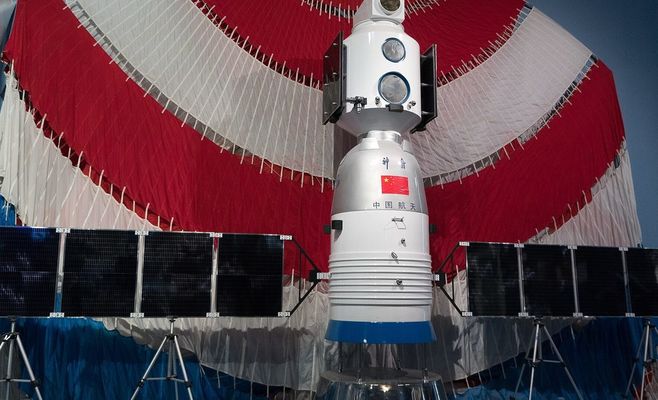
China plans to launch its Shenzhou 24 mission to the Tiangong space station on Nov. 25, and one of the three people aboard will be a Pakistani astronaut, the first foreigner to travel to the station, according to Universe Today. The crew wi
Astronomers have identified another of the strange radio sources known as long-period transients, an object that sent out powerful flares every 62.2 minutes and then went quiet, ScienceAlert reported. The discovery, led by Scott Hyman of Sw
NASA has announced that its Voyager 1 probe will soon become the first human-made object to travel one light-day from Earth, according to Al Jazeera. The milestone is due on Wednesday, when the spacecraft will have covered at least 16 billi
A comb-shaped electronic device has regrown nearly all the lost hair in mice with a form of pattern baldness, according to ScienceAlert. The results are preliminary: the system, called Detangle, has so far been tested only in mice, and it i
Older adults who keep regular daily schedules report less physical pain and fewer symptoms of depression, even when they sleep poorly, according to a University of Missouri study summarized by ScienceDaily. The researchers say the work show
The Pleiades star cluster is becoming easy to find in the evening sky, and Space.com is encouraging skywatchers to count how many of its stars they can see without a telescope. The result depends less on eyesight alone than on how well prep
Mars and Jupiter will sit side by side in the constellation Leo on the night of Nov. 15-16, in a pairing that will not repeat this closely until July 2029, Space.com reports. For viewers in the U.S., the two planets rise over the eastern ho
Astronomers have found a large icy object beyond Pluto that could become the sixth officially recognized dwarf planet, according to ScienceDaily and the University of Washington. The object, temporarily named 2026 ED138, turned up in observ
Four planets are strung out in a diagonal line across the pre-dawn sky this month, and all of them can be seen without a telescope. The BBC reports that Mercury, Venus, Mars and Jupiter will be visible to the naked eye in the south-eastern