Mars and Jupiter Pair Up Overnight Nov. 15-16, Closest Until 2029
USD 22,10
Popular
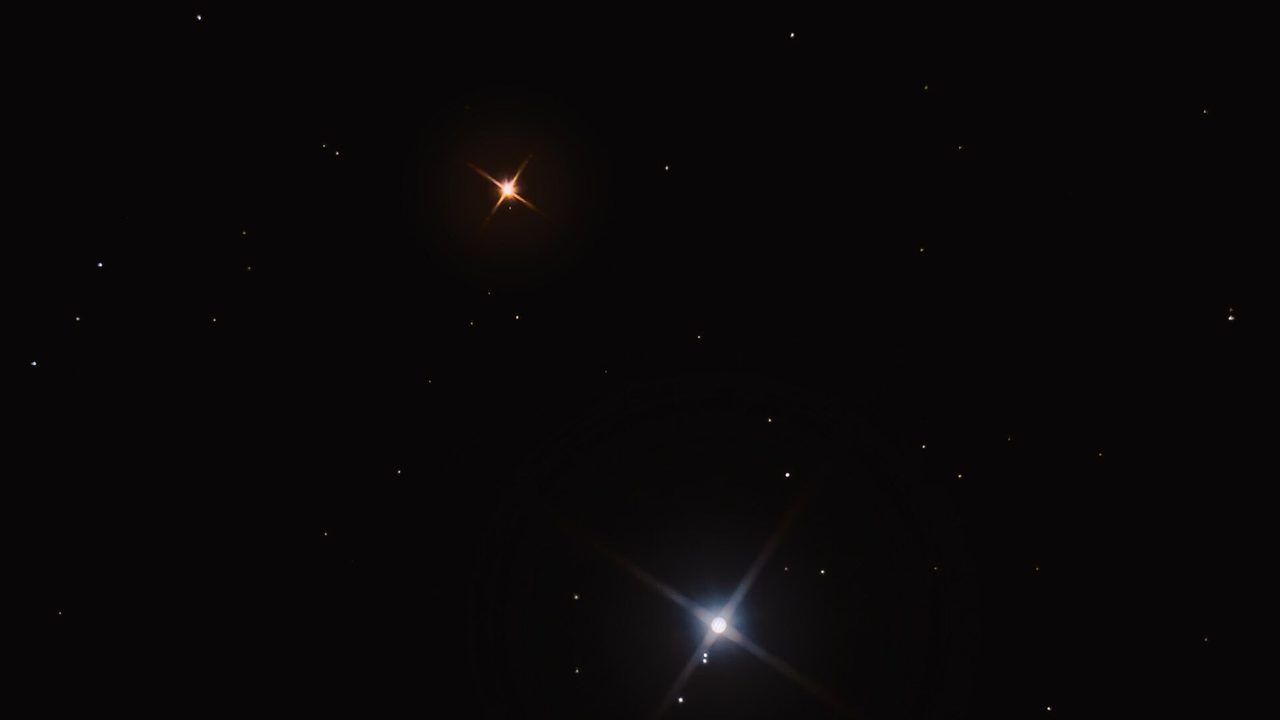
Mars and Jupiter will sit side by side in the constellation Leo on the night of Nov. 15-16, in a pairing that will not repeat this closely until July 2029, Space.com reports. For viewers in the U.S., the two planets rise over the eastern horizon around midnight, with the blue-white star Regulus glowing below them, according to the site, which cites In-The-Sky.
The planets will appear a little over 1 degree from each other. Space.com notes that the closeness is a trick of perspective rather than a real meeting.
The numbers behind the sky show
- A little over 1 degree: the apparent gap between Mars and Jupiter as they rise.
- Over 368 million miles: the actual distance separating the two planets, according to Space.com.
- 79 light-years: roughly how long the light from Regulus has traveled before reaching Earth.
- Every 2 to 2.5 years: how often Mars catches up to Jupiter and the pair line up this way.
- July 2029: the next time they will be this close.
- 6-inch telescope: the size Space.com says is enough to reveal the planets' very different characters.
Why the planets line up
Astronomers call the event an appulse. It happens when Mars, on its faster inner orbit, catches up to Jupiter, which travels a more distant path, and the two appear next to each other from Earth. That happens just once every 2 to 2.5 years, Space.com says.
Both are what astronomers call superior planets, meaning their orbits lie beyond Earth's. As a result, their disks always look full through a telescope eyepiece. Mercury and Venus, which circle the Sun inside Earth's orbit, instead show moon-like phases.
What a telescope reveals
A 6-inch telescope shows how different the two worlds are. Pointed at Jupiter, it can pick out the huge cloud bands and lighter zones circling the gas giant. Space.com says these are formed from masses of ammonia and water moving in different directions through Jupiter's hydrogen and helium atmosphere, driven by powerful jet streams.
Mars looks like a reddish, ochre disk with dark surface features. According to NASA, those features are places where basaltic rock has been scoured clean of the iron-rich dust that covers much of the planet's surface.
What this means for stargazers
The event is visible to the naked eye as a close pair of bright points in the eastern sky, with no equipment required. Binoculars or a small telescope add detail, but the main appeal is the sight of two planets sharing one patch of sky with a bright star below them.
Because the planets rise around midnight for U.S. viewers, the pairing is a late-night event. Space.com says the next chance to see them this close comes in July 2029.
Read next
November Sky Guide: Leonids, Mars Meets Jupiter and a Voyager 1 Milestone
A Hot Jupiter Vanished From View After Seven Years. A Hidden Planet Did It
Starship Heads to Orbit Nov. 13 With 26 Starlink Satellites You Might See
Around Prague, based on reporting by Space.com
Cover photo: Sebas FL / Wikimedia Commons, CC BY-SA 4.0, cropped