Dark energy may stem from the strong nuclear force inside atoms
USD 22,36
Popular
Physicist Ariel Zhitnitsky of the University of British Columbia (UBC) and his colleagues have proposed a new explanation for dark energy: it may originate in the strong nuclear force that holds quarks together inside protons and neutrons. If the calculations hold up, explaining the accelerating expansion of the universe would require neither new particles nor additional hypothetical fields.
A puzzle unsolved for decades
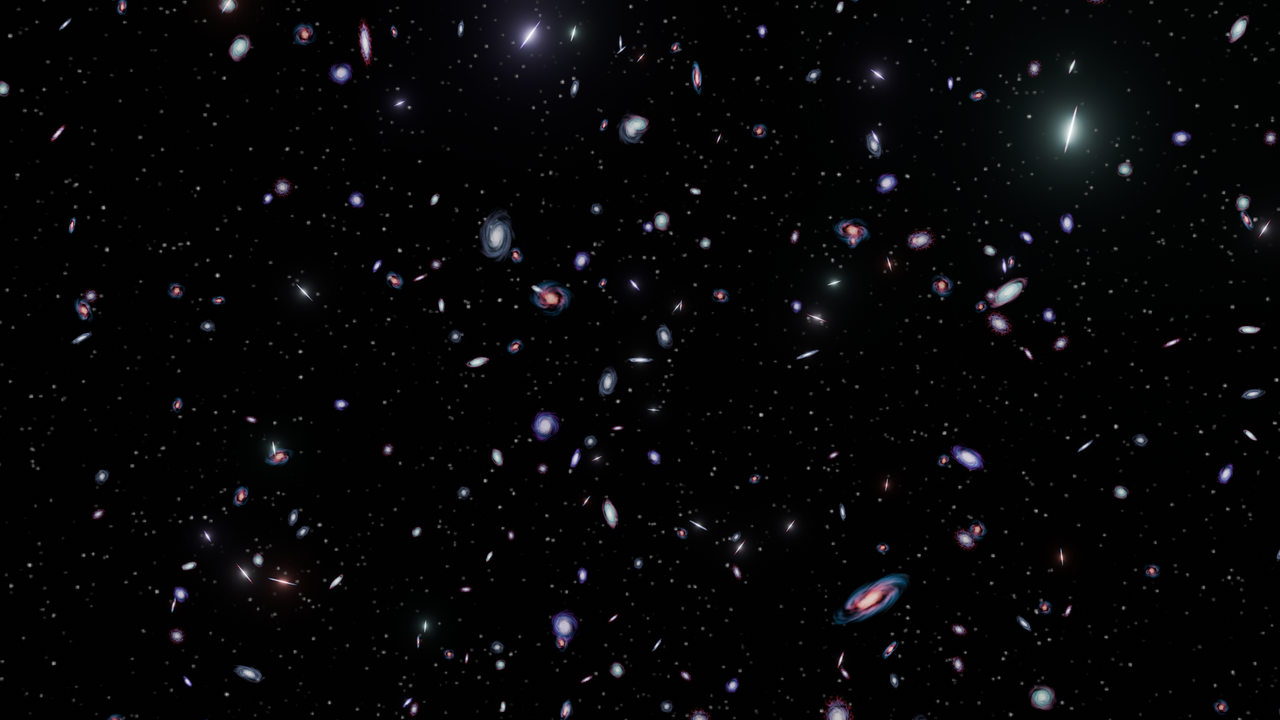
Dark energy, scientists believe, makes up about 70 percent of the universe's total energy content and is thought to be making it expand faster and faster. Yet its nature and origin remain unknown. Earlier explanations mostly relied on the existence of extra fields or particles, but none of them has produced anything concrete so far.
An answer from quantum chromodynamics
Zhitnitsky and his colleagues look for a solution in quantum chromodynamics (QCD), a long-tested theory of the strong interaction. According to their calculations, which start from the properties of the quantum vacuum and gravity, the resulting energy density is close to what astronomers observe for dark energy. No new parameter has to be introduced to get there.
The idea rests on the fact that empty space is never truly empty: it is permeated by subatomic fields and quantum energy. In quantum chromodynamics, the vacuum also has topological properties that can affect space even across vast distances.
What comes next
According to the authors, as the universe expands, the subatomic structure of empty space changes. This produces an energy shift that may be just enough to account for the observed acceleration of expansion.
For now, it remains a hypothesis. More theoretical work is needed to clarify how the QCD vacuum responds to the expansion of the universe and to yield testable predictions. Those predictions are to be checked by next-generation telescopes, which will open up unprecedented opportunities for scientists in the coming years.
Around Prague, based on reporting by osel.cz