Webb Telescope Finds Dust Clues to a Star’s Last Hours Before Exploding
USD 22,36
Popular
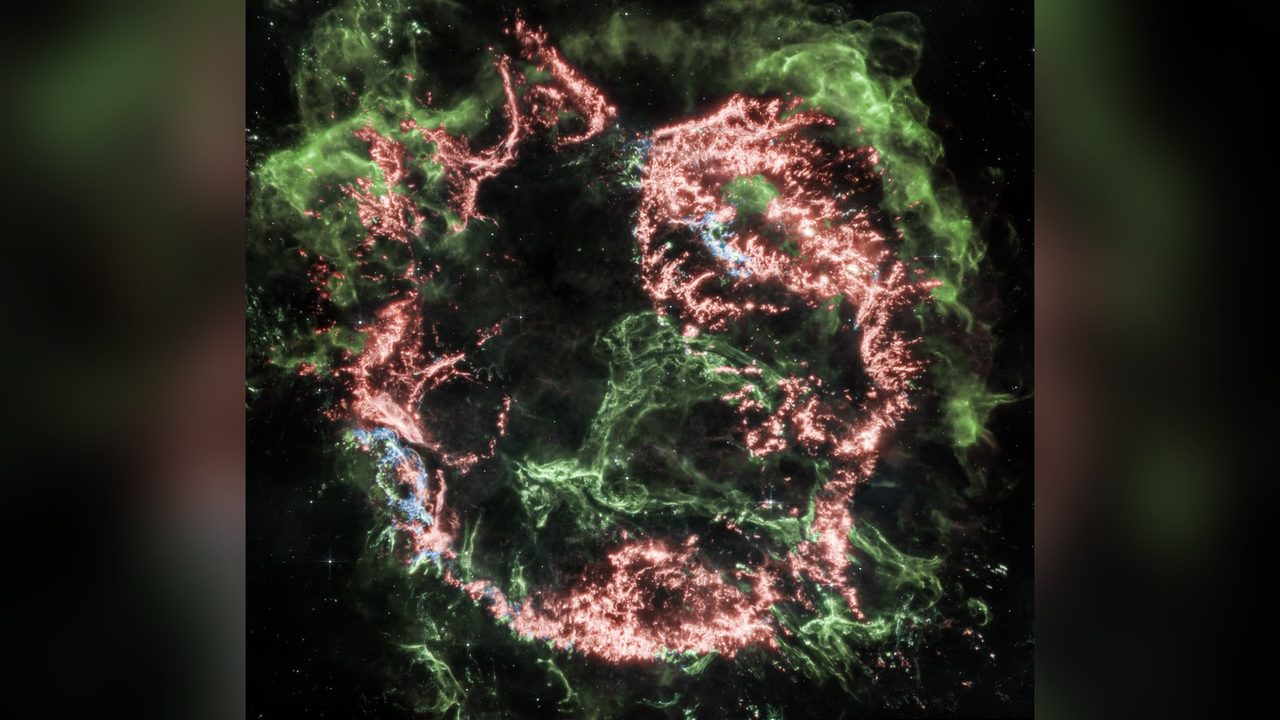
NASA’s James Webb Space Telescope has mapped the dust inside the supernova remnant Cassiopeia A, and the pattern suggests the star’s interior was reshuffled shortly before it exploded, according to NASA. The researchers say the change may have happened just hours before the star’s death.
The results were published Monday in The Astrophysical Journal Letters. The team also describes the dust-mapping approach as a new method other astronomers can use to learn about a star’s structure from the debris it leaves behind.
What Webb saw in Cassiopeia A
Supernova remnants are the clouds of gas and dust left after a massive star explodes. They eventually help seed new generations of stars and planets. Cassiopeia A, often shortened to Cas A, is a well-known example.
Webb’s high-resolution, mid-infrared observation can pick out individual dust clumps, each roughly the size of our solar system, NASA said. By mapping what those clumps are made of, the team found evidence of what astronomers call a shell merger: a process in which layers inside a star mix before the explosion.
How a star’s layers leave a record in dust
NASA explains that stars fuse lighter elements into heavier ones over their lives. Heavier elements fuse in the core, stopping at iron, while lighter ones fuse in surrounding layers. The result is a set of shells, each with a different mix of elements, that records the star’s history.
When the star explodes, those elements are scattered into space. Some condense into dust grains that can clump together. Because the dust keeps a chemical fingerprint of the layers it came from, its composition can be read like a record of the star’s interior.
Tea Temim, the study’s lead author and a research scientist at Columbia University, said material in the shells churns and circulates, which can cause shells to merge shortly before the explosion. She gave the example of the oxygen-burning and carbon-burning shells combining, which would significantly change the star’s structure and the mix of elements seen in the debris afterward.
Three regions, three different dust signatures
To decide where to point Webb, the team used data from NASA’s retired Spitzer Space Telescope. Spitzer could not resolve fine detail, NASA said, but it identified three regions worth a closer look.
Two were inside Cas A’s reverse-shocked region, where an inward-moving shock wave meets debris thrown outward by the explosion. In one, the ejecta contained mostly silica dust. In the other, carbon dust dominated.
The third target was the “Green Monster,” a structure first discovered by Webb. It was rich in complex magnesium silicates. Unlike the other two regions, it came from material the star shed before exploding, not from the supernova’s ejecta, NASA said.
The team combined the Webb dust map with X-ray observations from NASA’s Chandra X-ray Observatory and the JAXA-led XRISM mission. Together, NASA said, the observations indicate the merger was underway very shortly before the explosion. The dust map also shows merger signatures across much of the remnant.
Why it matters
For most readers, this is a story about how astronomers reconstruct events that cannot be watched directly. Dan Milisavljevic, an associate professor at Purdue University and a co-author, said Webb’s ability to resolve individual clumps allows more sophisticated dust chemistry. That lets researchers tie the explosion back to the makeup of the original star hundreds of years afterward.
The findings also bear on a basic question: which elements a supernova releases into the galaxy, and how they enrich future stars and planets. Milisavljevic said understanding the process is essential to answering it. The dust-based method may let other researchers probe the interiors of other exploded stars in the same way.
The conclusions are interpretations of the data. The researchers describe the timing as possibly just hours before the star’s demise, and Milisavljevic framed it as what the team thinks was happening in the hours leading up to core collapse. The study is based on observations of one remnant.
Webb is an international program led by NASA with its partners, the European Space Agency and the Canadian Space Agency.
Read next
Webb Telescope Finds Dense Star Clusters That May Have Birthed Black Hole Seeds
Webb Peers Through Dust to Reveal Young Stars Hidden in a Stellar Nursery
A Strange Gap in Black Hole Sizes Hints at Stars That Vanished Without Exploding
Around Prague, based on reporting by NASA
Cover photo: NASA, public domain