Science & Space By

Orbiter Images Show Dead Martian Volcano Steeper Than Mauna Kea
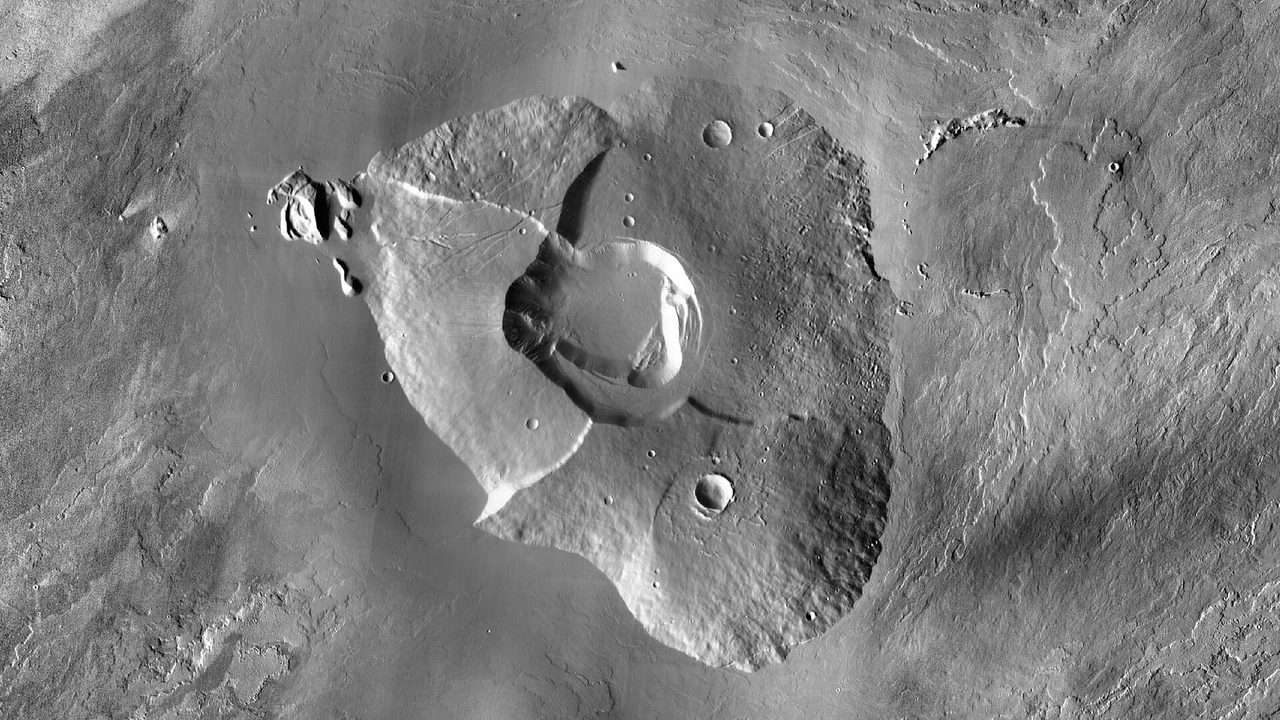
A spacecraft circling Mars has returned new images of Tharsis Tholus, an ancient volcano that is no longer active. According to Space.com, the European Space Agency's Mars Express orbiter captured the views, which show a worn but remarkably steep mountain scarred by impacts and cracks.

The images offer scientists a close look at the volcano's surface, and every feature on it can help them reconstruct what this part of Mars was like in the distant past.

What is Tharsis Tholus?

It is a dead Martian volcano. Space.com reported that Mars Express photographed it with its High Resolution Stereo Camera. The spacecraft has been orbiting and studying the planet since it arrived in 2003.

How big is it?

The volcano stands about 4.97 miles (8 kilometers) tall, according to Space.com. That is comparable to some of the highest peaks in the Himalayas on Earth, even though the mountain is old and eroded.

By Martian standards, however, it is only medium-sized. The planet's largest volcano, Olympus Mons, measures roughly 13.2 miles (21.3 kilometers) high.

What makes it unusual?

Its steepness. Space.com said Tharsis Tholus is steeper than Mauna Kea in Hawaii. The outlet also noted that, as ESA reported, researchers exaggerated the vertical scale in the image to show the volcano's structure and terrain in three dimensions. The slopes may therefore look sharper in the picture than they would to someone standing on them.

The surface is also dotted with what look like small holes. These are craters left by impacts from objects such as asteroids. According to Space.com, the volcano's present shape comes from three things working together: those impacts, erosion and warping caused by environmental factors, and built-up material from ancient lava flows. The Mars Express observations also reveal cracks and other flaws in the structure.

Why does it matter?

For most readers, this is a window onto another world rather than a matter of daily life. The scientific value lies in the details. Space.com wrote that every small crater, lumpy cliffside and worn surface holds information about the planet's past.

By studying volcanoes like this one, researchers can piece together what ancient Mars may have looked like. They can ask how active the volcano once was and how it interacted with the landscape around it. Space.com said observations like these could hold the answers, but it did not report any specific findings on those questions.

The images are also a reminder that Mars Express, in orbit since 2003, is still returning new views of the planet. The outlet described the imagery as new and recently captured.

Is this a new discovery?

Space.com's account focuses on the new imagery rather than on a first-ever finding. Its report presents the pictures as a detailed look at the volcano's shape, craters and cracks. It does not describe a study or a peer-reviewed paper, and it gives no timeline for further analysis of the volcano.

Around Prague, based on reporting by Space.com

Cover photo: NASA / JPL-Caltech / Arizona State University / Wikimedia Commons (public domain)

Share: Telegram WhatsApp

More science news

Shroud of Turin Carries DNA From Maize, Peanuts and Red Coral, Study Finds
The most thorough DNA analysis of the Shroud of Turin to date has found genetic traces from many people, animals and plants, including crops native to the Americas. According to ScienceAlert, the inte
Part of the Milky Way’s Norma Arm May Be a Star Factory on the Galactic Bar
Part of what astronomers have long called the Norma spiral arm of the Milky Way may not be a spiral arm at all, according to a new study in Nature Astronomy. The researchers say it could instead be a
Why DNA Uses Thymine: A Built-In Sunscreen That May Have Shielded Early Life
A building block of DNA that looks like a weakness may actually have been a strength. Researchers at Texas A&M University report that thymine, which DNA uses in place of RNA's uracil, appears to chann
Arctic Laser Station Tracks Satellites With Thousands of Pulses a Second
A faster and more precise satellite-tracking laser officially began operating on Oct. 12 at the Ny-Ålesund Geodetic Observatory in Svalbard, Norway, according to NASA. It is the first of NASA's next-g
Why Black Saturn Needs a Fifth Dimension and a Spinning Ring
A "Black Saturn" is a theoretical object: a round black hole circled by a ring-shaped black hole, with each keeping its own boundary. A new paper by theoretical physicist Jay Armas, submitted to the a
Robot Finds Explosive Volcanic Rock 20,000 Feet Down in Mariana Trench
A robotic submersible exploring the Mariana Trench has found the shattered debris of explosive volcanic eruptions on a trench wall about 20,000 feet below the surface, Popular Science reported. The re

Related news

The most thorough DNA analysis of the Shroud of Turin to date has found genetic traces from many people, animals and plants, including crops native to the Americas. According to ScienceAlert, the international team behind the study, publish
Part of what astronomers have long called the Norma spiral arm of the Milky Way may not be a spiral arm at all, according to a new study in Nature Astronomy. The researchers say it could instead be a region where stars are forming along the
A building block of DNA that looks like a weakness may actually have been a strength. Researchers at Texas A&M University report that thymine, which DNA uses in place of RNA's uracil, appears to channel ultraviolet damage into forms that ar
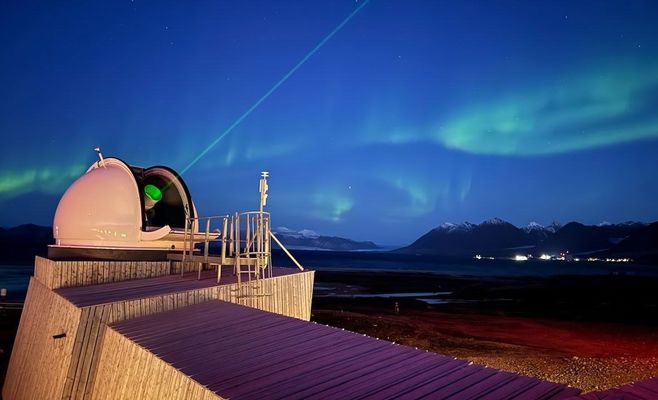
A faster and more precise satellite-tracking laser officially began operating on Oct. 12 at the Ny-Ålesund Geodetic Observatory in Svalbard, Norway, according to NASA. It is the first of NASA's next-generation satellite laser ranging system
A "Black Saturn" is a theoretical object: a round black hole circled by a ring-shaped black hole, with each keeping its own boundary. A new paper by theoretical physicist Jay Armas, submitted to the arXiv platform on Nov. 16, 2026, extends
A robotic submersible exploring the Mariana Trench has found the shattered debris of explosive volcanic eruptions on a trench wall about 20,000 feet below the surface, Popular Science reported. The researchers say it is the deepest evidence
Scientists exploring the deepest part of the ocean have found evidence of an explosive eruption where they did not expect any volcanic activity at all. According to Live Science, a robotic submersible spotted the deepest pyroclastic flow ev
Some massive stars may end their lives without the blast scientists usually expect, collapsing straight into black holes instead. A new Caltech-led study of gravitational wave data finds a pattern in black hole masses that fits that idea, a
Astronomers say the strange orbits of some icy objects far beyond Neptune could point to a hidden planet, and it would not be the long-sought Planet Nine. A new study proposes a second world, informally called Planet X2, according to Scienc
Black holes are known to collide and merge, but a new theoretical study suggests they might also break apart. Under extremely specific conditions, the researchers propose, a black hole could fragment into smaller ones, a bit like a pair of
Archaeologists in western Hungary have uncovered a hoard of more than 200 Celtic silver coins, each over 2,000 years old, according to Live Science. The cache is described as one of the largest found in the country in decades. The coins cam
Light that is supposed to push an interstellar spacecraft forward can start working against it, according to a new physics study. Once a laser-driven solar sail reaches about 75% of the speed of light, part of the scattered light produces d