Harvard dropout's AI chip startup Etched now worth $21 billion
USD 21,66
Popular
In March 2023, Gavin Uberti dropped out of Harvard mid-semester, giving up a degree in computer science and math for Peter Thiel’s $250,000 fellowship. Three years later, investors have valued the startup he founded, Etched, at $21 billion — about 441 billion crowns — with the company’s valuation more than doubling in just the past month.
The Thiel Fellowship is one of Silicon Valley’s best-known programs. PayPal co-founder, early Facebook investor and Donald Trump backer Peter Thiel launched it back in 2011: people under 22 are offered up to $250,000 on the condition that they drop out of university and build their own business. The program’s acceptance rate is tougher than getting into Harvard — only one-tenth of a percent of applicants are accepted. Its alumni already include 11 companies valued at over a billion dollars, including Vitalik Buterin’s Ethereum and Dylan Field’s Figma. Etched became the fastest addition yet to this elite club.
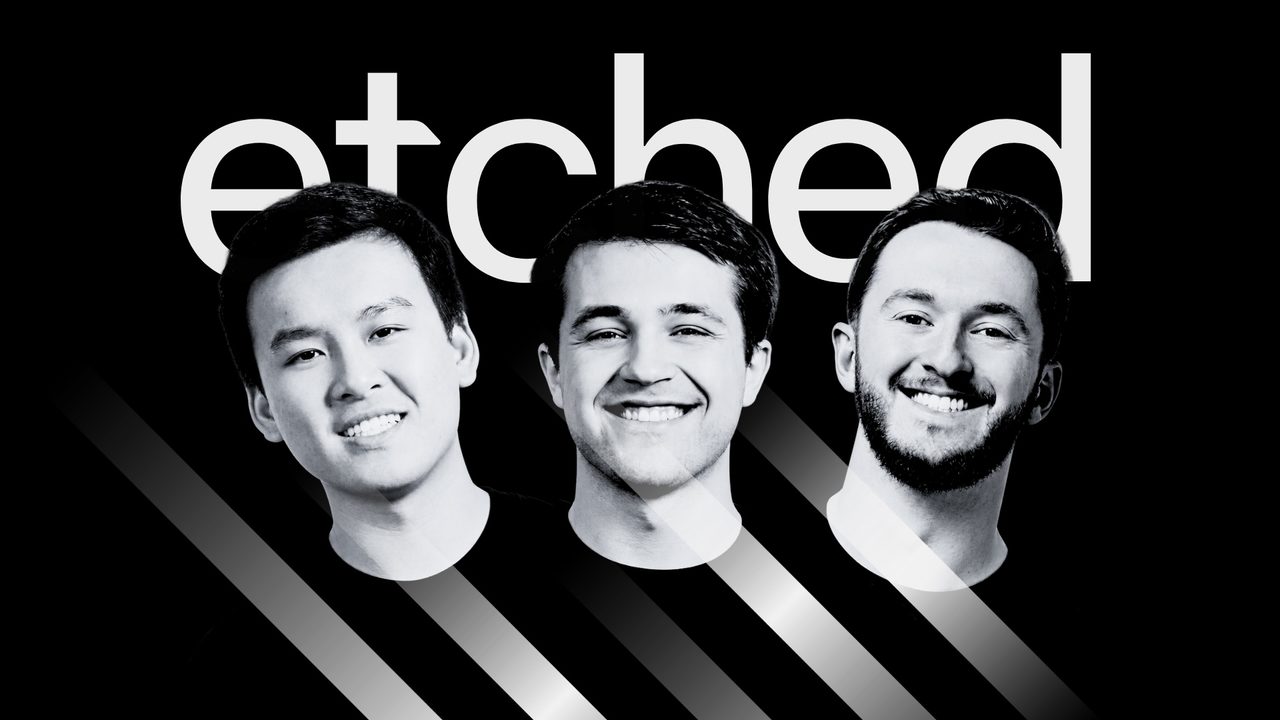
By the time he left university, the 25-year-old Uberti already had startup experience — as a teenager he had worked part-time at Xnor.ai, a company that ran artificial intelligence on edge devices. He left Harvard together with Chris Zhu and Robert Wachen, who had previously run the elite university’s student startup incubator.
The trio’s bet was bold even by Valley standards. “In 2022, we bet that transformers would run the world,” Uberti told TechCrunch, referring to the neural network architecture that powers all major large language models today. Etched built the Sohu chip, whose architecture, according to the founders, is literally “burned into silicon” for transformers — one such server, the company claimed, can replace 160 Nvidia H100 GPUs.
Money came in surprisingly fast: just a month after leaving university, Etched closed a seed round of $5.36 million. That was followed by $120 million in June 2024, with Peter Thiel himself among the investors — at the time, the company had only a chip design on hand, without a single working sample.
Critics doubted that betting on a single architecture made sense in an industry where everything changes every few months. The team partly took that to heart: today, Etched’s systems can work with any top model, including ones not based on transformers. “A lot has changed. It’s a completely different world,” Wachen admitted.
The turning point came when the chip, manufactured by Taiwanese giant TSMC, worked on the first try. Last December, Etched was valued at $5 billion; by July this year, that had risen to $10.3 billion, and this week investors put in another $700 million at a $21 billion valuation.
In other words, the company’s valuation grew by more than 100% in just a month, to the equivalent of 440 billion crowns. Etched now employs around 400 people, and the company is building a ten-megawatt computing data center.
The latest round was led by algorithmic trading firm Jane Street, which also became Etched’s first customer. “We tested the chip and are pleased with the initial results. Etched’s unique approach to inference delivers the accuracy we’ll need for our most demanding tasks,” the firm said. Elite investors Kleiner Perkins, Sequoia Capital and Andreessen Horowitz also joined the round.