People By

Visa's Marcel Hajdoš: soon AI agents will shop and pay for us

Marcel Hajdoš (Visa): soon AI agents will shop for us — and find the best price without ever getting lazy

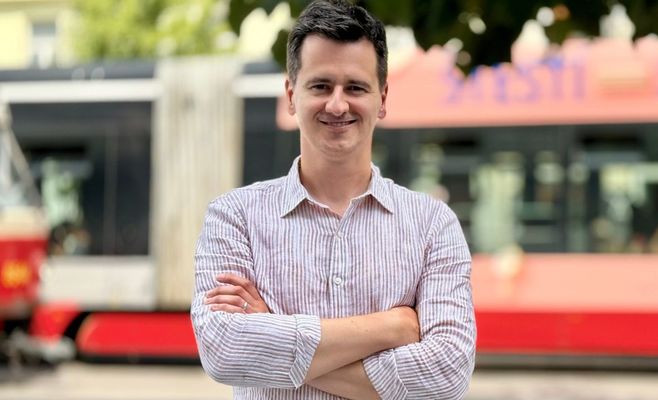
Marcel Hajdoš, Visa's head for Czechia, Hungary and Slovakia, is convinced that the next era of online shopping will belong to autonomous AI agents that search for products, compare prices and pay on a person's behalf. In his view, if the last decade was the era of mobile payments, the next one will be the era of “agentic shopping.”

Hajdoš has worked at Visa for more than twenty years and was effectively one of two people who launched the company's Prague office, which served the entire Czech card and terminal market. Today he oversees Visa's operations across three countries at once, and his focus has shifted toward artificial intelligence technology.

The idea is simple: a user tells an AI agent — in ChatGPT or Claude, for instance — the parameters of a purchase: the product, the desired delivery time, the maximum price, and then steps back from the process entirely. The agent checks dozens of online stores on its own, finds the best offer, places the order and makes the payment.

Visa's key task in this process is to preserve the same level of trust and security that people are used to with ordinary bank cards. “We want the same highly secure, convenient environment we built for contactless cards and mobile payments to work exactly the same way in e-commerce,” Hajdoš explains.

Technically, when a card is linked to an AI system, the card number is tokenized — neither the agent nor the merchant ever sees it in the clear. Visa protects both the buyer and the seller at once: it matters to the merchant to be certain that a purchase request comes from a certified agent rather than a fraudulent bot.

According to Hajdoš, Visa is developing standards and trust mechanisms for interactions between cardholders, AI agents and merchants. The company is also exploring broader use of stablecoins for cross-border settlements, which would allow transactions to go through even outside traditional banking hours.

These ambitions make sense given the current state of the Czech e-commerce market: online purchases account for just 15–20% of total card transactions in Czechia, whereas in the UK offline and online purchases are split almost evenly, 50-50. Hajdoš notes that Czechs were long fairly conservative about online payments, and it took the COVID-19 pandemic to get them used to ordering even everyday goods through services like Rohlík or Košík.

Today, growing trust in digital payments is being reinforced by Apple Pay, Google Pay and the global Click to Pay standard, developed by a consortium of the market's biggest players, including Visa. In Hajdoš's view, the arrival of AI agents in shopping will be a natural continuation of this trend — an autonomous agent can process far more information than a person, and many times faster.

Share: Telegram WhatsApp

Related news

Two Czech billionaires, Pavel Tykač and Jaroslav Strnad, are building an industrial alliance: steel from the Norwegian plant 7 Steel Nordic, owned by energy magnate Tykač, has started shipping to the Nová huť steelworks in Ostrava, closely
The Brno-based company Logmanager, a developer of a cybersecurity analytics platform, is joining Denmark's Guardsix. The deal's value, estimated by CzechCrunch, could reach the low hundreds of millions of crowns, and for Logmanager's direct
Petr Janošík, founder of the Brno-based startup Smartlook, sold his company to the American tech giant Cisco in 2023 for a sum in the billions of crowns. But the real test for the entrepreneur wasn't the deal itself — it was figuring out wh
Slovak investor Michael Kollár left his native Bratislava at the age of 17 to chase a dream — working on Wall Street. Years later he landed in Prague, where just nine months after launching his own fund, GateVest, he had raised two billion
Emil Blažek spent more than a decade coaching the Czech Republic's top sport shooters and preparing the national team for the Atlanta Olympics, but after the Games he turned down a tempting offer to lead the Swiss national team and threw hi
The Foodora delivery service is now available to 70% of Czechia's population, and the company itself has turned a profit for the first time after years of investment and losses. That's according to the head of Foodora's Czech division, Adam
The founder of Czechia's largest family amusement park, Jiří Antoš, has announced record investments worth hundreds of millions of crowns — his company is building a unique wooden roller coaster unlike anything the country has seen before.
Jan Boruta, co-founder of the investment group Leverage, has described how a small Czech backpack and bag brand, Playbag, with annual revenue of around 7 million crowns, turned into an internally fully automated business thanks to artificia
The Swedish startup Lovable, not even three years old, has raised $400 million at a $13.3 billion valuation (around 280 billion crowns) — twice what it was worth six months ago. Its founder, Anton Osika, together with his partner Fabian Hed
Luděk Palata, founder of the investment firm Versute Investments and one of the most experienced names in Czech private equity, told The Forbes Show podcast how he can tell within a couple of minutes whether a company is healthy inside, and
Penta Real Estate, part of the investment group led by Marek Dospiva, has acquired a 50% stake in HoldCo Bubny, which owns land in Prague's Bubny-Zátory area. This makes Penta the lead developer of one of Prague's largest undeveloped sites
Czech investor Luděk Palata is one of the few businessmen in the country who have worked in private equity since the 1990s. In a new episode of The Forbes Show podcast, he explained how to tell at a glance whether a company is healthy, and