Hyperloop: the future of transport, says CEO Dirk Ahlborn
USD 21,65
Popular
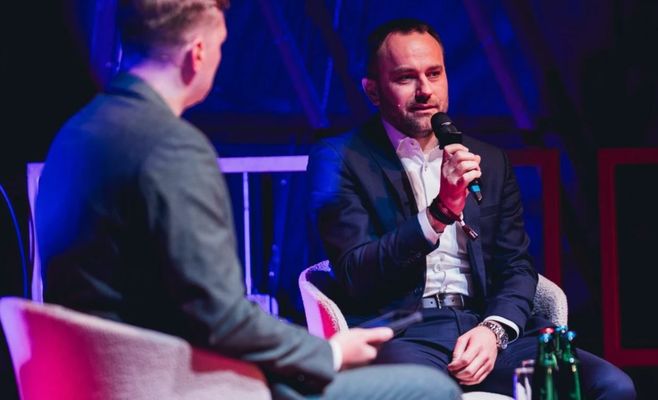
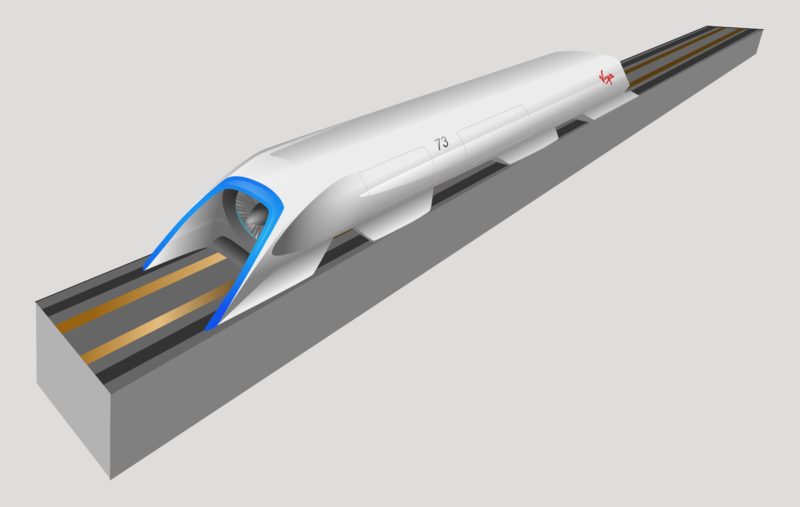
Hyperloop is the transport system of the future, created by Elon Musk, the founder of Tesla and SpaceX, and within a few years it could replace trains as a new way to travel. Hyperloop is a capsule riding on air cushions that will carry passengers through a tube at speeds of up to 1,200 km/h. That is what Dirk Ahlborn, CEO of Hyperloop Transportation Technologies, told the news outlet Info at an investment summit in Bratislava.
“We work with people from many different fields. We do this because we want to change the very idea of transport,” Ahlborn said at the start of the interview. Hyperloop Transportation Technologies is a community of engineers from the world’s leading technology companies and scientists from top American universities, all working together to build the transport of the future.
“Hyperloop should be not just fast and comfortable, but environmentally friendly too. The tube itself will be covered in solar panels, so running costs will be minimal. We want to change what people think transport is and show that it can actually turn a profit. In Los Angeles, the metro earns 76 cents per passenger, with the state covering another $2.5, while New York’s subway loses $2.2 billion a year. Things aren’t much better in Europe – Germany, for instance, spends $22 billion a year from its state budget just to maintain its railways,” the CEO says.
Do you think Hyperloop could replace traditional modes of transport such as buses and trains?
“They already exist, so I don’t think so. This is about creating something entirely new. A new form of transport needs to emerge – one that can actually turn a profit, for the first time ever. There isn’t a single railway system or metro anywhere in the world that turns a profit. We want to show that it’s possible,” Ahlborn says.
Isn’t that a bit overconfident – why would your solution be the one to make money?
Not at all. We want to do our job better than everyone else – you can be sure of that. Public transport hasn’t changed in the last hundred years; it just keeps losing money. There’s no overconfidence in what I’m saying – it’s actually quite simple, and we know we can pull it off. Our costs are minimal, so making a profit is straightforward.
We’re here in Bratislava – what can you tell us about this project?
The project will be officially presented in the next few months. For now it will be local in scope. As for building a transport link between Bratislava and Vienna, I can say that both governments view it positively and support the project. There are certain political changes happening in Austria right now, but overall everything is on track. The Czech government supports our ideas too.
Do you have plans to build a Hyperloop line between Prague and Brno, or Prague and Vienna – maybe even Prague–Bratislava?
We’ve already held several conferences on this topic, and you’ll find out more very soon. Nothing has changed on the Prague–Brno route for years, but as I understand it, there are certain issues there, particularly around buying up the land needed to build the system.
Do you think people might be afraid to travel inside the capsules?
We’re doing everything we can to make sure our future customers never even think about that. Hyperloop is meant to be even more comfortable than flying.
How many people can fit in one capsule?
I think around 28 people.
There have been reports in the media more than once suggesting Hyperloop could even become free to use – is that true?
We look at transport from a somewhat different angle. You need to step back from everything and look at it differently. Once you do that, you’ll realize that you spend quite a lot of time on a train or a plane, so transport and marketing can essentially be treated as the same thing. Today, transport companies can make real money only because people spend a significant amount of time inside them.
You have to understand that, put simply, we’re a construction company – we just build the modern mode of transport, and then it’s the government of whatever country it’s built in that operates each stretch. If that’s in the Czech Republic, then Czech authorities will decide whether to charge for rides or not. Personally, I think travel should be free. Paying just to use public transport is a thing of the past. What would make sense is paying extra for service, for certain amenities – but never simply for the ride itself.
When do you think Hyperloop could become an everyday mode of transport?
By 2020, several test sections will be built and go through extensive testing, and after that we’ll start building Hyperloop in different parts of the world. I’d say it will take around 10 years for Hyperloop to become a familiar mode of transport.