Voynich manuscript: researchers say its pages were put out of order
USD 21,86
Popular
A new study suggests that the pages of the mysterious Voynich manuscript were rebound in the 15th century, which may have changed their order completely. The work has been published in a scholarly journal devoted to medieval culture, and it shifts attention from the script itself to the construction of the book.
For more than a hundred years the manuscript has resisted linguists, cryptologists and historians. One recent hypothesis, reported by the website Novinki, showed that text resembling so-called Voynichese can be produced with a carefully designed cipher.
Singletons instead of a book
According to the authors, the leaves were originally made up as singletons — separate bifolia, that is, sheets of parchment or paper folded in half. In an ordinary binding, several such sheets are nested inside one another, whereas singletons are laid one on top of the other. Later, apparently still in the 15th century, they were assembled into their present form, and the order of the pages could have changed.
The researchers applied latent semantic analysis, a statistical method that makes it possible to compare the similarity of blocks of text. It turned out that some parts of the manuscript are very similar to each other, even though today they are separated by other pages. This, the authors say, suggests that they once lay much closer together.
The drawings also partly support the hypothesis. For example, streams of water in the current binding run into the inner edge of the page, and the drawing on the facing page does not continue them. With a different order of the bifolia, the pictures make more sense. “As soon as you start treating them as loose pages stacked in a pile, all these inconsistencies suddenly fall into place,” one of the authors, Colin Layfield, told the British newspaper The Guardian. A similar construction is known from several medieval Qurans from North Africa.
A manuscript as collective work
If the manuscript was originally a set of separate bifolia, it may have served more as a set of small working or study notebooks than as a single book by one author. This is consistent with palaeographic analysis, according to which up to five different scribes may have worked on the manuscript.
“Many people wanted the Voynich manuscript to be created by some mad genius working in an attic in medieval London or somewhere else. But in fact the evidence points more to collective work, perhaps a set of booklets through which knowledge was passed down from generation to generation,” added co-author Lisa Fagin Davis. Judging by the drawings of plants, astrological diagrams and female figures, she allows that the manuscript preserved folk women’s knowledge of the body, herbs and astrology, but this cannot yet be proved.
What is known about the manuscript
The Voynich manuscript is a richly illustrated codex that resembles a strange medieval encyclopedia. According to radiocarbon dating, the parchment dates from the early 15th century, between 1404 and 1438. It takes its name from the antiquarian Wilfrid Voynich, who drew the attention of specialists and the public to it in 1912. Today the book is kept in the library of Yale University in the United States.
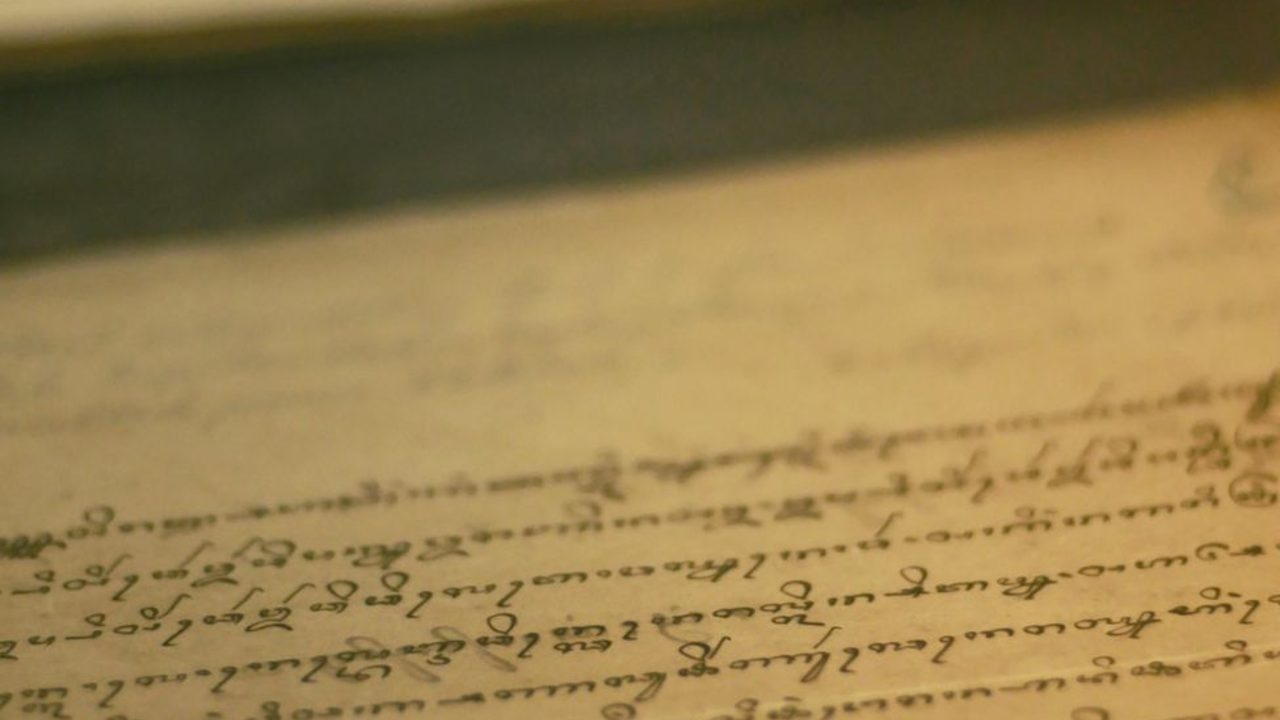
It contains hundreds of drawings of plants, astronomical and astrological diagrams, circular charts and scenes with nude female figures. The main mystery is the text, written in a script that has still not been deciphered. It does not look like a random set of signs: the “words” repeat regularly, form patterns, and their frequency differs between parts of the manuscript. Some researchers see in it an encoded natural language, others an artificial language, an alchemical code or even a carefully constructed forgery.
Source: novinky.cz