Czech prices nearly catch up with German ones — the gap narrows to just 2.3%

USD 21,75
Popular
- today at 20:10
- News
- War in Ukraine
Five Ukrainian soldiers shot dead near Kharkiv
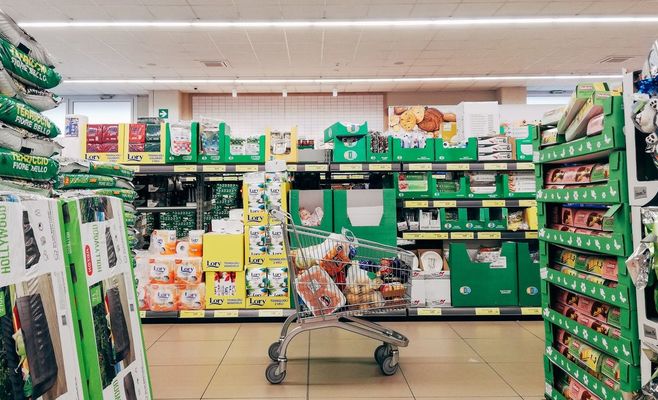
The price gap between Czech and German grocery stores has all but disappeared. According to a comparative price study conducted by Seznam Zprávy Byznys at Lidl stores in Frýdlant (Czechia), Zittau (Germany) and Bogatynia (Poland), shopping in Germany was still 9.2% cheaper just a year ago — but today the difference has shrunk to a mere 2.3%.
For the study, researchers compared 27 identical items — bread, milk, butter, cheese, meat, eggs, vegetables, fruit, coffee, pasta, rice, drinks, as well as dishwasher tablets and toilet paper. A basket assembled on 22 September 2026 at regular prices came out 28 crowns cheaper in Germany and 103 crowns cheaper in Poland. But once promotional discounts were factored in, Czech and German prices were essentially level, while Poland remained cheaper by around 78 crowns.
Czech prices are falling faster than those of its neighbours
The cost of the same basket at Czech Lidl stores dropped over the past year from 1,396 to 1,244 crowns — an 11% decline. By comparison, prices in Germany fell just 4.1% over the same period, and in Poland, 4.8%.
A notable shift has taken place since February 2022, when the outlet first ran this kind of comparison. Back then, the same basket cost 71 crowns less in Germany, and a striking 239 crowns less in Poland. That was the golden age of cross-border “shopping tourism” to Poland, driven largely by political decisions: in 2022 the Polish government sharply cut VAT in response to the energy crisis, drawing droves of Czechs to Polish chains such as Biedronka, Lidl and Dino.
In 2024, however, Poland scrapped its zero VAT rate on food, while Czechia, as part of its consolidation package, merged its two reduced VAT rates (15% and 10%) into a single 12% rate. That slightly lowered prices on staple goods — meat, sausages, dairy, eggs, vegetables and fruit.
Why prices are converging right now
The trend with Germany looks like this: in February 2022, shopping there was 6.3% cheaper; a year later, 5.8% cheaper; in 2024, 4.7% cheaper; and by June 2025, 3.9% cheaper. Last September the gap unexpectedly jumped back up to 9.2% — only to collapse to 2.3% this year.
But this sudden convergence isn’t down to VAT changes — it’s the result of a new pricing strategy at Czech Lidl. Since February, the chain has been gradually lowering standard prices on a number of basket items, adding flour, milk, rice, pasta, eggs and butter to its “Steady Prices” programme. Compared to last September, the model shopping basket in Czechia has become 151 crowns cheaper overall — 80 crowns of that saving coming specifically from items in the new programme.
According to marketing expert Zdeněk Skála of the agency Skála & Schulz, this kind of move is a way to stand out in a market oversaturated with discounts and to become more transparent to shoppers. “In many categories, the gap between promotional and regular prices has stopped making sense — promotions have eroded trust in regular prices altogether. Lidl is responding to exactly that,” the expert explains.
Competitive pressure may also be at play: according to Euromonitor, Lidl’s share of the Czech discount market fell from 61% in 2020 to 57% in 2025, while Penny — thanks to an aggressive pricing strategy during the “great inflation wave” — grew from 36% to 41%. Skála notes that Penny has been strengthening its position through aggressive regional expansion, building retail parks across the country.
Where it now pays to shop
As with Poland, the same rule increasingly applies to shopping in Germany: to actually save money, you need to pick and choose specific items. A year ago, it made sense for Czechs to buy 17 of the 27 items on the list in Germany — this September, that number had dropped to just 13.
The biggest gap in Germany’s favour is apples: a kilo of red apples there cost around 27 crowns — roughly a third (about 13 crowns) cheaper than at Czech Lidl. Nutella and tomatoes were also roughly a third cheaper, while butter and dishwasher tablets were more than a quarter cheaper (29 crowns in Germany versus 40 crowns in Czechia). Dairy market experts attribute the drop in dairy prices to fierce competition among chains amid a European milk surplus, along with retailers squeezing producers on price.
On the other hand, it doesn’t pay for Czechs to buy chicken breast, fish fingers, flour, milk, bread or rice in Germany — rice there is 29% more expensive, and chicken breast, 24% more expensive.
Poland remains the cheapest of the three countries overall, though its edge over Czechia has narrowed: last September, shopping in Poland was about 14% cheaper than in Czechia, but this year the difference has shrunk to roughly 8%. The best Polish bargains are cucumbers, about 55% cheaper, along with potatoes and yoghurt at around 44% cheaper; bread and apples are also noticeably cheaper there.
Read also: Outlets and shopping in Prague
Source: seznamzpravy.cz