Science & Space By

Drone Survey Finds Erect-Crested Penguins Stable on One Island, Falling on Another
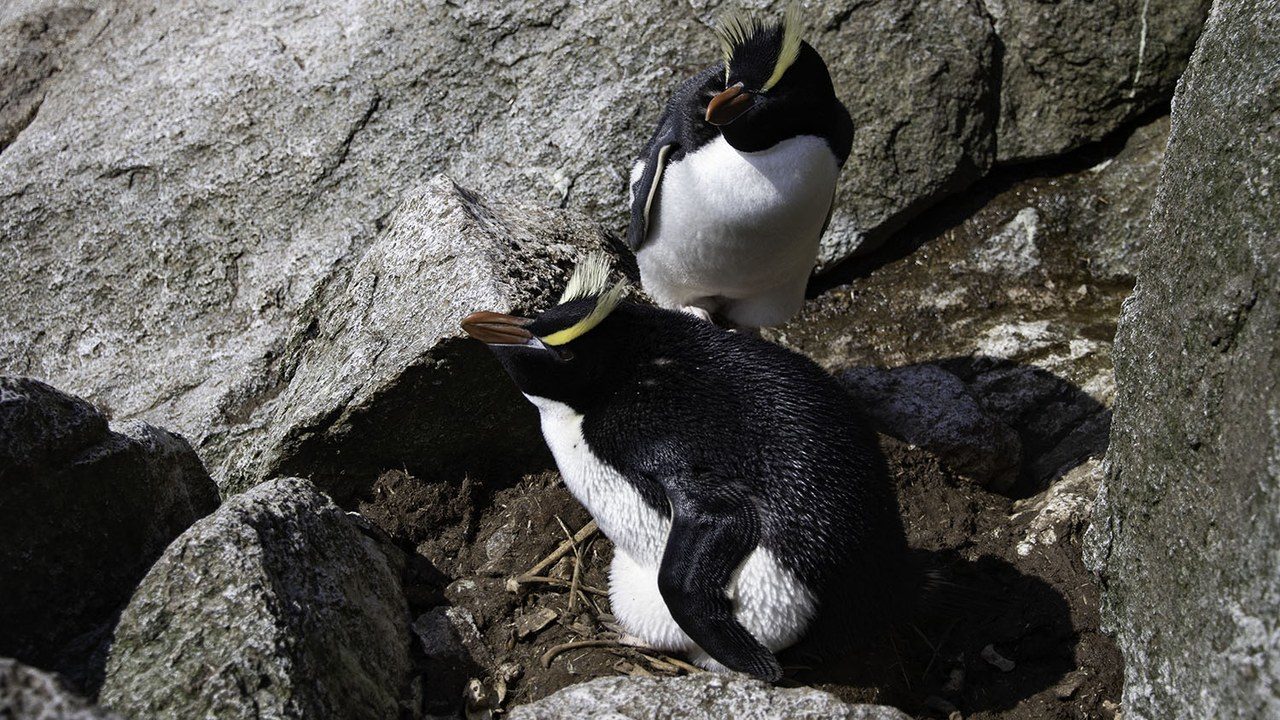
One of New Zealand's least understood penguin species is doing well in one place and badly in another, according to a University of Otago study published in PLOS ONE. Erect-crested penguins breed on only two remote island groups, and a drone survey found that one population has held steady for at least 25 years while the other has dropped by more than 40 percent over three decades.

The findings, reported by ScienceDaily, overturn a long-held assumption about which island group matters most to the species.

What the drone survey counted

The penguins breed only on the Bounty and Antipodes islands, which lie roughly 800 kilometers southeast of New Zealand's South Island. Between 2022 and 2024, researchers used drones to photograph and count every breeding colony on both island groups, producing the first comprehensive population survey of the entire species.

The results surprised the team. The Bounty Islands, only 50 hectares in size, hold about 27,800 breeding pairs. The Antipodes Islands, which are 40 times larger and were historically seen as the species' stronghold, hold about 29,800. Dr. Thomas Mattern, who led the study for the university's Tawaki Project, said the long-standing assumption did not hold up.

Why one population is shrinking

When the new counts were compared with historical records going back to the mid-1990s, the Bounty Islands population turned out to be essentially unchanged. The Antipodes population has fallen by more than 40 percent since 1995.

The researchers believe several pressures overlap. One is predation by skuas, native subantarctic birds that eat penguin eggs and chicks. Mattern said that as Antipodes colonies shrank, the protection they once gained from nesting in large groups weakened, so losses to predators rose and colonies broke up further.

Co-author Dr. Klemens Pütz of the Antarctic Research Trust suggested that another species may have made this worse. Eastern Rockhopper penguins suffered a severe collapse in the second half of the 20th century, likely driven by warming ocean waters, and fewer than 1,000 breeding pairs now remain on the Antipodes Islands. Pütz said skuas may have turned to Erect-crested eggs and chicks as Rockhoppers disappeared.

Storms are another factor. Increasingly powerful storms, consistent with wider climate trends across the Southern Ocean, have caused landslides that split up breeding colonies and leave birds more exposed.

Movement at sea may also play a part. According to Mattern, Antipodes birds travel long distances into the Antarctic Polar Frontal Zone once breeding ends, while Bounty Islands birds stay nearer their nesting grounds, where the water is more sheltered and may hold more food.

Why it matters: one species, two different outlooks

The researchers named the situation Schrödinger's Penguin, a twist on the physics thought experiment of a cat that is both alive and dead until a box is opened. Mattern said the penguins work the other way around: from a distance, everyone assumed a single answer for the whole species, but once scientists looked, they found two states, stable on the Bounty Islands and declining on the Antipodes Islands.

The practical lesson, the report says, is that looking at a species as a whole can hide what is happening within individual populations. For an endangered penguin that breeds in only two places, the survey shows that the overall picture can look reassuring while one of its two strongholds is steadily losing birds.

The study was carried out with the Antarctic Research Trust and the Global Penguin Society.

Around Prague, based on reporting by ScienceDaily

Cover photo: C00ch / Wikimedia Commons, CC BY-SA 4.0, cropped

Share: Telegram WhatsApp

More science news

Coffee May Change Your Gut Beyond the Bathroom Rush, Small Study Finds
Coffee may do more inside the body than wake you up and get your bowels moving. A small new study in the journal Gut Microbiology links regular coffee drinking to differences in gut physiology and in
Fish-Heavy Diets Made Medieval Danish Monks Look Centuries Too Old
Some skeletons found at medieval monasteries in Denmark appear to be older than the monasteries themselves, and researchers now say a diet heavy in freshwater fish is the likely reason. According to S
Ancient Underwater Canyons Helped Preserve Earth's Oldest Animals
Huge canyons cut into the seafloor more than half a billion years ago may be the reason scientists can study some of Earth's earliest animals at all, according to a new study of rock formations in Sou
Pakistani Astronaut Will Be First Foreigner to Fly to China's Tiangong Station
China plans to launch its Shenzhou 24 mission to the Tiangong space station on Nov. 25, and one of the three people aboard will be a Pakistani astronaut, the first foreigner to travel to the station,
Mystery Object in the Milky Way Flared Every 62 Minutes, Then Went Silent
Astronomers have identified another of the strange radio sources known as long-period transients, an object that sent out powerful flares every 62.2 minutes and then went quiet, ScienceAlert reported.
Voyager 1 Becomes First Human-Made Object to Reach One Light-Day From Earth
NASA has announced that its Voyager 1 probe will soon become the first human-made object to travel one light-day from Earth, according to Al Jazeera. The milestone is due on Wednesday, when the spacec

Related news

Coffee may do more inside the body than wake you up and get your bowels moving. A small new study in the journal Gut Microbiology links regular coffee drinking to differences in gut physiology and in the bacteria found in stool, according t
Some skeletons found at medieval monasteries in Denmark appear to be older than the monasteries themselves, and researchers now say a diet heavy in freshwater fish is the likely reason. According to ScienceAlert, scientists from the Univers
Huge canyons cut into the seafloor more than half a billion years ago may be the reason scientists can study some of Earth's earliest animals at all, according to a new study of rock formations in South Australia. ScienceAlert reported that
China plans to launch its Shenzhou 24 mission to the Tiangong space station on Nov. 25, and one of the three people aboard will be a Pakistani astronaut, the first foreigner to travel to the station, according to Universe Today. The crew wi
Astronomers have identified another of the strange radio sources known as long-period transients, an object that sent out powerful flares every 62.2 minutes and then went quiet, ScienceAlert reported. The discovery, led by Scott Hyman of Sw
NASA has announced that its Voyager 1 probe will soon become the first human-made object to travel one light-day from Earth, according to Al Jazeera. The milestone is due on Wednesday, when the spacecraft will have covered at least 16 billi
A comb-shaped electronic device has regrown nearly all the lost hair in mice with a form of pattern baldness, according to ScienceAlert. The results are preliminary: the system, called Detangle, has so far been tested only in mice, and it i
Older adults who keep regular daily schedules report less physical pain and fewer symptoms of depression, even when they sleep poorly, according to a University of Missouri study summarized by ScienceDaily. The researchers say the work show
The Pleiades star cluster is becoming easy to find in the evening sky, and Space.com is encouraging skywatchers to count how many of its stars they can see without a telescope. The result depends less on eyesight alone than on how well prep
Mars and Jupiter will sit side by side in the constellation Leo on the night of Nov. 15-16, in a pairing that will not repeat this closely until July 2029, Space.com reports. For viewers in the U.S., the two planets rise over the eastern ho
Astronomers have found a large icy object beyond Pluto that could become the sixth officially recognized dwarf planet, according to ScienceDaily and the University of Washington. The object, temporarily named 2026 ED138, turned up in observ
Four planets are strung out in a diagonal line across the pre-dawn sky this month, and all of them can be seen without a telescope. The BBC reports that Mercury, Venus, Mars and Jupiter will be visible to the naked eye in the south-eastern