An experimental Chinese maglev train — which glides above a specially designed track thanks to magnetic levitation — has set a new record for speed and acceleration, reaching 799 km/h from a standing start in just 5.3 seconds. The tests took place at the Tongxu laboratory in China's central Hubei province.
The 1.1-tonne prototype was tested on a short one-kilometre stretch of track. According to Jan Bauer, head of the Department of Electric Drives and Traction at the Faculty of Electrical Engineering of the Czech Technical University (CTU) in Prague, the track's deviation from a perfectly flat surface didn't exceed 0.1 millimetres — a level of precision that's practically impossible to achieve under real-world operating conditions.
Why China Chases Such Records
According to the Czech expert, showcasing achievements like this is primarily a way for China to demonstrate its scientific and technological prowess — its ability to master complex technologies and push objects to extreme speeds and accelerations.
The acceleration achieved by the prototype was around 4G, or roughly 40 m/s². For a human passenger, that kind of force would be extremely uncomfortable — and completely unacceptable from a passenger-safety standpoint. Ordinary trains and trams accelerate at just 1 to 1.5 m/s².
Still, the tests confirmed that extreme speed doesn't rule out controlled braking: after accelerating to 799 km/h, the metal capsule weighing over a tonne came to a smooth stop, with a braking distance just over 200 metres. Bauer notes that this kind of technology might be more relevant for long-distance freight transport, given the sheer scale of Chinese territory. According to The Independent, researchers are also hoping to apply the technology to electromagnetic catapults for rockets and fighter jets — meaning military applications could well outpace civilian ones.
How Magnetic Levitation Works
Unlike conventional trains, maglevs have no wheels: magnetic forces hold them above the guideway, eliminating any physical contact with the track — and with it, the friction that normally slows trains down. Coils running along the track generate alternating electromagnetic fields that create a travelling magnetic wave, essentially forming a giant catapult that propels the train forward.
But even this technology has its limits — air resistance being one of them. The force the train must overcome grows sharply with speed: while Shanghai's maglev tops out at around 400 km/h, the experimental prototype reaches double that — meaning air resistance increases fourfold. Energy costs rise right along with speed.
Cheap flights from Prague
One search across every airline and travel agency.
In Europe, the main obstacle to adopting maglev technology won't be the technology itself, but rather the strict track-quality requirements and the population's purchasing power.
"If you look at Czechia in terms of available land or the feasibility of building new rail corridors, it's practically impossible. In China, they approach railway construction differently — they simply decide to build a new line to the exact specifications they need," explains Jan Bauer.
Michal Drábek, an engineer at CTU's Faculty of Transportation Sciences, adds that maglev requires an entirely new network of tracks, and that both China and Japan far outstrip Czechia in terms of population and economic output. There's also the question of ticket prices: while China and Japan can easily find enough affluent passengers to fill the trains, a Czech maglev line would risk running without enough paying customers.
Another complication lies in switching tracks: since a maglev train is held aloft by coils and a magnetic cushion rather than resting on rails, changing tracks requires far more complex engineering solutions.
"Personally, I lean toward conventional high-speed trains running at 320 or even 250 km/h as the backbone of our public transport system. But such a train shouldn't require mandatory seat reservations — otherwise we'll kill the system on Friday and Sunday evenings and scare passengers away," says Drábek. He believes fares should vary by comfort level and include cheaper options — otherwise trains won't fill up, and building expensive infrastructure for a narrow circle of wealthy passengers makes no economic sense.
Kimberly Guilfoyle is leaving her post as U.S. ambassador to Greece after the White House asked her to resign amid allegations of misconduct, according to NBC News and Fox News. She announced the move
Kroger plans to lay off 3,000 corporate employees over the next three years as it expands its use of artificial intelligence, according to ABC News and Fox Business. CEO Greg Foran announced the move
The Supreme Court on Tuesday agreed to hear a dispute over whether the Department of Government Efficiency, known as DOGE, is covered by the Freedom of Information Act. The case could determine whethe
The Supreme Court on Tuesday agreed to hear a Trump administration appeal in a dispute over whether the Department of Government Efficiency, known as DOGE, must turn over records under the Freedom of
A woman wearing a shirt that read "Release the Epstein Files" was punched in the face by an apparent supporter of President Donald Trump during a rally Monday in Youngstown, Ohio, according to Fox New
No NFL team and not the league itself mentioned Columbus Day on social media Monday, according to Fox News. Three teams, the Minnesota Vikings, Kansas City Chiefs and Los Angeles Rams, instead posted
Microsoft has moved the end of extended support for Windows 10 for home users: the ESU programme now runs until 12 October 2027 instead of 13 October 2026. For owners of older computers, that means one more year of security updates.Under th
Apple has unveiled a new line of smart home devices: cameras, a door lock, a video doorbell and thermostats. All the hardware connects through the iPhone and is controlled from the Home app or by voice via Siri. The Apple HomeView smart dis
Vast areas of Siberia hold the remains of microorganisms thousands and tens of thousands of years old in permafrost. As the Arctic warms rapidly due to climate change, more and more of this “infected soil” is thawing, the news agency Bloomb
Online grocery store Rohlík.cz has told customers about a major personal data leak: an outsider gained access to part of their communication with customer support. The company said so in an email it sent to shoppers.The leaked data includes
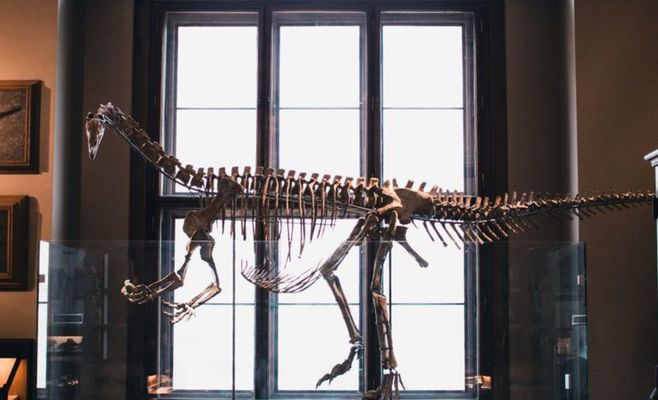
Spanish palaeontologists have found the first evidence that diplodocus lived in Europe as well. They have assigned a skeleton from the village of El Castellar near Teruel, about 100 kilometres northwest of Valencia, to the genus Diplodocus.
World Space Week is held every year from October 4 to 10. The world's largest celebration of space exploration, proclaimed by the UN, commemorates two important milestones: the launch of the first artificial satellite, Sputnik 1 (October 4,
Interest in the new iPhones has proved weaker than expected, and Apple is cutting their production. Nikkei Asia reports this, citing several well-informed sources.According to the publication, Apple has taken a more cautious approach to shi
Three former OpenAI safety researchers say the company fired them because they raised safety concerns. OpenAI says they were dismissed for mishandling sensitive information, and that the decisions had nothing to do with speaking out. Mikita
French startup Harmattan AI has unveiled IRIFI, an autonomous, expendable long-range strike drone. According to its creators, it can hit a target up to 2,000 kilometres away without using satellite navigation or help from an operator during
Software pioneer Margaret Hamilton died in late September at the age of 90, the Massachusetts Institute of Technology (MIT) announced on Thursday. In 1969, her program helped the Apollo 11 crew, led by Neil Armstrong, land on the Moon. Hami
At a presentation in San Francisco, Microsoft unveiled the Surface Laptop Ultra, the most powerful and most expensive laptop in the Surface family. The base version costs $2,599 (about CZK 56,600). When and at what price the device will arr
Artificial intelligence makes work easier, but it can also put a company in the firing line: according to Irena Hysková, head of the Czech cybersecurity firm Alintrust, employees often secretly use free public chatbots, such as ChatGPT, for