Solomon Islands Ends China Security Pact Ahead of Australia Treaty
USD 22,36
Popular
Solomon Islands has told China it will not renew the 2022 security agreement between the two countries, according to The Sydney Morning Herald and ABC News Australia. The Pacific nation is expected to sign a wide-ranging treaty with Australia in Canberra on Wednesday, which would make Australia its main security partner.
Both outlets relied on sources for the news. They said Prime Minister Matthew Wale's government notified Beijing that the five-year pact will lapse in April rather than extend. The ABC said it contacted the Solomon Islands government, the Chinese Embassy in Solomon Islands and the Australian government for comment.
What the 2022 pact allowed
The Herald said a leaked copy of the agreement, struck in April 2022, shows it runs for five years and renews automatically for another five unless either side gives six months' written notice. It lets Solomon Islands ask China to send police and military personnel to help maintain social order, and it permits Chinese naval vessels to make stopovers.
The ABC reported that the arrangement lets China rotate police training teams through the country, with about two dozen Chinese police permanently there at any time. The Herald reported that China's policing presence is now expected to shrink significantly.
Solomon Islands lies 1,600 km from Australia. The Herald said the deal raised fears that China might seek a military base there, though that has not happened.
Why Canberra cared so much
The pact's disclosure rattled Australia and became an issue in the 2022 federal election. Penny Wong, then in opposition and now foreign minister, called it the “worst foreign policy blunder in the Pacific” since World War II. The ABC noted that the Albanese government says it is in a “permanent contest” with China in the region.
The Herald reported that Australia went on to sign its own security agreements with Tuvalu, Nauru, Papua New Guinea, Vanuatu and Fiji.
What Australia is reportedly offering
The treaty's details have not been officially released. The ABC confirmed last month that Australia will provide $980 million in additional funding. Leaked texts seen by the ABC show $142 million for Wale's free education policy and $47.8 million for visa improvements and “security requests” from Solomon Islands.
The Herald cited a leaked message from Australia's high commissioner in Honiara, Jeffrey Roach, to Deputy Prime Minister Francis Sade. It said each Solomon Islands constituency would receive an estimated $1.9 million over three years for community priorities. The message also put the education funding at $142 million over two years and the total Australian funding at $980 million by 2028.
Wale is leading a 24-member delegation to Canberra, the Herald said, including 15 cabinet ministers. The ABC said the delegation flew on a chartered flight paid for by the Australian government.
What analysts and politicians are saying
Oliver Nobetau, Pacific Islands program director at the Lowy Institute, a Sydney-based think tank, called the move a “massive win” for Australia. He asked what Australia had offered Wale in return and said he suspected a very large incentive.
Anna Powles, a security studies academic at Massey University in New Zealand, told the ABC the decision is significant and ties Solomon Islands more closely to Australia. Two former Australian high commissioners to Honiara also commented. James Batley called it a significant reversal for China's interests in the region. Lachlan Strahan said China's policing role in the Pacific had been pushed onto the back foot.
Former prime minister Manasseh Sogavare, now opposition leader and a key figure behind the 2022 deal, urged the government to explain its reasons and say what would replace the cooperation Solomon Islands received from China. The Herald dated his statement to Tuesday and the ABC to Monday. He said the people of Solomon Islands, not China or Australia, would bear the consequences.
Peter Kenilorea Junior, a senior minister under Sogavare, told the Herald after Wale's June visit to Australia that the new government wanted “a rebalancing of relations” with China. He said it would focus on economic development rather than policing.
What this means for Solomon Islands and the region
For people in Solomon Islands, the shift could change who provides policing support and how development money flows. The reported Australian package includes school education funding and community grants for each constituency. China's police presence is expected to shrink, according to the Herald.
For the wider Pacific, analysts said the move could point the region in a different direction. Wale may also face political risk at home. He was elected in May and survived a no-confidence motion in September, which the Herald said was widely believed to be linked to China's efforts to derail the Australia talks. Nobetau told the ABC that Wale's decision could invite another challenge.
What happens next
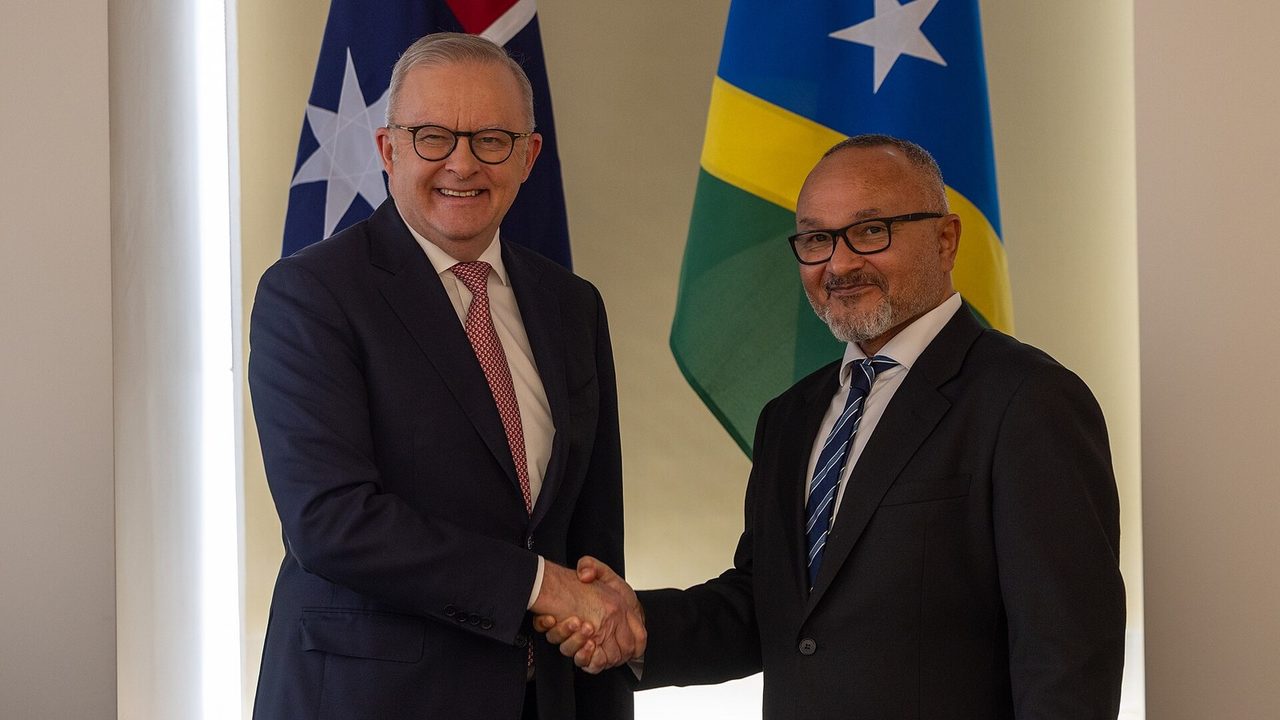
Wale is due to meet Prime Minister Anthony Albanese in Canberra on Wednesday, when the treaty is expected to be signed. Albanese said in a statement that he looked forward to welcoming his friend to continue strengthening the security and prosperity of the region. Wong told the Senate that Australia is finalizing a treaty that will elevate and deepen the partnership. The China pact is due to expire in April.
Read next
Nvidia Ends China Sales of Its Licensed AI Chips After $2.4 Billion Quarter
Canada Wraps Up Philippines Trade Talks as It Courts Asia Beyond the U.S.
Poland Seeks NATO Reinforcement as Kaliningrad Drone Claims Spark Disinformation Warning
Around Prague, based on reporting by The Sydney Morning Herald, ABC News Australia
Cover photo: Andrew Kelly/DFAT / Wikimedia Commons, CC BY 4.0, cropped