Olomouc restores Mercury fountain using Prague Castle lead method
USD 21,62
Popular
Olomouc has completed a large-scale restoration of the Baroque Mercury fountain, one of the city's most valuable Baroque-era monuments. Specialists replaced the worn water circulation system installed back in the 1980s and fixed a chronic leak in the basin by lining it with a lead sheet — a method that has been successfully used for more than three decades in restoring the fountains of Prague Castle.
Lead instead of clay
For many years the fountain's basin suffered from leaks. The traditional clay sealing that restorers usually prefer failed to solve the problem for long. “We had to line the basin with a lead sheet. It provides reliable watertightness while still respecting the fountain's historic structure,” said Olomouc deputy mayor Tomáš Sikora (ANO party).
According to him, this is not an experimental solution: lead sealing has proven its reliability in restoring fountains on the grounds of Prague Castle, where it has been successfully used for more than 30 years. “Lead cladding combines reliable protection with a long service life. It treats the original material gently, and in the future it can be removed without any serious intervention in the historic structure,” Sikora added.
Laser cleaning of the statue and new engineering
The lead-laying work of restorer Jiří Finger was highly praised by Petr Skalický of the Directorate General of the National Heritage Institute, who said it was carried out “precisely and to a high standard, with respect for the monument and maximum regard for its material historical structure.”
The true extent of the damage to the Mercury statue itself only became apparent after it was cleaned, so restorers applied additional laser cleaning — a method that allows precise control over the intensity of treatment and gently removes unwanted deposits without mechanically damaging the original material. The piping and the underground service shaft were also renewed: it received new hatches and reinforced-concrete beams so it can safely bear the weight of heavy vehicles passing near the fountain. During the trial run, specialists will determine the optimal water level and fine-tune the system's operating parameters.
The god of trade at a crossroads
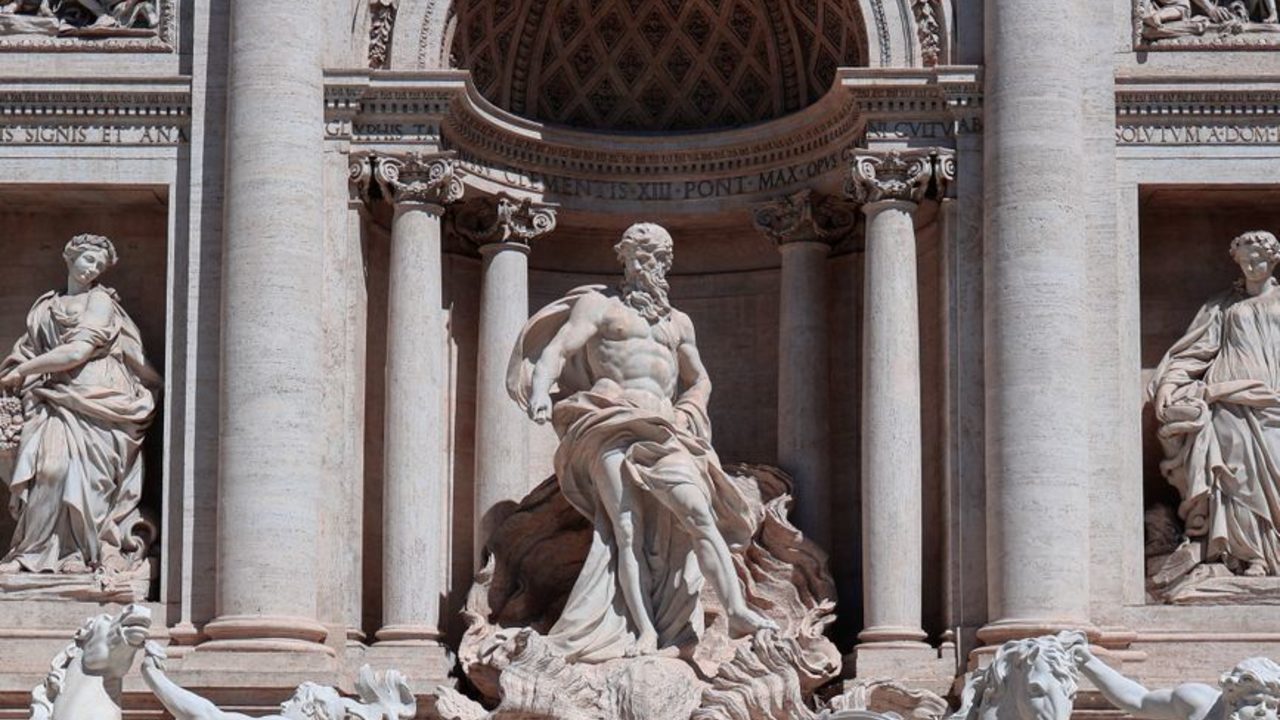
The Mercury fountain was completed in 1727. It was created by stonemason Václav Render, builder Jan Jakub Kniebandl, and sculptor Filip Sattler, who made the central figure of Mercury.
The ancient patron of merchants, travelers and messengers is depicted in a dynamic, spiraling pose: in his right hand he holds a gilded winged staff — a caduceus. Three serpentine fish-shaped water spouts emerge from a stylized rock at his feet. According to one interpretation, they symbolize the rivers of the underworld — Lethe, Styx and Acheron — and Mercury's role as a guide of souls to the afterlife.
The fountain stands at the crossing of 8. května and 28. října streets, where one of the main trade routes through historic Olomouc once ran — so the location of a monument dedicated to the god of trade was no accident.
A unique ensemble of six fountains
In the center of Olomouc, within a relatively small area, six Baroque fountains dedicated to figures from ancient mythology have survived: Hercules, Caesar, Neptune, Jupiter, Mercury and the Tritons. This ensemble is a unique phenomenon on a European scale. The oldest of them is the 1683 Neptune fountain, and the youngest is the 1727 Mercury fountain.
Source: novinky.cz