Science & Space By

A New Egg-Eating Snake, No Thicker Than a Knitting Needle, Found in Ethiopia
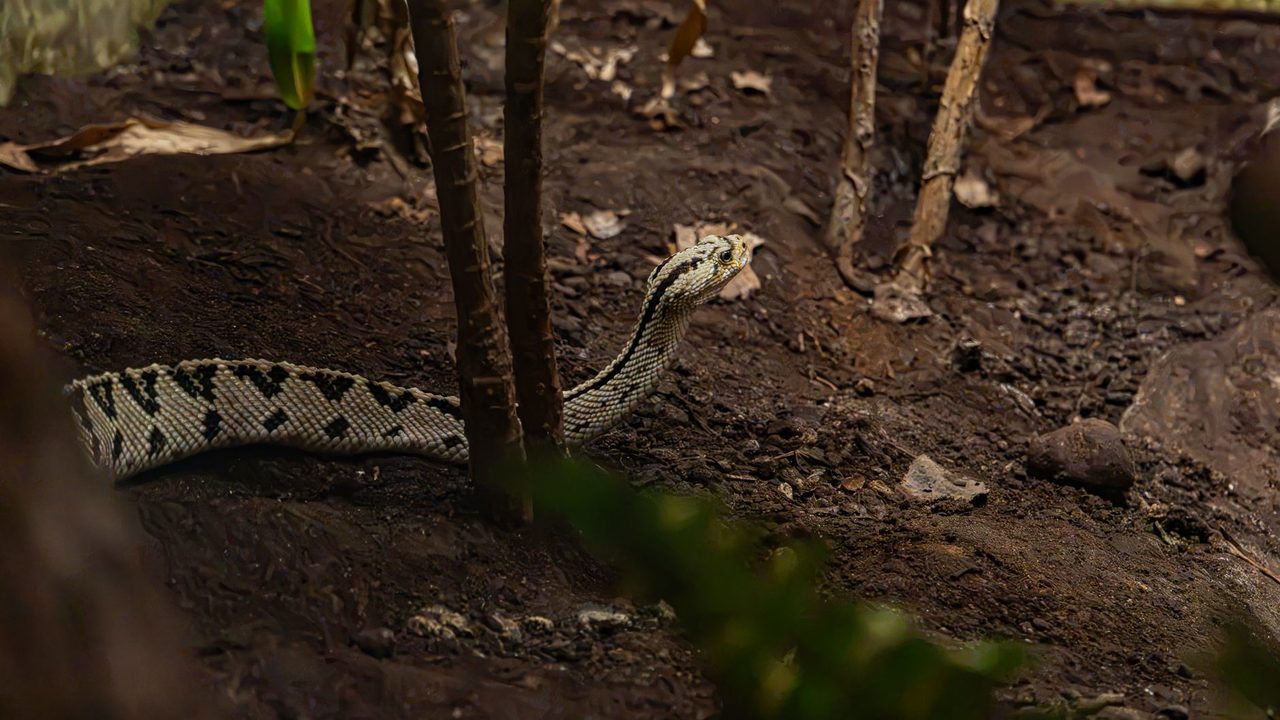
Biologists have described a new species of egg-eating snake from forests near the Bale Mountains in southeastern Ethiopia, according to Popular Science. The white-throated egg-eater, Dasypeltis albigularis, is a tiny, nonvenomous snake that lives entirely on eggs, and its discoverers say more new relatives are on the way.

The description appeared in a study recently published in the journal Herpetozoa. Here is what the research reports.

What did the researchers find?

The team found multiple new species of egg-eating snakes in the area, but the study formally describes only one of them. Arthur Tiutenko, a co-author and herpetologist at Germany’s Friedrich-Alexander University of Erlangen–Nuremberg, said in a statement that “Three other species in this genus are still waiting in line.” The researchers promised that information on those additional finds is on the way.

How do the snakes eat only eggs?

Many snakes will eat an egg when they get the chance, but a handful of species eat nothing else. According to Popular Science, these snakes live mostly in Africa and some parts of India, and they have evolved a set of unusual tricks.

Extensions of their backbones reach into the esophagus and work like a saw to cut open the shell. Neck muscles then squeeze the contents down the throat, and the snake spits out the cracked shell when it is done.

How can scientists tell this species apart?

The team nearly missed it. At first glance the snake looks very much like the montane egg-eater, Dasypeltis atra. A closer look showed differences. A patch of white scales runs down its underside, which gave the new species its name, and the skin between the scales has a distinct blue shimmer.

There is a behavioral difference too. Other egg-eating snakes rub their scales together to make a rustling sound that startles enemies. Only females of the new species do the same motion, and they do it silently.

How big is it?

Not big at all. The white-throated egg-eater is less than eight inches long, weighs only 0.05 ounces and is about as thick as a knitting needle. That means it can only handle the tiniest eggs, laid by small birds. Tiutenko suggested the region’s abundance of such eggs may help explain why egg-eating snakes live only in Africa, and in particular in a small area in the southwest corner of the Arabian peninsula.

Why does it matter?

For readers, the find is a reminder that even well-studied groups of animals can hold unknown species, especially in less-surveyed forests. The snake looks so much like a known species that it could easily have been overlooked, and the researchers say the same genus still holds at least three more undescribed species from the same area.

The study describes the species and how it differs from its close lookalike. It does not, according to the Popular Science account, say how common the snake is or how it is faring in the wild. Those questions, along with the identities of the other three species, remain for future work.

Around Prague, based on reporting by Popular Science
Share: Telegram WhatsApp

More science news

Hamster Cells Now Carry Algae DNA Across 150 Generations of Division
Researchers in Japan have fused hamster cells with algae and kept the combined genetic material stable through more than 150 generations of cell division, ScienceAlert reported. The team calls the res
Webb Telescope Catches Two Stars Merging in the Andromeda Galaxy in Real Time
Astronomers have for the first time watched the final inspiral of two stars inside a shared envelope of gas, ending in a merger and a bright eruption, according to Universe Today. The event, cataloged
Florida Flooding Closes Schools and Parks Across Several Counties
Flooding in South Florida has shut schools, parks, libraries and county offices from Palm Beach to Broward, and two counties have extended local states of emergency, CBS12 reported on Thursday, Nov. 1
Physicists Imagine a Hidden Periodic Table Made of Dark Matter Atoms
A team of physicists in the U.S. and Canada has proposed that dark matter could contain its own versions of familiar chemical elements, a sort of hidden periodic table, according to ScienceAlert. The
Physicists Flipped an Atom's Nuclear Spin in an Experiment Theory Says Can't Work
Physicists at Delft University of Technology in the Netherlands have flipped the spin of an atom's nucleus using a scanning tunneling microscope, an effect that current understanding says should not h
Why Frozen Mars Dunes Look Like Forests of Trees in a NASA Photo
A photograph taken in 2008 by NASA's Mars Reconnaissance Orbiter appears to show thickets of scraggly trees standing upright on frozen dunes near the Martian north pole, ScienceAlert reported. The tre

Related news

Researchers in Japan have fused hamster cells with algae and kept the combined genetic material stable through more than 150 generations of cell division, ScienceAlert reported. The team calls the resulting cells “planimals,” and the study
Astronomers have for the first time watched the final inspiral of two stars inside a shared envelope of gas, ending in a merger and a bright eruption, according to Universe Today. The event, cataloged as AT 2025abao and nicknamed “Bao,” too
Flooding in South Florida has shut schools, parks, libraries and county offices from Palm Beach to Broward, and two counties have extended local states of emergency, CBS12 reported on Thursday, Nov. 19. A flood watch remains in effect for p
A team of physicists in the U.S. and Canada has proposed that dark matter could contain its own versions of familiar chemical elements, a sort of hidden periodic table, according to ScienceAlert. The idea, laid out in a long preprint paper,
Physicists at Delft University of Technology in the Netherlands have flipped the spin of an atom's nucleus using a scanning tunneling microscope, an effect that current understanding says should not happen, according to New Atlas. The resul
A photograph taken in 2008 by NASA's Mars Reconnaissance Orbiter appears to show thickets of scraggly trees standing upright on frozen dunes near the Martian north pole, ScienceAlert reported. The trees are an illusion. The dark streaks are
A joint European-Japanese space mission has arrived at Mercury after a voyage of more than eight years, The Guardian reported. Flight controllers are due to fire the spacecraft's thrusters on Saturday to send it into orbit around the smalle
Four years after NASA deliberately crashed a spacecraft into an asteroid, Europe's Hera probe has returned its first images of the target system, Universe Today reported, based on a European Space Agency press release. The pictures are the
The European Space Agency's Euclid space telescope has identified 15,000 new candidates for strong gravitational lenses, according to Universe Today. Astronomers say these rare cosmic magnifiers are one of the best ways to trace dark matter
A black hole no bigger than an atom could destroy an entire star from the inside, and the resulting flash might be bright enough for today's telescopes to spot, according to a new study by physicists at MIT and other institutions. The findi
Scientists on a NASA-backed project have grown potatoes in simulated moon soil, and with enough added compost the harvest matched what the same plants produced in ordinary Earth soil, according to a study in the journal npj Microgravity. Th
The rapid growth of data centers built for artificial intelligence harms air quality and health in regions far from the buildings themselves, according to a new study by MIT researchers. The team estimates that extra air pollution from the