Webb Telescope Catches Two Stars Merging in the Andromeda Galaxy in Real Time
USD 22,26
Popular
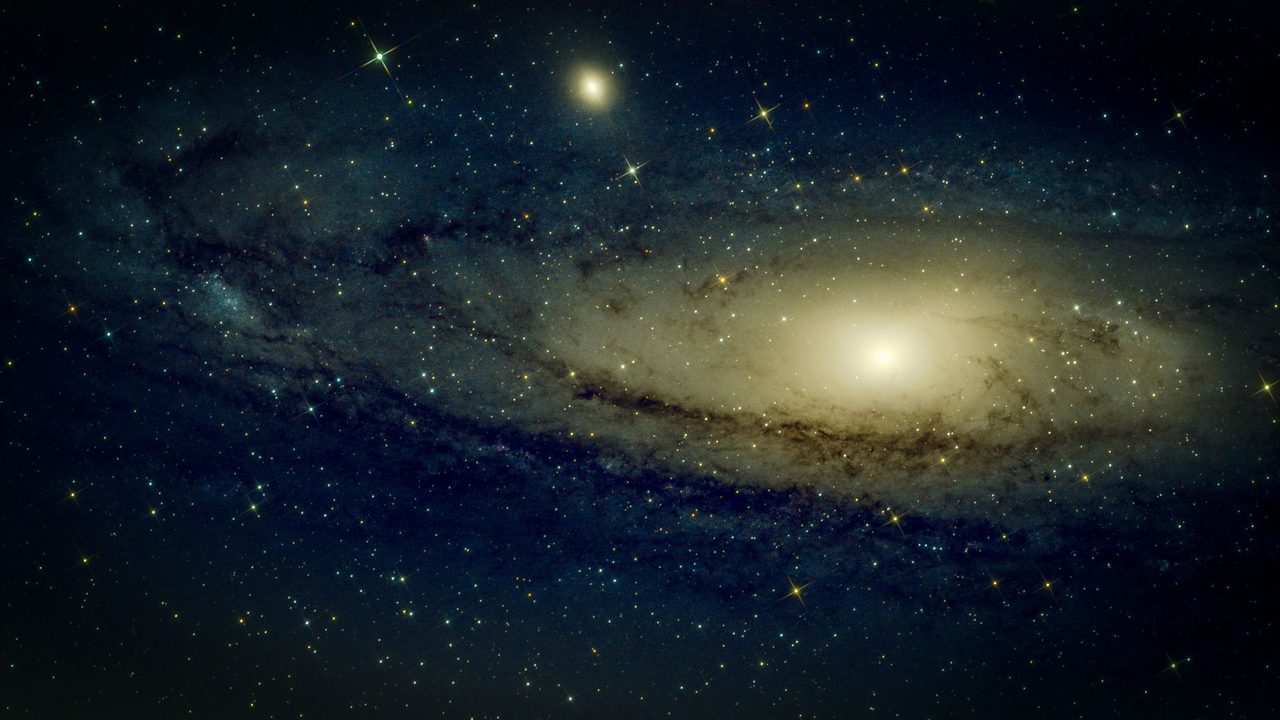
Astronomers have for the first time watched the final inspiral of two stars inside a shared envelope of gas, ending in a merger and a bright eruption, according to Universe Today. The event, cataloged as AT 2025abao and nicknamed “Bao,” took place in the Andromeda Galaxy, the Milky Way's neighbor.
The findings appear in a new paper in Nature, led by Viraj Karambelkar, a NASA Hubble Fellow at Columbia University in New York. The James Webb Space Telescope observed the aftermath earlier than it has ever followed up an event of this kind, which gave researchers a look at the system before, during and right after the merger.
The key numbers behind the Bao merger
- 47 days: how long after the eruption peaked that Webb observed Bao. The team describes this as the earliest follow-up of such an event.
- 7 orbits: how long the stars needed to merge once they made contact, about 7 years. Other stars in shared envelopes take thousands of orbits before they merge.
- 100 times: how much Bao brightened in the r-band, over a period of 25 days, in October 2025.
- About 8000 Kelvin: the temperature after that jump in brightness.
- About 3000 Kelvin: the temperature after the system cooled during a plateau that lasted about 80 days.
- 2018: the year the observations of the system go back to, when it began gradually brightening in optical light.
What astronomers saw
Many stars in the Milky Way are in pairs. In some of them, one star swells up and spills gas onto its companion until both are wrapped in a common envelope. That gas creates drag, which pulls the stars closer together. Either the envelope is thrown off and the stars remain as a tight pair, or it lingers and the stars merge, producing an explosion known as a luminous red nova.
Theory has long described this process, but nobody had observed the end of the inspiral and the eruption. Such events are rare and hard to predict. In Bao's case, a main-sequence star a little less massive than the Sun spiraled into a puffy supergiant companion.
The system had already drawn attention. Between 2018 and early 2025 it slowly brightened in optical light, then began to fade in optical light while its infrared light kept rising. Karambelkar said the team noticed something unusual in 2023 and kept watching. Then, in October 2025, it erupted.
Co-author Nadia Blagorodnova, an associate professor at the University of Barcelona in Spain, said the team had expected an outburst from such an extended star to take years. Instead, she said, the brightness began rising one day and peaked within a week.
Co-author Kishalay De, an assistant professor at Columbia University, described the early slow brightening as the sign of the companion beginning to interact with the outer surface of the main star. As the companion keeps orbiting, he said, it peels away the main star's outer layers and the gas flows into surrounding space.
Why it matters for understanding stars
This is a result about how stars live and die, not an event that affects life on Earth. Common envelope evolution is described in the report as a critical stage in the evolution of binary stars, and it is thought to be how tightly bound stellar pairs form in the first place. Until now, astronomers had to rely on theory for the final steps.
Because Bao was caught while it was happening, with data from before, during and immediately after the merger, researchers now have a real case to compare with their models. The fact that the stars merged after only 7 orbits also shows that not every such system follows the same slow timetable.
The result comes from one event in one galaxy, so it is a single case rather than a rule for all binary stars. Still, Karambelkar called the view Webb provided of the merger “absolutely mind-blowing,” according to Universe Today.
Universe Today reported that the Asiago 67/92cm Schmidt telescope captured a finding chart for the event on Nov. 7, 2025, when the light was at its maximum.
Around Prague, based on reporting by Universe Today