Comet Brightened Thousands of Times as Gas Blasted Off Its Crust
USD 22,10
Popular
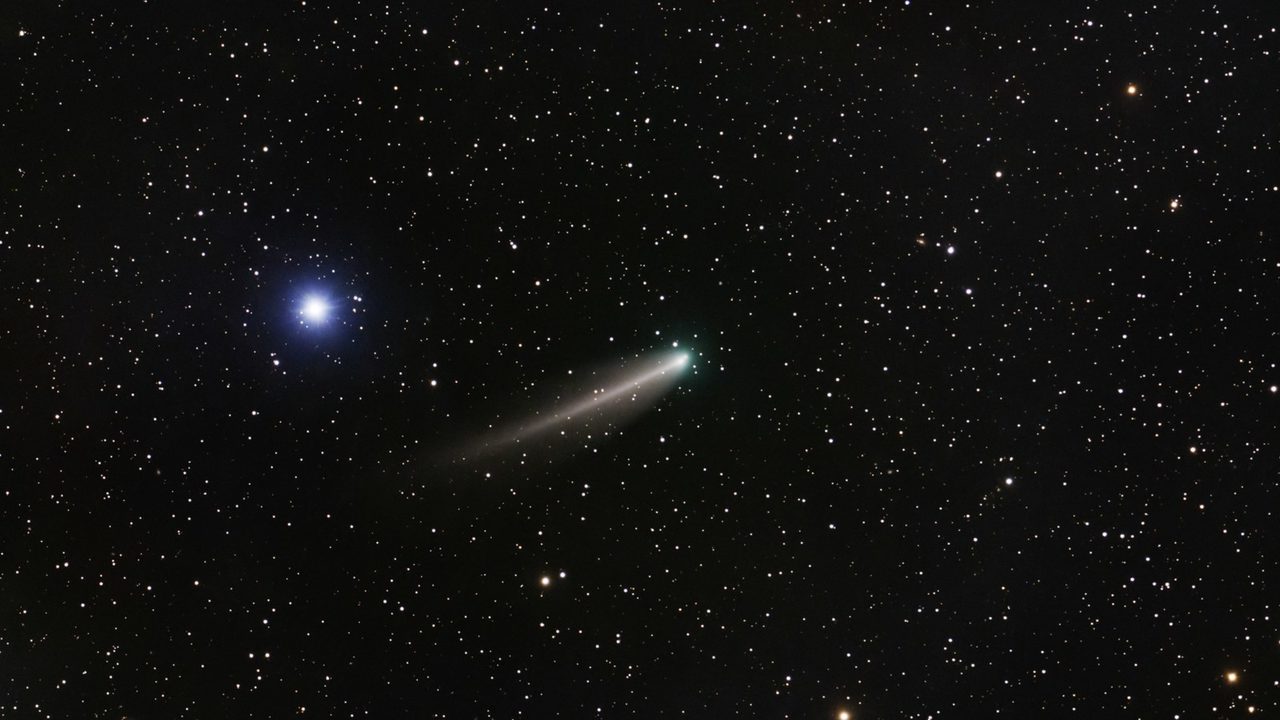
A faint, little-noticed comet flared up twice this summer, and researchers now say they know why. According to Space.com, sunlight warmed ice below the surface of comet 220P/McNaught, the ice turned to gas, and the escaping gas tore through the crust and threw out huge amounts of dust that made the comet far brighter.
The findings were published Nov. 3 in the Monthly Notices of the Royal Astronomical Society. Here is what the study and the observations show.
What is comet 220P/McNaught?
Australian comet hunter Robert McNaught discovered it in 2004. It is a periodic comet that returns to the inner solar system every 5.5 years, getting about as close to the sun as Mars. Its short orbit makes it a Jupiter-family comet. Normally it is dim, usually fainter than magnitude +15 and out of reach of most amateur telescopes. On the astronomers' scale, a higher number means a fainter object.
How much did it brighten?
Space.com reported that on May 31 the comet stood at magnitude +17.39. Within less than 14 hours it had climbed to magnitude +11.05, which put it within range of small amateur telescopes. By June 2 it reached magnitude +8.23 and was briefly visible in 10x50 binoculars from a dark site.
By its closest approach to the sun, at 1.5 times the Earth-sun distance, it had faded back to magnitude +12. A second outburst began at the end of July, taking the comet from magnitude +14 on July 28 to magnitude 6.1 by Aug. 6.
What actually happened to the comet?
Comets are often described as dirty snowballs. Under a dusty crust they hold ices of water, carbon dioxide and nitrogen. Even at roughly the distance of Mars, heat from the sun can make those ices turn to gas quickly, and the pressure of the escaping gas can rip the surface apart.
Models built from the observations suggest the outburst released between tens of billions and hundreds of billions of pounds of dust. The grains, only millionths of a meter across, moved outward at about 1,280 feet (390 meters) per second. They filled the coma, the hazy cloud around the comet's solid core, and scattered sunlight.
Study author Josep M. Trigo-Rodríguez, of the Institut de Ciències de l'Espai in Spain, said in a statement that the comet shed parts of its crust and formed a dust-rich shell. He said this made the comet 250 times brighter in half a day.
Has anything like this happened before?
This was the first time 220P has been seen in outburst, Space.com reported, but other comets have done the same. A well-known case is comet 17P/Holmes, which brightened a million-fold in the fall of 2007, going from magnitude +17 to magnitude +2.8 and becoming a naked-eye object in the constellation Perseus.
Why does it matter?
Outbursts give scientists a rare look at how strong a comet's body really is. Trigo-Rodríguez said Jupiter-family comets are of interest because they come mainly from the Kuiper Belt and the Scattered Disk, regions beyond the orbit of Neptune, before Jupiter captures them into short orbits.
He also linked the work to planetary defense. His group studies the tensile strength and nature of comets as part of research on impact hazards. He said some comets prove fragile enough that they could suggest approaches for deflecting or breaking up a threatening object that differ from those proposed for asteroids. That is a researcher's view of a possible direction, not a plan, and nothing in the reporting points to a comet threatening Earth.
Where is the comet now, and when can it be seen again?
The comet is heading back toward the far point of its orbit, just inside Jupiter's orbit at 4.68 astronomical units, or 435 million miles (700 million kilometers) from the sun. It passed closest to Earth on Oct. 12 at 1.04 astronomical units, or 97 million miles (156 million kilometers). It is now around magnitude +13 and fading. Astronomers expect to watch it again on its next trip around the sun in late 2031.
Read next
Interstellar Comet 3I/ATLAS Carries 13 Times More Heavy Methane Than Any Solar System Comet
Dust From Halley's Comet Will Streak Across the Sky Despite a Bright Moon
Asteroid 1998 KY26 Too Warm to Be a Dark Comet, New Heat Model Finds
Around Prague, based on reporting by Space.com
Cover photo: paramsach / Wikimedia Commons, CC BY 4.0, cropped