Science & Space By

Robot Dog Guided by Lab-Grown Neurons Finds Its Way to a Target on a Map
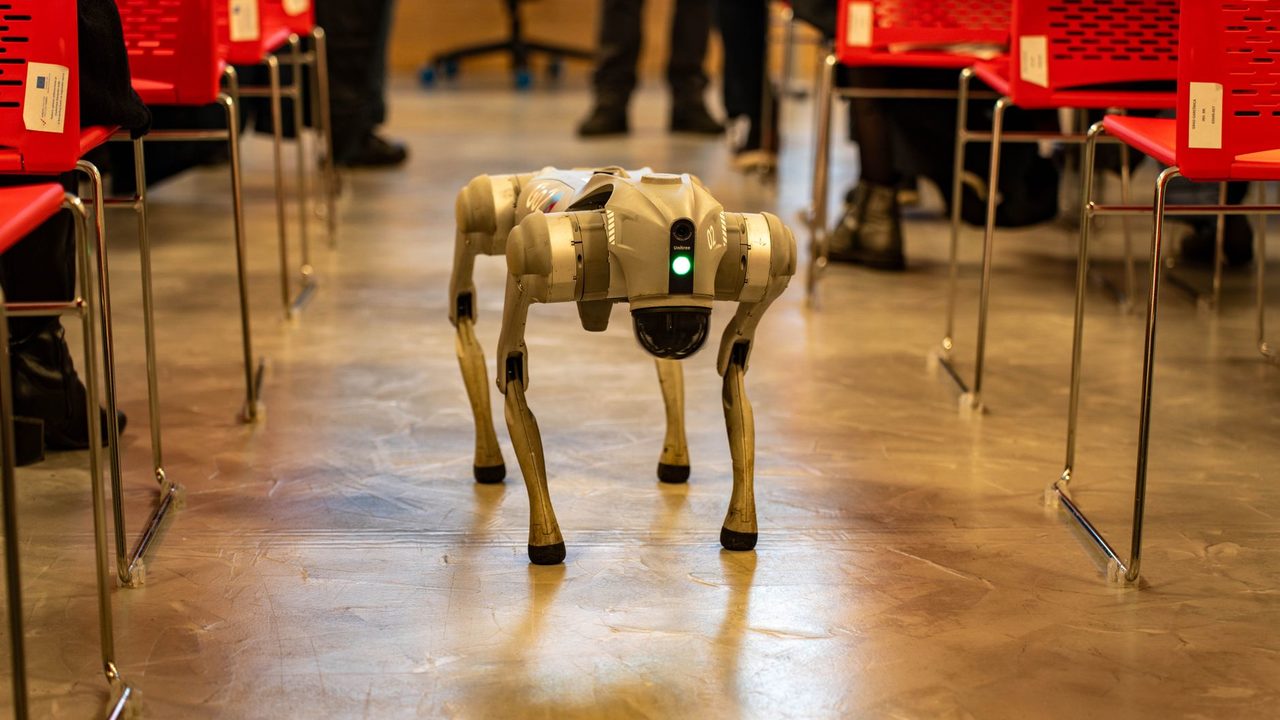
Scientists at Cortical Labs in Australia have fitted a robotic dog with lab-grown neurons that steer it toward a target on a simple map, according to ScienceAlert. The outlet described the cells as human brain cells in its headline.

The work is an early demonstration of a technology that aims to use living neurons as the basis of computer chips. The research on navigation has not yet been peer-reviewed, but it was presented at the NeurIPS 2026 conference and is available on arXiv.

How does the robot dog work?

The team grew the neurons directly on a chip fitted with electrodes that send electrical signals in both directions. That setup lets researchers translate activity in the small group of neurons into movement for the attached robot.

Brett Kagan, co-founder and CEO of Cortical Labs, called the dog a simple demonstration that helps make the opportunity tangible. He said the longer-term goal is to support robots and autonomous systems that must make decisions in unpredictable, real-world environments.

What did the Honda collaboration add?

Cortical Labs also ran a similar demonstration with Honda Research Institute Europe. In that test, everything ran in a virtual system, but the aim was the same: direct an agent around a basic grid in search of a reward.

The method was also the same. Electrical signals stimulated the neurons on a chip, and the chip sent electrical messages back. By changing the characteristics of the signal and giving feedback on the agent’s moves, the researchers trained the living chip and interpreted its movement. Over more than 4,000 hours of interactions, the team tested almost 1,300 different signal combinations.

Daniel Tanneberg, a senior scientist at Honda Research Institute Europe, said the collaboration lets researchers investigate fundamentally different approaches to intelligent agents. He said living cells as the core of computation bring many challenges but also potential in energy efficiency, robustness and adaptation.

Why does it matter?

ScienceAlert said living neurons promise advantages over conventional systems in energy efficiency and adaptability. Even though AI is sophisticated, the human brain needs far less power to run and is still much better at handling unfamiliar situations.

Kagan said robots are becoming remarkably capable at physical control, but still struggle to learn quickly or adapt when conditions change. In the longer term, ScienceAlert said, neuron-controlled robots could work in remote or hazardous conditions, or assist people with personalized responses that learn over time. Those uses remain a possibility, not a product.

Cortical Labs has previously shown clusters of neurons completing computer tasks, including playing the games Pong and Doom. The robotic dog extends that idea into the physical world.

How far along is the technology?

It is still early. ScienceAlert said the technology is not particularly fast or efficient yet, and the Honda experiment involved a fair amount of trial and error.

The next steps are to scale up the chips so they can handle more complex tasks in a shorter time, since robots in the real world will have to do far more than move around a simple grid. The researchers also want to learn more about how the neuron-based chips retain information and what kind of memory they might have.

Johnson Zhou, a research software engineer at Cortical Labs, said the challenge is not simply growing neurons on silicon. In his words, it is finding reliable ways to communicate with biological systems, train them and understand which approaches give consistent results. He said the new research provides a framework for testing those questions at scale.

Around Prague, based on reporting by ScienceAlert
Share: Telegram WhatsApp

More science news

Brains of People With PTSD Carry a Distinct Chemical Signature, Study of 302 Brains Finds
Scientists have found chemical marks on DNA in the brains of people with post-traumatic stress disorder that do not appear in people without the condition, and that also look different from the marks
New Method Stops AI Weather and Turbulence Models From Predicting the Impossible
Researchers at MIT say they have found a way to keep machine-learning models of chaotic systems from drifting into predictions that could never happen in the real world. According to MIT News, the met
NASA Backs 302 Small-Business Projects, From Rollable Solar Arrays to Lunar Landing Pads
NASA has selected 302 projects from small businesses for up to $171 million in early-stage funding, the agency announced. The awards target technology for exploring the Moon and Mars, including work t
Planet Hunt Turns Up a Surprise: A Red Dwarf Orbited by Two White Dwarfs
Astronomers looking for planets have found a triple star system only 28 light-years from Earth that one of the researchers says should not exist. According to Universe Today, the team went searching f
A New Egg-Eating Snake, No Thicker Than a Knitting Needle, Found in Ethiopia
Biologists have described a new species of egg-eating snake from forests near the Bale Mountains in southeastern Ethiopia, according to Popular Science. The white-throated egg-eater, Dasypeltis albigu
Hamster Cells Now Carry Algae DNA Across 150 Generations of Division
Researchers in Japan have fused hamster cells with algae and kept the combined genetic material stable through more than 150 generations of cell division, ScienceAlert reported. The team calls the res

Related news

Scientists have found chemical marks on DNA in the brains of people with post-traumatic stress disorder that do not appear in people without the condition, and that also look different from the marks seen in depression, Live Science reporte
Researchers at MIT say they have found a way to keep machine-learning models of chaotic systems from drifting into predictions that could never happen in the real world. According to MIT News, the method builds physical limits directly into
NASA has selected 302 projects from small businesses for up to $171 million in early-stage funding, the agency announced. The awards target technology for exploring the Moon and Mars, including work tied to Artemis and a planned U.S. Moon B
Astronomers looking for planets have found a triple star system only 28 light-years from Earth that one of the researchers says should not exist. According to Universe Today, the team went searching for an exoplanet around a nearby red dwar
Biologists have described a new species of egg-eating snake from forests near the Bale Mountains in southeastern Ethiopia, according to Popular Science. The white-throated egg-eater, Dasypeltis albigularis, is a tiny, nonvenomous snake that
Researchers in Japan have fused hamster cells with algae and kept the combined genetic material stable through more than 150 generations of cell division, ScienceAlert reported. The team calls the resulting cells “planimals,” and the study
Astronomers have for the first time watched the final inspiral of two stars inside a shared envelope of gas, ending in a merger and a bright eruption, according to Universe Today. The event, cataloged as AT 2025abao and nicknamed “Bao,” too
Flooding in South Florida has shut schools, parks, libraries and county offices from Palm Beach to Broward, and two counties have extended local states of emergency, CBS12 reported on Thursday, Nov. 19. A flood watch remains in effect for p
A team of physicists in the U.S. and Canada has proposed that dark matter could contain its own versions of familiar chemical elements, a sort of hidden periodic table, according to ScienceAlert. The idea, laid out in a long preprint paper,
Physicists at Delft University of Technology in the Netherlands have flipped the spin of an atom's nucleus using a scanning tunneling microscope, an effect that current understanding says should not happen, according to New Atlas. The resul
A photograph taken in 2008 by NASA's Mars Reconnaissance Orbiter appears to show thickets of scraggly trees standing upright on frozen dunes near the Martian north pole, ScienceAlert reported. The trees are an illusion. The dark streaks are
A joint European-Japanese space mission has arrived at Mercury after a voyage of more than eight years, The Guardian reported. Flight controllers are due to fire the spacecraft's thrusters on Saturday to send it into orbit around the smalle