Hubble Photographs a Barred Galaxy That Looks Like Our Milky Way
USD 22,28
Popular
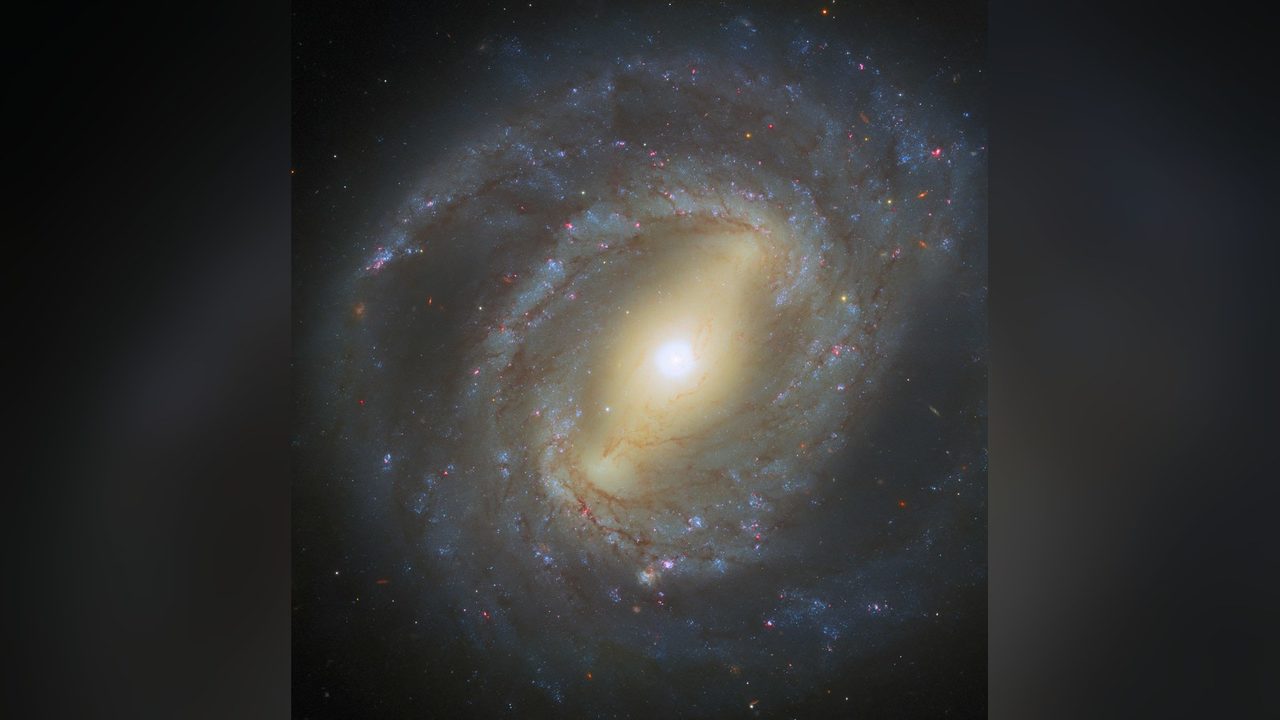
A new image from the NASA/ESA Hubble Space Telescope shows NGC 4394, a spiral galaxy with a straight bar of stars across its center. According to NASA, the galaxy closely resembles what astronomers think the Milky Way would look like if we could see it face-on from a similar vantage point.
The galaxy lies in the constellation Coma Berenices, also known as Berenice's Hair. NASA says it is considered relatively nearby, and the new picture combines observations from two Hubble programs separated by about a decade.
The numbers behind NGC 4394
- About 55 million light-years: NASA's estimate of the galaxy's distance. That is close by galactic standards.
- More than 1,000 galaxies: the size of the Virgo Cluster, which NASA describes as the galaxy cluster closest to us. NGC 4394 is one of its members.
- 65 percent: the share of nearby spiral galaxies that astronomers estimate have a bar, which makes bars extremely common.
- 40 galaxies: the number studied in the recent Hubble program that contributed to this image. Researchers used it to determine the ages of individual star clusters.
How galactic bars form
Most spiral arms curve, so the straight streak of a galactic bar stands out. NASA says explanations for how bars form tend to center on a galaxy's disk of stars becoming unstable. Possible triggers include gravitational nudges from passing galaxies, interactions between stars or other forces.
Once the disk is unstable, the circular orbits of stars stretch into elongated ones, which produces the barred shape. NASA adds that bars are more common in galaxies today than they were several billion years ago. Research suggests this may be temporary, because bars can become unstable themselves as they grow more massive.
A possible second likeness to the Milky Way
NASA notes that NGC 4394 and the Milky Way might both contain a LINER, short for low-ionization nuclear emission-line region. This is an area near a galaxy's center where the light spectrum shows certain ionized or neutral elements. Researchers do not yet know exactly how LINERs form. According to NASA, either hungry supermassive black holes or intense star formation likely play a role.
Where the image comes from
Hubble has looked at this patch of sky more than once. An earlier image of NGC 4394 was released a decade ago. It came from a program that focused on a neighbor, Messier 85, and studied that galaxy's unusual collection of star clusters. While one instrument examined Messier 85, Hubble's Advanced Camera for Surveys captured a parallel area of sky that happened to contain NGC 4394.
The new image also uses data from a more recent program on how star formation ends in galaxies in dense cluster environments. The program compares that process with how it unfolds in more isolated galaxies adrift in the field. For that work, researchers used Hubble's Wide Field Camera 3, which is sensitive to a broad range of wavelengths.
Why it matters
For most readers, this is a chance to see what our own galaxy may look like from the outside. We live inside the Milky Way and cannot photograph it face-on, so a nearby galaxy with a similar bar and spiral arms is a useful stand-in. NASA says NGC 4394 closely resembles the astronomers' picture of our home galaxy.
The image also reflects ongoing research. Astronomers are still working out how bars form and how LINERs arise. They are also studying how star formation shuts down in crowded galaxy clusters like Virgo. The image itself is a release of observations rather than a new finding, and NASA presents the formation ideas as explanations that tend to be favored, not settled answers.
Read next
Hubble Images a Galaxy Warped Into Arcs as NASA Preps for Roman Telescope
Rubin Observatory Spots Two Faint Companions of the Milky Way in Early Data
Hubble Images Cosmic Lenses That Could Test a Dark Matter Theory
Around Prague, based on reporting by NASA
Cover photo: ESA/Hubble, public domain