Tilted Stars Don't Seem to Reshape Their Planets' Orbits Over Time, Study Finds
USD 22,28
Popular
Planetary orbits around sunlike stars appear to change little after the planets form, according to a new study reported by Universe Today. The work also found no evidence that a star's tilt, known as stellar obliquity, directly affects whether a planet can support life.
Lauren Biddle, an astrophysicist at Princeton University, and co-author Brendan Bowler compared the spin of 114 single, sunlike stars with the orbits of the planets or planet-forming disks around them. The paper has been accepted for publication in The Astronomical Journal.
What stellar obliquity is and how it was measured
Stellar obliquity is the angle between a star's spin axis and the orbital axis of its planets. Biddle described an aligned system as one where the star's equator lies in the same plane as the planet's orbit, like a spinning top at the center of a hula hoop. A misaligned system is one where the star's spin axis is tipped relative to that plane.
The team sampled four kinds of systems: 49 protoplanetary disk systems, where planets are just beginning to form; 24 debris disk systems, where stars are ringed by gas, dust and rocky planetesimals; 21 warm Jupiter systems, with giant planets on orbits of 10 to 100 days; and 20 hot Jupiter systems. Hot Jupiters usually circle their stars in less than ten days, and at least one does so in only 16 hours.
What the comparison showed
Some theories predict that planetary orbits could shift sharply over time. Gravitational interactions with other planets or stars could do it, and for hot Jupiters, so could tidal forces from the host star. Biddle told Universe Today the data do not show this. The share of misaligned orbits in young systems resembles that in older ones.
The researchers tested for change across "space," by comparing systems at different orbital distances, and across "time," by comparing systems of different ages. Stellar obliquities were similar in both comparisons. Biddle said this suggests large orbital changes after planet formation are rare, and that any smaller changes are not detectable in current data.
Misaligned systems do exist. Biddle said every system the team classified as misaligned is tilted by at least 10 degrees, and the misaligned ones average roughly 30 to 50 degrees. She added that astronomers can measure only a lower limit on the angle, so the true tilt could be larger.
Limits of the study
Biddle flagged a major caveat. The team deliberately chose single stars that are cooler and host giant transiting planets. It left out stars with close stellar companions, hot stars, small planets, and non-transiting giant planets on wider orbits. Large tilts could be common in any of those groups, she said, so the findings should not be applied to every kind of planetary system.
Where the Sun fits in
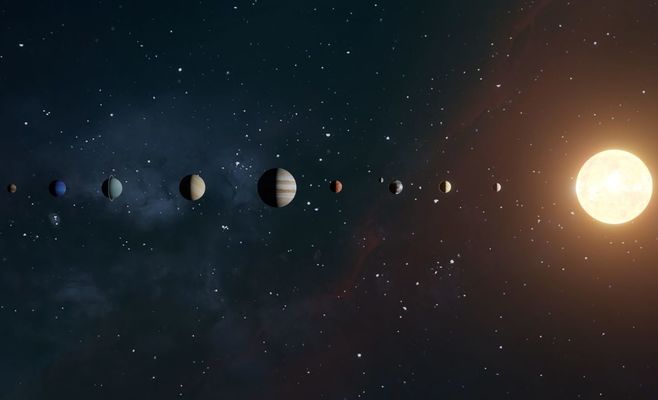
Before exoplanets were found, ideas about alignment rested on the Solar System, where the planets orbit in nearly the same plane and mostly line up with the Sun. Biddle said it was a surprise when astronomers found giant, close-in exoplanets on very misaligned orbits.
Even the Sun is slightly off. Its spin axis is tilted by about 6 degrees relative to the average orbital plane of the planets and dwarf planets, Biddle said. She does not know whether it was tilted from the start. If it began aligned, proposed causes include a past fly-by of another star, tugs from an undiscovered distant planet, torques from stellar winds and internal gravity waves.
Why it matters for the search for habitable worlds
For readers following the hunt for Earth-like planets, the main message is that a star's tilt is not itself a sign of a more or less livable world. Biddle said there is no evidence that stellar obliquity affects habitability.
The measurement is still useful, she said. It records the history of how planets formed and where they ended up relative to their star, which matters a great deal for habitability. A system's alignment can therefore help astronomers reconstruct how it came to look the way it does, without being a verdict on whether life could exist there.
Read next
Giant Planet Vanishes From View as an Unseen Neighbor Tilts Its Orbit
Dead Star Wears Two Rings of Shattered Planets, Hinting at Our Sun's Fate
Some White Dwarf Stars Glow Pink and Yellow, Astronomers Find
Around Prague, based on reporting by Universe Today