Society By

Expert: Czechia will never build reservoirs like Slapy again — the climate demands a different approach
Expert: Czechia will never build reservoirs like Slapy again — the climate demands a different approach

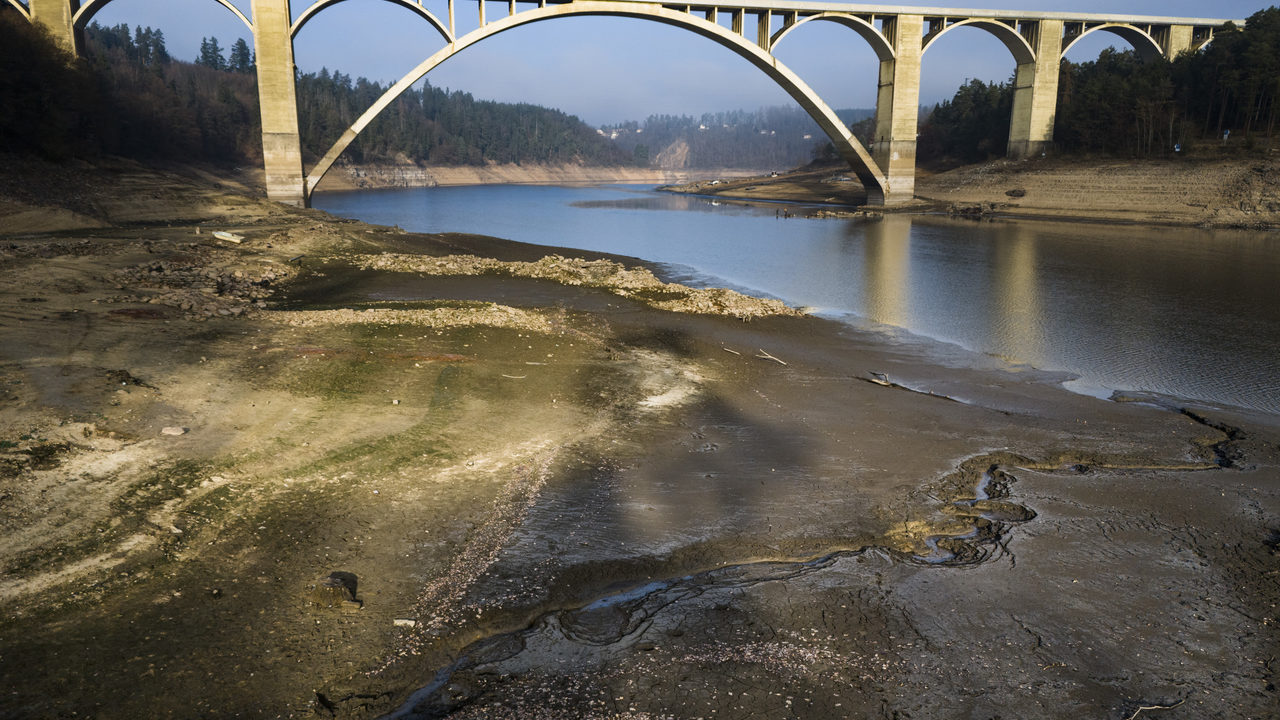
Czechia is facing increasingly severe droughts, with southern Moravia and the Elbe basin (Polabí) at risk of desertification, according to Vojtěch Kotecký of Charles University's Environment Centre, who spoke to the Seznam Zprávy podcast. He noted that climatologists warned of these consequences 20–30 years ago, and those forecasts are now becoming everyday reality.

Since the start of the year, Czechia has received on average 34% less rainfall than the long-term norm, according to meteorologists. The situation is worse than last year, which was itself one of the driest since 1961. Water management company Povodí Moravy is recording drought at half of its measuring points, with some showing zero water levels. More than 50% of the area served by Povodí Labe is also experiencing extreme drought, and Povodí Odry is beginning to see problems as well. As a result, farmers finished this year's harvest unusually early, with yields on some farms down by as much as 20%.

Southern Moravia and Polabí at risk of desertification

The European Commission's Joint Research Centre (JRC) has reported that by 2040, desertification risk zones will expand specifically in Czechia — primarily in southern Moravia and the Elbe basin. According to Kotecký, this isn't about sand dunes, but rather a combination of soil degradation and intensifying drought in a specific region. "We're used to thinking of desertification as a problem for Africa, or at most Spain. Now it turns out it applies to southern Moravia too — and, over the coming decades, to parts of Polabí as well," the expert said.

In his assessment, a significant share of farmland in these regions could become unsuitable for cultivation and turn into pastures or meadows. The process can no longer be stopped entirely, but it can be slowed — through systematic work on landscape resilience.

Why there won't be another Slapy

Speaking about reservoirs, Kotecký was blunt: "We are certainly not going to build anything like Slapy again." If new reservoirs are built, they will be far smaller in scale — orders of magnitude more modest than the famous Vltava Cascade. He argued it would be more effective to restore rivers' natural channels, making them wider and shallower so water can seep into the ground more easily, as well as creating safe flood-overflow zones and restoring networks of small wetlands.

The expert identified soil itself as the key area of focus: improving its water-retention capacity through living organisms and proper structure. Healthy soil is about one-fifth air and can absorb substantial volumes of water — but decades of intensive farming focused on large fields and heavy use of agrochemicals have weakened that capacity.

Forests and farming face change

According to Kotecký, Czech forests have gotten off relatively lightly so far — new mass bark-beetle damage is expected in western Bohemia, where large areas of old spruce forest remain. Meanwhile, the state enterprise Lesy České republiky, which manages a sixth of the country's territory, has already begun gradually shifting its forestry approach, sending foresters for training at Mendel University's teaching forest estate in Brno.

In agriculture, the expert believes salvation lies not in copying Israel's drip-irrigation model (only about 4% of Czech farmland is currently irrigated), but in large-scale investment in robotics, digitalisation and artificial intelligence — tools that can help maintain competitiveness while treating the soil more gently. Kotecký also noted that some regions of Czechia are already reporting problems with wells and falling groundwater levels, a trend that is set to intensify.

Read also: Brno: what to see and where to go

Around Prague, based on reporting by seznamzpravy.cz

Share: Telegram WhatsApp

More U.S. news

US Strikes Iran's Qeshm Island as War Costs Top $47.1 Billion
The U.S. military carried out limited strikes on Iran's Qeshm Island on Nov. 2, hours before the midterm elections, according to U.S. officials who spoke to CBS News and Radio Free Europe/Radio Libert
What to Watch as Midterm Polls Close and Why Control of Congress May Take Days
Millions of Americans are voting in midterm elections that will decide whether President Donald Trump's Republicans or the opposition Democrats control Congress. The BBC reported that once polls close
How Michigan and Alaska Surprises Could Decide Which Party Controls the Senate
Two late controversies, one in Michigan and one in Alaska, have shaken up the fight for the Senate and could help decide which party holds the majority, according to an NBC News analysis. If the Alask
Why a Judge Threw Out the Case Against Two Former FBI Officials
A federal magistrate judge on Monday dismissed a criminal complaint accusing two former FBI officials of lying to Congress about their roles in the Hunter Biden investigation, delivering a sharp rebuk
U.S. Strikes Iranian Island on Eve of Midterms, Calling It Self-Defense
The U.S. military carried out limited strikes on Iran's Qeshm Island on Monday, the day before the midterm elections, according to NBC News, which cited two U.S. officials. The officials said the acti
Supreme Court Turns Down DOJ Bid to Set Aside California Mail Ballots
The U.S. Supreme Court on Monday refused a Trump administration request to intervene in a fight over California mail ballots, one day before Election Day. The Justice Department had asked the court to

Related news

On Tuesday, 3 November, traffic in central Prague will be severely restricted: student marches are due to start at around 2 p.m., and at 4:36 p.m. a rally in support of Czech Television and Czech Radio begins on Wenceslas Square. Police adv
How the Czech Potraviny na pranýři register works, what records and statuses mean, how to check a place yourself and what it lists for Prague on 30 October 2026.
Cermat, the centre responsible for organising admissions to secondary schools in Czechia, has simplified the requirements for the unified entrance exam in maths and the Czech language. The changes affect all three school years from which ch
On 28 October, Czechoslovak Independence Day, shops larger than 200 square metres are closed in Czechia. In 2026 the holiday falls on a Wednesday, so it is best to stock up in advance.Which shops are closed on the holidayThe 2016 Trading Ho
A 36-year-old driver died in a collision between two cars in the Karlovy Vary region. The crash happened on a first-class road, and all integrated rescue system services rushed to the scene.“Two cars collided. Four of our units worked at th
A 40-year-old Audi driver has died in a crash in South Bohemia. The accident happened shortly after 2 a.m. on a second-class road between Čimelice and Nová Bystřice: for reasons not yet established, the man left the roadway and hit a tree.P
Significantly more doctors in Czechia will now be able to offer flu shots: health insurers are widely simplifying the conditions for hospitals and specialists. Previously they had to sign a separate contract with the insurer for this servic
A school in the Prague 21 district, where a salmonella outbreak struck, has released the “technological procedure” for making spaghetti carbonara, and it matches word for word a recipe on the cooking site Jídlo.cz. But there is so far no wa
On Saturday, Oct. 24, two people fell from an unfinished bridge on the D11 motorway under construction near Bernartice in the Trutnov district. One of them died at the scene; the other, who suffered a head injury, was taken to hospital.The
After incidents near its border with Ukraine, Poland has stepped up how it informs residents about crises, while Czechia is not preparing a similar law. According to Karla Mráčková, spokeswoman for the Government Office, the crisis manageme
On the night from Saturday to Sunday, when Czechia switches to winter time, more than 20 night trains and buses will be delayed by an hour. The clock change will affect international services run by several operators, including routes from
On the outskirts of towns and in villages, high concrete fences, really more like walls, increasingly replace wooden pickets and wire mesh. Their supporters cite the right to privacy. Critics, whom the author of the weekly newsletter Pod ča