Ukraine Reburies Nationalist Leader Konovalets 88 Years After His Assassination by a Soviet Agent
USD 21,74
Popular
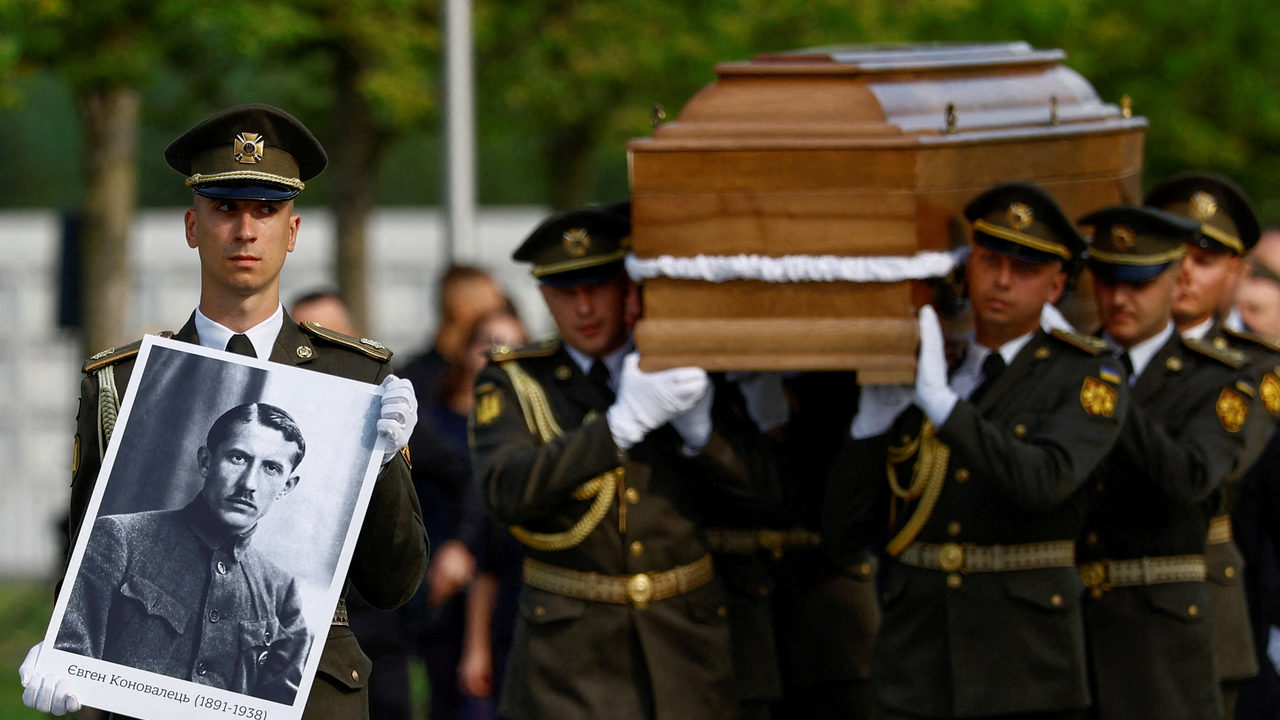
The remains of Yevhen Konovalets, founder of the Ukrainian Military Organization who was assassinated by a Soviet intelligence agent in 1938, were reburied with military honours at a military cemetery in Kyiv. The coffin, draped in the yellow-and-blue Ukrainian flag, had lain in the ground in Rotterdam, the Netherlands, for 87 years before his remains were finally brought home.
The reburial sparked a wide response on Ukrainian social media. Historian Volodymyr Viatrovych wrote that "the reborn Ukrainian state was slow to search for its own roots," and that only the threat of annihilation forced the country to "hold more firmly to its own land." According to him, the graves of national heroes on native soil are an essential part of those roots, giving strength "to stand today and grow further." The current burial is temporary: after the war, a pantheon of heroes is planned for central Kyiv, near the Kyiv-Pechersk Lavra.
A Secret Organization Born in Prague
Yevhen Konovalets was born in Galicia near Lviv, then part of Austria-Hungary. After the outbreak of World War I, he was taken prisoner by Russian forces and spent two years in a camp in Tsaritsyn (later Stalingrad, now Volgograd), from which he escaped in 1917. Unlike the Czechs, Ukrainians failed to establish an independent state after the war — their territory was divided among Bolshevik Russia, Poland, Romania and Czechoslovakia.
Refusing to accept this outcome, Konovalets founded the Ukrainian Military Organization (UVO) in July 1920, with the goal of uniting all Ukrainians into a single state by force of arms. The organization was established at a secret meeting in Prague, which strained relations between Poland and Czechoslovakia: Warsaw regarded Konovalets as a terrorist, especially after a UVO member attempted to assassinate Polish Commander-in-Chief Marshal Józef Piłsudski a year later.
Konovalets visited Czechoslovakia on several occasions and held talks with Ukrainian émigrés, though the Ukrainians operated under strict secrecy. According to Czech Ukrainian studies scholar David Svoboda, there is no documented evidence that Konovalets ever met with President Masaryk, although such claims occasionally surface. Fleeing Polish and Soviet agents, the UVO leader frequently changed his place of residence throughout the 1920s and 1930s, living at various times in Berlin, Vienna, Geneva and Rome. Though he did not share Nazi ideology, he still hoped Germany would help Ukraine achieve independence. In a 1937 diary entry, Konovalets predicted an imminent German-Italian attack on the USSR and Stalin's defeat, after which Ukraine might gain autonomy and its own army.
A Bomb in a Box of Chocolates
Joseph Stalin regarded the Ukrainian émigré movement as dangerous and decided to eliminate its leader. To this end, Soviet intelligence agent Pavel Sudoplatov — whose father was Ukrainian and mother Russian — was sent to approach Konovalets. Posing as a Ukrainian patriot who had fled the USSR, Sudoplatov managed to win Konovalets's trust.
On 23 May 1938, the two men met at a restaurant in Rotterdam, the Netherlands, where Sudoplatov handed Konovalets a box of chocolates concealing an explosive device. The bomb detonated half an hour later, killing the leader of the Ukrainian independence movement instantly. He was buried in Rotterdam, where his remains rested for 87 years — shortly before this reburial, the remains of his successor, Andrii Melnyk, who died in Luxembourg in 1964, had already been transferred to Kyiv.
Two more graves abroad remain the subject of repatriation discussions: Stepan Bandera, leader of the Ukrainian Insurgent Army, is buried in Munich, where he was shot dead by a Soviet agent in 1959, while Hetman Ivan Mazepa — who in 1709 tried, in alliance with Sweden, to free Ukraine from Russian dominance but lost the Battle of Poltava — is buried in the Romanian city of Galați.
Read also: 9 Michelin-starred restaurants in Czechia: where to find fine dining from Prague to Moravia
Source: seznamzpravy.cz