Mariia and Mykola, a married couple who fled Ukraine as refugees, took jobs at a warehouse in the Czech town of Ústí nad Labem — and ended up at the centre of a story about “hidden” job-placement middlemen. For minimum wage, they spent 12-hour shifts picking orders for the online grocery store Košík.cz, and after falling ill and being fired, were then billed 25,000 crowns in compensation.
A tempting ad that turned into a warehouse job
Three months after arriving in Czechia, the couple's free temporary housing ran out, and they urgently needed work to pay rent. In Ukrainian social media groups they found an offer that looked entirely official: an employment contract with social and health insurance contributions included. After calling the number given, the couple showed up a few days later at a warehouse in Ústí nad Labem that, from the outside, looked like an ordinary Makro store-warehouse. There they signed a contract with a company called KonstantaCZ for the minimum wage of 22,400 crowns — and only afterwards learned that their job was actually preparing orders for the online grocery store Košík.cz.
Night shifts and a ban on gloves
The couple lasted only a few weeks at the warehouse. They mostly worked nights, in 12-hour shifts that often ran over — sometimes by half an hour, sometimes by several hours — until every order had been picked. Supervisors constantly pushed staff to run rather than walk. Workplace injuries happened regularly, but no doctor was ever called. Unlike Makro's own staff, who had hats and gloves for working in the cold-storage rooms, the couple were explicitly forbidden from using them, which often caused them health problems.
A sudden dismissal and a demand for money
The job at the warehouse ended abruptly and dramatically: first an illness, then immediate termination of the contract — followed by the employer's demand that they pay 25,000 crowns for alleged damages. The employer claimed the couple had missed four shifts without a valid reason. Mariia and Mykola dispute this: two of those days weren't even scheduled as work shifts, and for the rest they had a doctor's sick note.
Who is actually responsible
The couple decided not to give up and turned to non-profit organisations for help; these found them a lawyer and explained that what had happened went beyond the bounds of Czech labour law. The couple carefully documented all the negotiations and correspondence. According to experts who study labour market abuses, such a tangled chain of intermediary companies is a typical tactic: it makes it hard to work out who is hiring whom, who pays whom, and who is responsible for what — and not only for the workers themselves, but for labour inspectors too. The Makro chain said it leases part of its premises to Košík.cz and bears no responsibility for working conditions there; the online store said the warehouse's logistics are handled by outside contractors; and KonstantaCZ's director, Konstantin Sergeyevich Bokovoy, said the couple had in fact been working for his firm and denied the accusations of “hidden” intermediation.
Relations between the United States and Ukraine have reached a new low, according to ABC News, after President Donald Trump waived sanctions on Russia that Congress had passed, said it was time for so
Vice President JD Vance said Monday that he will not endorse Israeli Prime Minister Benjamin Netanyahu for re-election, days after President Donald Trump publicly gave Netanyahu his full backing. Vanc
Actress Christina Applegate said on Tuesday that she does not have multiple sclerosis, five years after announcing she had been diagnosed with the disease. She shared the news, tearfully, in a two-par
A nor’easter spinning off the Atlantic coast is expected to bring coastal flooding, high surf, rip currents and gusty winds to parts of the East Coast for several days, according to The Weather Channe
Some Spotify Family plan members are being told to prove they live with the person who pays for the plan by scanning a QR code. According to 9to5Google, those who miss a 7-day window drop to the free
The Atlanta Dream beat the Golden State Valkyries in Game 2 of the WNBA Finals on Monday night in San Francisco, handing the Valkyries their first loss of this postseason, according to KQED. Angel Ree
On Monday the Czech government approved extending the so-called emergency work visas until 31 December 2028. The programme has run since 2019 and was due to expire this year; the proposal came from the Ministry of Agriculture, which is head
Czechia's ruling coalition has agreed to cut spending on benefits for Ukrainian refugees by four billion crowns, but who will put it into law and how is still in dispute. Chamber of Deputies Speaker Okamura said the amendment will be submit
A further 22,000 Ukrainian refugees in Czechia received the special long-term residence permit in 2025 — it guarantees at least five years of legal stay in the country and the right to apply for permanent residence. According to the Interio
You need a doctor, but the first page of search results already gives you three different answers. What matters is not finding the best clinic but working out where to start.
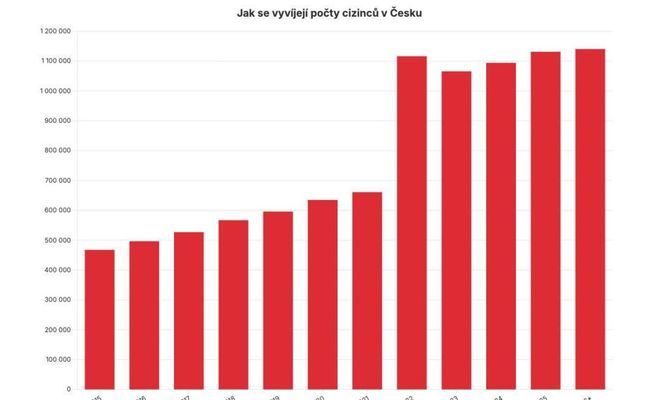
According to statisticians' estimates, up to 1.52 million foreigners were living or working in Czechia at the end of December. The figure is based on national accounts — statistical data covering the state of the entire Czech economy."The e
A native of Tajikistan holding Uzbek citizenship, fighter Muradov, has avoided forced expulsion from Czechia, yet he still has not obtained official permission to stay in the country. As a citizen of a non-EU state, without such a permit he
Rental prices for students in Czechia have risen sharply ahead of the new academic year. According to data from Sreality.cz, the country's largest property portal, the steepest increase was recorded in Pardubice, where the median cost of a
Since 5 August 2024, dozens of Ukrainian refugees in Czechia have been denied temporary protection under a new EU requirement obliging men of conscription age to prove they have fulfilled their obligations to the Ukrainian armed forces. The
As of Wednesday, Czechia has stopped granting temporary protection to Ukrainian men of conscription and reserve age — from 23 to 60 years old. This was announced by Interior Minister Lubomír Metnar (ANO), who noted that the government has l
Sangita Shrestova, an intercultural communication researcher at the University of Southern California who was born in Prague to a Czech mother and Nepali father, has published a book on raising children at the crossroads of cultures. The Cr
The Czech government has approved a bill requiring online shops and financial companies to feature a special button on their websites for cancelling a contract. The rule is set to take effect in January 2027, but it still needs approval fro
Уже мысленно паковали чемоданы и представляли, как приезжаете в Прагу, но визовый запрет отнял вашу мечту? Приходите на бесплатный живой вебинар школы VLTAVA, чтобы узнать, как не расстаться с планами на будущее!