Moon Craters Could Shield a Lunar Base From Its Nuclear Reactor, Study Finds
USD 22,33
Popular
Engineers could use the Moon’s own terrain as a radiation shield for a future nuclear reactor, according to a new paper from researchers at Los Alamos, NASA Glenn, Oak Ridge, Idaho National Lab and Lockheed Martin, as reported by Universe Today. The work was presented at the American Nuclear Society’s Nuclear and Emerging Technologies for Space conference in April and is based on computer simulations, not a physical test.
The idea is to place a reactor behind a crater wall or hill so that terrain, rather than heavy shielding hauled from Earth, blocks most of the radiation from reaching a habitat.
The key numbers
- 40 kilowatts: the size of the reactor planned under NASA’s Space Power and Reactor Capabilities program, known as SPARC.
- 6,000 kg: the weight limit for the system, so it can ride on a mobile rover on the lunar surface.
- 1 km: even at this distance from an unshielded reactor, the radiation would be deadly, according to the report.
- Roughly one-tenth of a rem per year: the dose in simulations with a three-meter-deep crater or a gently sloping three-meter-high dirt hill, about fifty times lower than the five-rem-per-year limit set for reactor radiation above the Moon’s natural background.
- About four-hundredths of a rem per year: the dose at a simulated base camp separated from the reactor by a 120-m-high crater wall.
Why a heavy reactor needs help from the terrain
The two-week lunar night can drain batteries charged by solar panels during the two-week day, so engineers have long planned to use a nuclear reactor to power at least part of a settlement. Weight is the constraint. Space reactor designers have historically used lightweight directional “shadow shields,” which protect sensitive parts such as control electronics but leave the surrounding area unprotected. Bringing more shielding from Earth to cover a living area would be extraordinarily expensive.
The team, led by Los Alamos researcher Alex Levinsky, used software called Monte Carlo N-Particle to simulate millions of subatomic particles coming from the reactor core. They placed the core 1.5 m off the ground to mimic a reactor on the back of a wheeled rover.
A test case at the lunar south pole
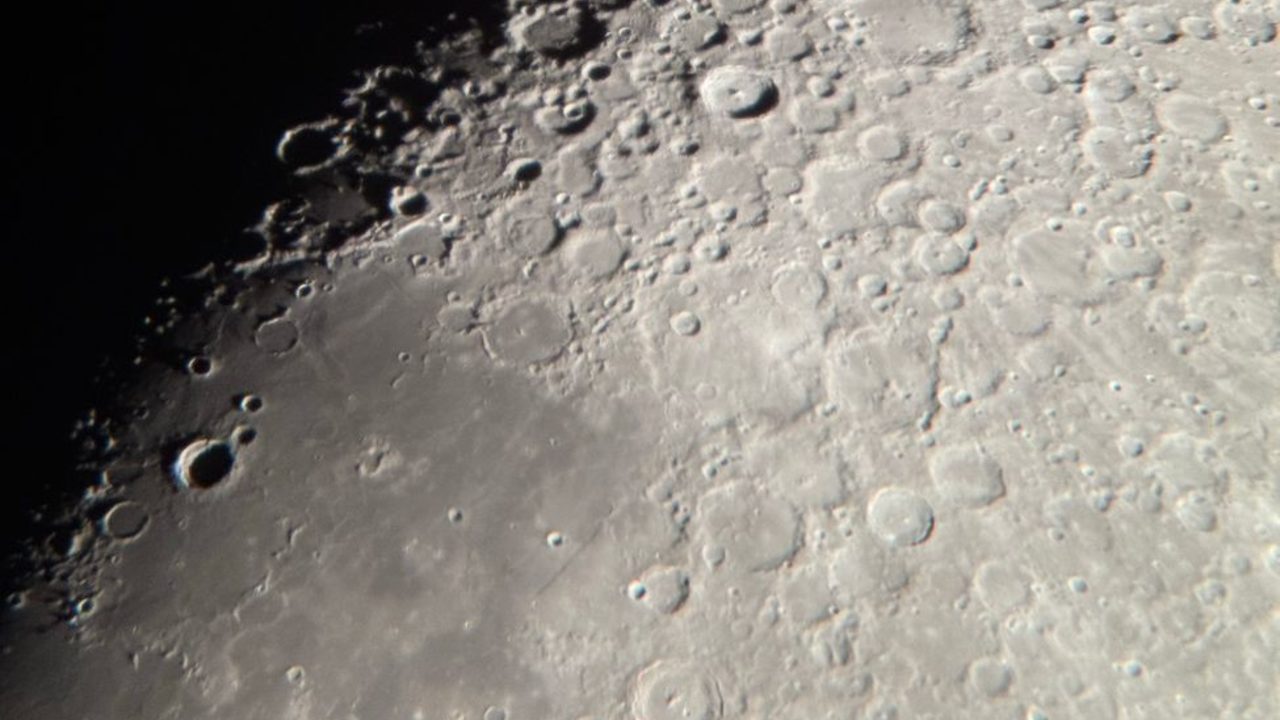
For a realistic setting, the researchers picked Connecting Ridge, near Shackleton Crater at the Lunar South Pole. Parts of the ridge are lit 80-90% of the time, and it sits next to permanently shadowed regions that hold water ice. Keeping within the rover’s limit of no slopes steeper than 18 degrees, they found a natural depression that could be separated from the simulated camp by the 120-m-high crater wall. With that barrier, the reactor’s onboard shadow shield could focus on protecting nearby electronics.
The Moon also has an advantage over Earth. With no atmosphere, there is no “skyshine,” where radiation bounces off air back down onto a habitat.
What this means for future Moon missions
The approach could save thousands of kilograms of launch cost, but it comes with a catch. The area around the reactor would be a death zone: astronauts who entered it while the reactor was running would quickly develop radiation poisoning. Because lunar soil reflects neutrons well, many are bounced into space, so spacecraft and landers could not fly directly over the site.
In practice, that could mean a no-fly exclusion zone over one small part of the Moon. Universe Today said the study brings reliable, continuous nuclear power on the Moon one step closer. The results so far come only from simulations.
Read next
Students Can Win Share of $1 Million for Designing NASA's Moon Base
Earth's Magnetic Shield Takes Harder Hits on Its Winter Side, Simulations Show
Dimorphos Crater: New Hera Photos Show What NASA's DART Did to Asteroid
Around Prague, based on reporting by Universe Today