Will the 2027 Solar Eclipse Be Visible in Prague? Times and Coverage
USD 22,28
Popular
Yes, but only as a partial eclipse. On Monday 2 August 2027, the Moon will cover about 42% of the Sun's disc as seen from Prague, according to Orbital Radar and NationalEclipse.com calculations. Totality, when the sky goes dark, happens more than 1,600 km to the south, along a path from southern Spain to Egypt and Saudi Arabia.
What Prague and the Czech Republic will see
Times below are for Prague in Central European Summer Time (CEST, UTC+2). The Sun will stand about 50 degrees above the south-eastern horizon at maximum, so the eclipse happens in bright late-morning daylight.
| Phase | Prague (CEST) |
|---|---|
| Partial eclipse begins | about 10:14 |
| Maximum | about 11:14 |
| Partial eclipse ends | about 12:16 |
| Share of the Sun covered at maximum | about 42% |
The whole event lasts roughly two hours. Timeanddate lists a slightly wider window for Czechia as a whole (10:11 to 12:22 CEST), which reflects differences across the country rather than a disagreement. Exact minutes vary by a minute or two between calculators and with your location, so check a local prediction closer to the date.
A 42% partial eclipse is easy to miss without a filter. The daylight dims only slightly, because the human eye adapts. The difference from a total eclipse is large: no darkness, no visible corona, no stars.
Where the eclipse is total
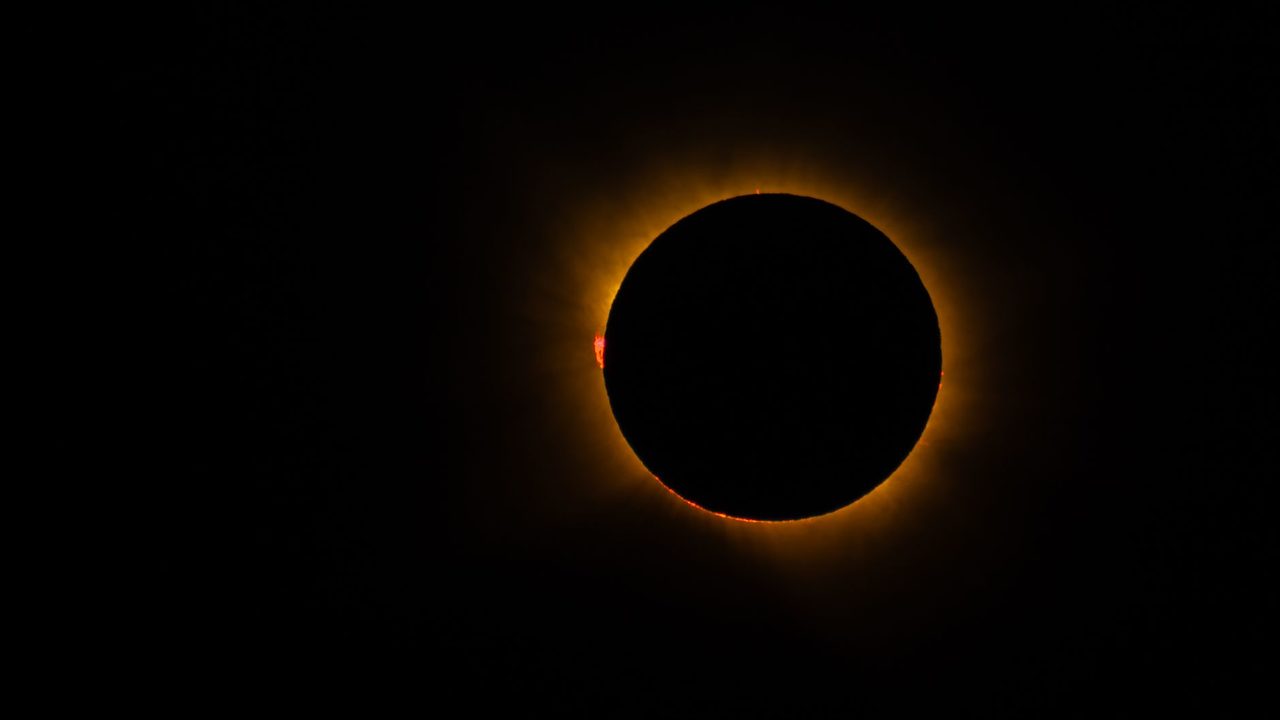
This is a total solar eclipse of Saros series 136, with a magnitude of 1.079. According to Wikipedia's summary of the NASA predictions, greatest eclipse occurs at 10:07 UTC near 25.5 degrees north, 33.2 degrees east in Egypt's Red Sea Governorate. The path is about 258 km wide.
The shadow crosses the Atlantic and reaches land at the Strait of Gibraltar. Timeanddate lists these countries and territories with totality: Spain, Gibraltar, Morocco, Algeria, Tunisia, Libya, Egypt, Sudan, Saudi Arabia, Yemen, Somalia and the British Indian Ocean Territory.
The longest totality is 6 minutes 23 seconds, in the north-east of Egypt's New Valley Governorate, and Luxor gets about 6 minutes 22 seconds. Some other durations from the same data:
- Spain: Cádiz about 2 min 56 s, Marbella about 3 min 21 s, Málaga about 1 min 57 s.
- Gibraltar: about 4 min 28 s.
- Morocco: Tangier about 4 min 51 s.
- Tunisia: Sfax about 5 min 41 s, Kasserine about 5 min 28 s.
- Libya: Benghazi about 6 min 11 s.
- Saudi Arabia: Jeddah about 5 min 53 s.
Spanish totality falls late in the morning local time, when the Sun is still fairly high. Southern Spain is the closest totality to Prague, around 2,000 km by air from the Czech capital. Weather is the main risk: summer skies in Andalusia are usually clear, but coastal haze or cloud can appear. Egypt has the best odds of a clear sky and the longest totality, but also extreme heat in August.
The Science Beat has a separate overview of the path, timing and best viewing places for the 2 August 2027 eclipse, including how totality compares across countries.
How to watch safely from Prague
- Use eclipse glasses or handheld viewers certified to ISO 12312-2 for the whole partial phase. Ordinary sunglasses are not safe.
- Check glasses for scratches or holes before use, and buy from a reputable seller.
- Never look at the Sun through binoculars, a telescope or a camera lens without a certified solar filter fitted at the front.
- For a no-cost method, use pinhole projection: a card with a small hole casting an image of the Sun onto a second card. Leaf shadows under trees also project small crescents.
- The only moment it is safe to look without a filter is during totality itself, and that happens only inside the path. In Prague there is no such moment.
Is it worth travelling for?
Astronomers generally say a partial eclipse, even a deep one, is a different experience from totality. If you want the full effect, you need to be inside the path. That is a practical matter of flights, hotels and weather forecasts, and accommodation along the Spanish and Moroccan coast will likely sell out well in advance. Check the safety advice of your government for Libya, Yemen, Somalia and parts of Egypt before planning travel.
For Prague, the 2 August 2027 partial eclipse is still worth stepping outside for, with proper glasses.
FAQ
When is the 2027 solar eclipse in Prague?
On 2 August 2027, from about 10:14 to 12:16 CEST, with maximum around 11:14 CEST.
How much of the Sun will be covered in Prague?
About 42%, according to two independent calculators. It is partial, not total.
Is the 2027 eclipse visible in the Czech Republic as a total eclipse?
No. Totality is limited to a narrow path across southern Spain, North Africa and the Arabian Peninsula.
Which place has the longest totality?
The Luxor area in Egypt, with just over 6 minutes. The maximum is 6 minutes 23 seconds.
Around Prague, based on reporting by Orbital Radar, NationalEclipse.com, timeanddate.com, Wikipedia, The Science Beat